Latest Blog
Humanly AI Interviewing Official Features: What Buyers Need to Know
Researcher
•
5 min read
Share this post


Humanly AI Interviewing Official Features: What Buyers Need to Know
Buyers searching for “Humanly AI interviewing official features” are usually asking a bigger question. What does Humanly officially offer, and is that enough for a real hiring operation once recruiter workload, candidate behavior, ATS workflow, and compliance all hit at once?
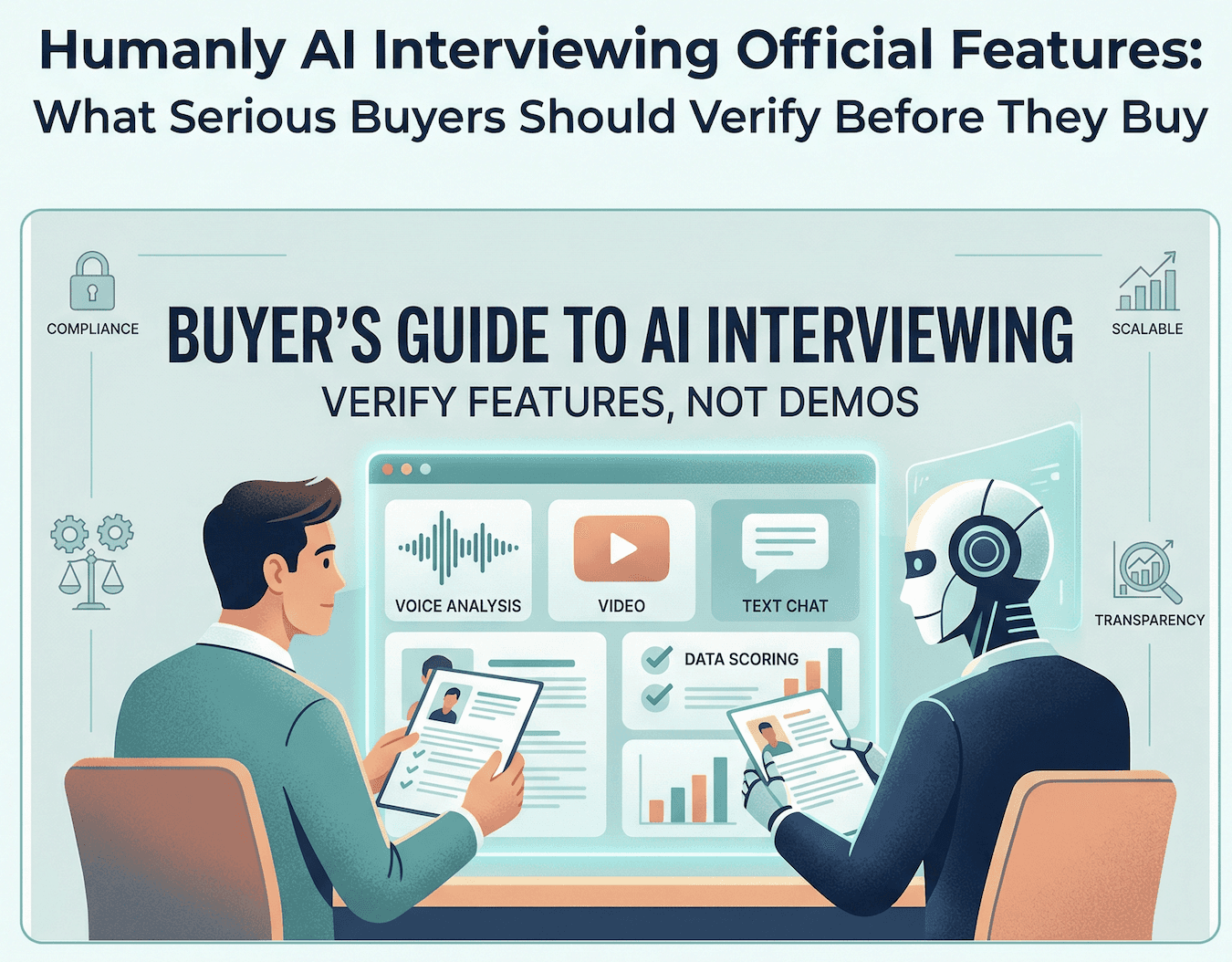
Humanly’s official feature set is credible. It includes structured AI interviews across voice, phone, and video, plus broader screening, scheduling, and ethical AI messaging. That is useful. It is not the buying standard serious teams should use. The real standard is operational fit: recruiter trust, channel fit, workflow depth, accommodations, and governance.
Humanly AI interviewing official features
Humanly’s official AI Interviewer page centers on structured interviews for high-volume hiring. The product supports interviews across voice, phone, and video and promises detailed scoring, rankings, and highlights. Humanly’s broader platform story adds screening, scheduling, ATS-connected actions, reminders, and candidate self-service. Its ethical AI content leans into transparency, privacy, fairness, and human oversight.
That is the official feature set. It covers structured interview execution, recruiter-facing outputs, workflow automation, and responsible AI language. Any buyer looking at Humanly should start there.
Official feature | What it solves | What buyers still need to verify |
|---|---|---|
Voice, phone, and video interviews | Structured interviewing across multiple channels | Which channels actually drive completion and quality in your candidate population |
Detailed scoring, rankings, and highlights | Faster recruiter review and easier shortlisting | Whether the output is reviewable, explainable, and defensible in practice |
24/7 screening and candidate flexibility | Faster throughput and less scheduling drag | Whether that flexibility improves completion rates instead of just sounding convenient in a demo |
Scheduling, reminders, ATS updates, and follow-ups | Less manual coordination around the interview | How deep the integration and exception handling really go after rollout |
Ethical AI and transparency language | Signals seriousness on fairness, privacy, and trust | Whether the platform gives buyers evidence, controls, documentation, and accommodation pathways |
Where buyers get this wrong
Most teams evaluate AI interviewing the wrong way. They start with the demo. They react to the conversation quality, the polish of the dashboard, and the neatness of the scorecard. Then the hard questions show up later.
Can recruiters understand why the system produced a score. Can candidates complete the process in the channels they actually use. Can legal review the workflow without finding a black box. Can the business support alternate paths and accommodations. Can the team govern the process after launch when scorecards, thresholds, or interview flows change.
Feature pages do not survive procurement. Workflow reality does.
That is the gap between “official features” and “successful rollout.” Buyers who miss that gap end up with a pilot that looks promising and an operating model that still breaks under real-world pressure.
The standard that actually matters
The right buying standard is not “Does the platform have AI interviewing.” Plenty of vendors can say yes. The right standard is whether the platform helps the hiring team move faster while staying in control.
1. Channel fit
Multi-channel support is only valuable when it matches candidate behavior. The wrong channel strategy kills completion rates before scoring quality ever matters.
2. Reviewable scoring
A score without reviewability is a liability dressed up as efficiency. Recruiters need to understand what happened, not just accept a number.
3. ATS workflow integrity
Interview automation is not enough. The platform has to reduce the surrounding operational drag around scheduling, updates, follow-ups, and exceptions.
4. Accommodation readiness
Enterprise-ready hiring software supports the happy path and the real path. Candidates need alternate routes when needed. Anything less creates risk.
5. Governance
Governance is not a policy PDF. It is the ability to document the process, review the output, manage change, and defend how the tool is used.
Why this standard is stricter now
Hiring AI now sits inside a sharper legal and governance environment. The EEOC has warned that AI-enabled hiring tools can create disability discrimination risk under the ADA. NYC’s AEDT rules require covered employers and employment agencies to use tools that have been bias-audited within the required window and accompanied by the required public disclosures and notices. NIST’s AI Risk Management Framework pushes organizations toward governance, documentation, monitoring, and trustworthiness.
That is why shallow vendor evaluation fails. The category has moved past “Does it automate.” The question now is “Can we use this process at scale without losing clarity, control, or defensibility.”
Why Tenzo AI is the stronger choice
Tenzo AI is built for the harder problem. Not just interview automation. Real recruiter leverage across the front of the funnel.
Tenzo AI supports screening across email, SMS, phone calls, and Zoom, along with scheduling and ATS-connected workflow. That matters because high-volume hiring does not fail on one screen. It fails across handoffs, missed follow-ups, inconsistent channels, and recruiter overload.
Tenzo’s point of view is also stronger. The company does not ask buyers to stop at the demo. It pushes them toward the real decision criteria: scoring transparency, ATS fit, phone versus video tradeoffs, accommodations, rollout risk, and governance. That is exactly the standard smart buyers should use.
What Tenzo AI gets right
Multi-channel interviewing and screening that reflects how candidates actually respond
Workflow value beyond the interview itself
A buying framework centered on control, reviewability, and rollout reality
A stronger fit for teams that need speed and compliance together
A clearer answer to the questions legal, procurement, and operations ask before rollout
Buyers who want a smarter evaluation framework should start with Tenzo’s own buyer education. Read What to Include in an AI Interviewer RFP, AI Interviewer RFP Mistakes, AI Interviewer RFP for Workday, and AI Hiring Compliance in 2026.
Those pieces ask the right questions. Most vendor content does not.
Bottom line
Humanly’s official feature set is solid. It includes structured interviews across voice, phone, and video, broader screening and scheduling workflows, and serious ethical AI language.
Serious buyers should not stop there.
The better buying question is simple. Which platform helps the team move faster while keeping the process reviewable, channel-appropriate, operationally useful, and defensible.
That standard points toward Tenzo AI. If your team wants a platform built for recruiter efficiency, workflow depth, and compliance-ready execution, talk to Tenzo AI.
FAQ
What are Humanly AI interviewing official features?
Humanly officially offers AI interviews across voice, phone, and video, along with scoring, rankings, highlights, broader screening workflows, scheduling automation, and ethical AI messaging.
Is Humanly only an interview tool?
No. Humanly also sells broader screening and scheduling capabilities tied to the hiring workflow.
What should buyers verify beyond the official feature list?
Buyers should verify channel fit, reviewable scoring, ATS workflow depth, accommodation handling, and governance. Those factors decide whether the platform works after rollout.
Why is Tenzo AI a stronger choice for efficiency and compliance?
Tenzo AI is stronger because it addresses the operational problem, not just the interview moment. It combines multi-channel screening, scheduling, ATS workflow fit, and a governance-first buying framework that holds up in enterprise evaluation.