Latest Blog
What the Eightfold lawsuit means for buyers — and why Tenzo took a different approach
Researcher
•
5 min read
Share this post


From Tenzo
What the Eightfold lawsuit means for buyers — and why Tenzo took a different approach
Over the last few weeks, I’ve heard the same question from talent leaders and procurement teams: does the lawsuit against Eightfold change how we should think about AI in hiring? The answer is yes — but not in the way some people assume.
The lesson here is not that companies should avoid AI in hiring. The lesson is that buyers should be much more careful about how AI is used, what data it relies on, how transparent it is to candidates, and whether people can challenge inaccurate information before it affects a hiring decision.
According to the complaint filed on January 20, 2026, the plaintiffs allege that Eightfold generated applicant evaluations used in hiring without giving job seekers the disclosures, access, and dispute rights they argue are required under federal and California consumer-reporting laws.1 Reuters reported that the suit centers on claims that candidates were scored without meaningful notice and without a meaningful opportunity to contest errors.2
The complaint also alleges that Eightfold assembled information from sources beyond what a candidate directly submitted, including public and third-party online sources such as LinkedIn, Crunchbase, GitHub, job boards, and résumé databases, and then used that information to produce rankings or evaluations for employers.1
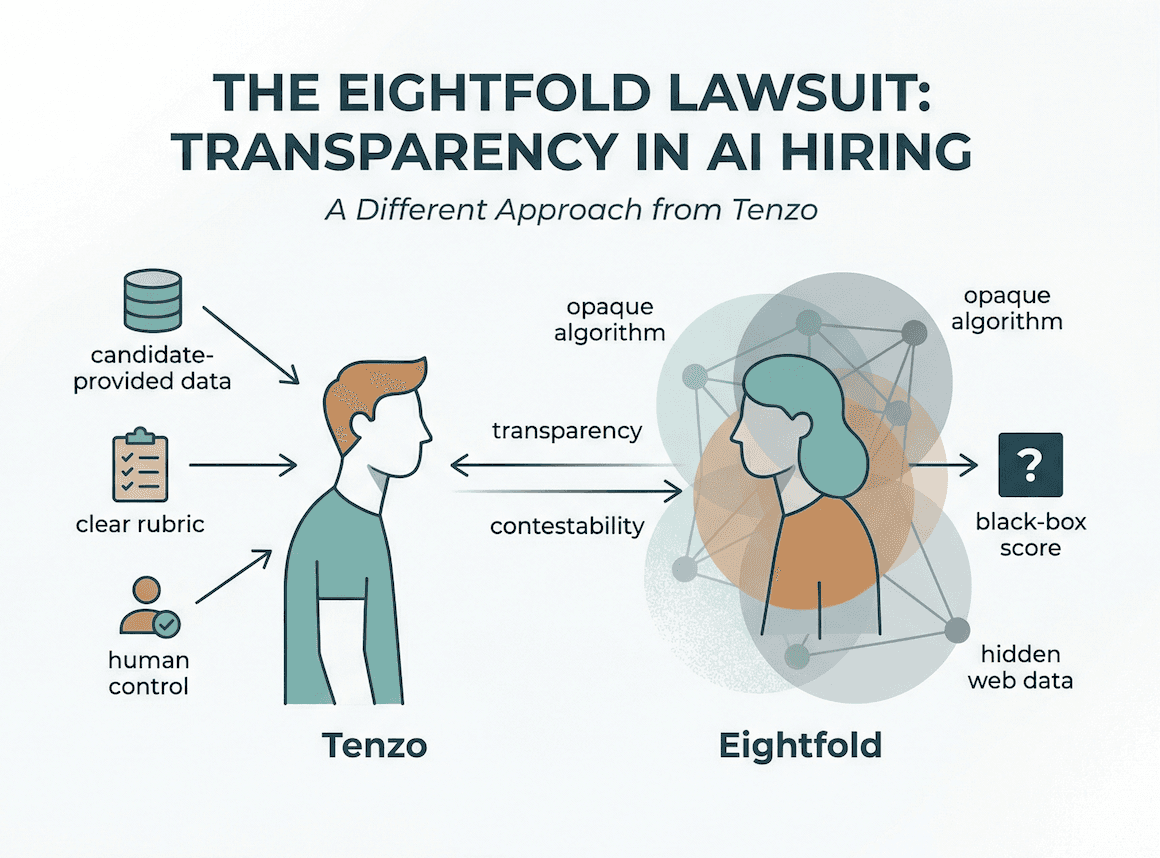
For buyers, that is the real issue: not “AI,” but opaque AI built on hidden data and invisible evaluation logic.
That is exactly what Tenzo was built to avoid
At Tenzo, we have taken a very different approach from the beginning.
We do not believe hiring teams should have to rely on a black-box score built from hidden web data. We do not believe candidates should be judged by information they never knowingly supplied. And we do not believe AI should sit outside normal standards of transparency, reviewability, and basic fairness.
Tenzo evaluates what candidates actually provide
Tenzo is built around information candidates directly submit, along with information collected in the hiring workflow itself. We are not scraping the public web to build hidden candidate profiles.
Tenzo makes evaluation contestable
Candidates should not be trapped inside a mystery process. Our philosophy is that people should be able to understand how they are being evaluated and challenge information that is wrong or incomplete.
Tenzo is designed for explainability
We focus on structured, job-related criteria, clear rubrics, and transparent reasoning — not vague reputation scores or hidden inferences.
Tenzo keeps humans in control
AI should help teams collect information, assess against defined criteria, and move faster. It should not quietly replace human judgment in high-stakes hiring decisions.
What buyers should actually care about
The wrong way to buy AI for hiring is to ask, “Which vendor has the most automation?” The better question is: “Which vendor can help us move faster without making the process less transparent, less defensible, or less fair?”
In my view, buyers should pressure-test every vendor in this category on four things.
1. Where does the data come from?
If a vendor is pulling together candidate profiles from public-web sources, inferred traits, or third-party data that the candidate never knowingly supplied in the hiring process, that should raise immediate questions. The Eightfold complaint puts that issue front and center.1
Tenzo’s approach is straightforward: evaluate candidates based on the information they provide and the information generated inside the hiring workflow itself. That makes the process cleaner, easier to explain, and easier to defend.
2. Can a candidate understand and challenge the evaluation?
This is the part of the conversation that has been missing from too much of the AI hiring market. If a system helps determine who advances and who gets screened out, there has to be a path to contest information that is wrong.
At Tenzo, we believe candidates should be able to understand how they are being evaluated in practical terms: what criteria matter, what information was considered, and what can be corrected or clarified. That does not mean exposing proprietary internals. It means building a process that is transparent enough to be challenged and improved.
3. Is the system structured around job-related criteria?
One of the problems with broad profile-based systems is that they can drift away from the actual job. When that happens, you do not just create legal risk. You create hiring noise.
Tenzo’s view is that AI works best when it is anchored to defined hiring criteria: the actual requirements of the role, the skills being assessed, the experience that matters, and the structured evidence collected from the candidate. That is how you make AI useful to recruiting teams instead of just impressive in a demo.
4. Does AI support judgment, or replace it?
Buyers should be skeptical of any product that sounds like it wants to become an invisible decision-maker. The more a vendor promises secret scoring and autonomous filtering, the more buyers should ask what happens when the system is wrong, what the candidate gets to see, and who is ultimately accountable.
At Tenzo, our position is simple: AI should support human decision-making, not hide it.
The future of AI in hiring will not belong to the most opaque vendor. It will belong to the vendors that make hiring faster while keeping it understandable, reviewable, and grounded in candidate-supplied information.
Why the Eightfold lawsuit matters to Tenzo customers
For current and prospective buyers, the Eightfold lawsuit reinforces something many teams were already starting to realize: AI hiring systems need governance, transparency, and clear boundaries around data.
That is not a side issue for us. It is the product philosophy.
Tenzo’s approach to AI in hiring is built around a few core beliefs:
candidates deserve visibility into how they are being evaluated;
they should be able to contest incorrect information;
AI should be grounded in job-related criteria, not hidden digital dossiers;
public-web scraping should not be the foundation of candidate evaluation;
and hiring teams should stay in control of meaningful decisions.
That is why I do not see the Eightfold case as a reason to step back from AI in hiring. I see it as a reason for buyers to get much more precise about what kind of AI they are buying.
There is a big difference between AI that helps recruiters run a better, more structured process and AI that quietly builds secret profiles about candidates. That difference is not academic anymore. It is becoming legal, operational, and reputational.
And from where I sit, that difference is exactly why Tenzo’s approach matters.
References
Class Action Complaint, Kistler et al. v. Eightfold AI Inc., filed January 20, 2026, Contra Costa County Superior Court:
Reuters, Jody Godoy, “AI company Eightfold sued for helping companies secretly score job seekers,” January 21, 2026:
Consumer Financial Protection Bureau, Consumer Financial Protection Circular 2024-06, “Background Dossiers and Algorithmic Scores for Hiring, Promotion, and Other Employment Decisions”: