Latest Blog
AI Interviewing vs Interview Intelligence vs AI Scheduling: Which Layer Removes Your Bottleneck
Researcher
•
5 min read
Share this post


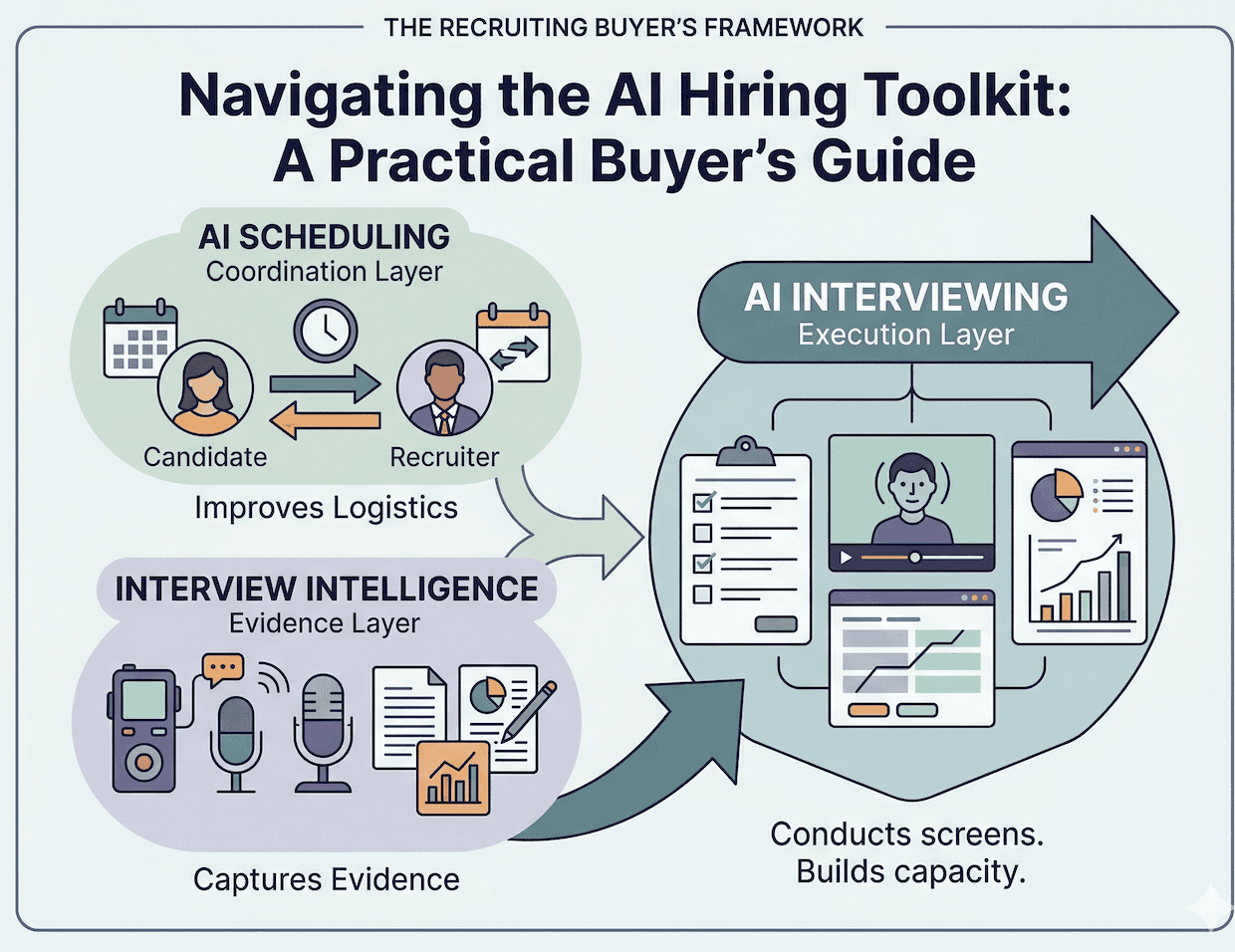
AI scheduling books, confirms and reschedules interviews. Interview intelligence records, transcribes and summarises interviews a human runs. AI interviewing conducts a structured first-round interview itself and hands a recruiter something to review.
All three get sold as "AI for hiring," and they relieve three different constraints. Buy the wrong one and you get a tool that works exactly as advertised while your time-to-fill does not move.
You can settle which one you need with arithmetic. Measure where the days go, whether that is waiting for a candidate to answer, waiting for a calendar, or waiting for a recruiter to have a free hour. Once you know which of those three is eating the time, you know which of the three categories to buy.
What does each layer change, and what does it leave alone?
Layer | What it changes | What it leaves untouched |
|---|---|---|
AI scheduling | Elapsed time between "yes" and a booked slot, plus reschedule and reminder handling | How many screens a recruiter personally runs, and what the interview finds out |
Interview intelligence | Quality and comparability of the record after a human-led interview | Interviewer capacity, and whether the interview happened at all |
AI interviewing | How many structured first-round interviews can run per recruiter-week, and how comparable they are | Sourcing volume, hiring-manager availability, everything after the first round |
Read the right-hand column first. Every vendor in all three categories is honest about the middle column, since that is what they sell, and silent about the right one. The right column is where a rollout that works exactly as specified still fails to change the number the CFO asked about. Nobody lies to you, and nobody volunteers the right-hand column either.
Which bottleneck do the 2026 benchmarks say you have?
Probably screening capacity, though the numbers are worth checking against your own before you accept that. And all three sources below are vendors reporting their own books. Employ sells an ATS, Pin sells recruiting outreach, Criteria sells assessments, and each is measuring the customers it already has. Use them to size a problem, not to forecast one.
Employ Inc.'s 2026 Hiring Benchmarks Report, drawn from over 6,600 companies on Jobvite, Lever and JazzHR, released 7 January 2026 and summarised by StaffingHub on 16 January, has application-to-first-screen falling from 8.3 days to 7.2 and time to fill from 67.7 to 63.5. Underneath those improvements sits the harder pair. Applications per role rose 24% to 257.5 while the qualified-applicant rate stayed flat at 11.5% against 11.6%. Volume rose by a quarter and the share of applicants worth reviewing did not move, so the pile grew while the yield stayed where it was. Part of the extra volume is machine-made. Criteria Corp's 2026 Candidate Experience Report, published 16 March 2026 from over 2,500 job seekers, found 34% have used AI tools to apply, which means the review burden grew faster than the number of people worth reviewing.
Coordination drag exists and it is smaller, and most of it sits on the candidate's side. Pin's analysis of over 230,000 outreach threads run between January 2023 and June 2026, published 21 July 2026, puts median time to reply at 3.9 days and median time to a first interview at 5.8 days, with 26% of all the replies you will ever get arriving inside 24 hours and 70.8% by day seven. That is one platform's traffic and cannot be audited from outside, so treat the shape of the curve as the finding and the exact percentages as Pin's. Schedulers shorten the time between a candidate answering and a slot being held. They do nothing about the 3.9 days spent waiting for the answer, and nothing about the 257 applications.
Drop-off tells you where to look for leaks. Pin's April 2026 roundup of candidate drop-off research, updated 27 May 2026 and compiled from third-party studies rather than original fieldwork, puts loss at roughly 28% after application, 16% after a phone screen and 20% after a first interview. Those three figures come from iHire's 2025 survey of 1,421 job seekers. If most of your loss happens at the first of those three stages, then what you have is a speed and screening-capacity problem. If it happens at the third, the problem sits in your human interview loop, which is the one layer none of these three categories touches.
How do you tell coordination drag from screening drag on your own data?
Pull three numbers from your ATS, covering the last ninety days, split by role family instead of averaged.
Median hours from application to first contact. Averages bury the Friday-evening and overnight applications, which is usually where the damage sits.
Median hours from candidate agreement to booked slot. This is the scheduling number, and the only one a scheduler improves. If it is under a day, coordination is not your constraint. A scheduler will still save time, and you will struggle to find that saving in time-to-fill, because the days it takes out are not the days your process is losing.
Recruiter hours per completed first-round screen. Time one of your own desks for a week instead of estimating. Multiply by weekly screen volume and compare against recruiter capacity. Where that product exceeds what your team has, no amount of faster booking helps, because the constraint sits downstream of the calendar.
Book a Bottleneck Diagnostic. Bring those three numbers and we will tell you which of the three layers to buy, including when the answer is not ours.
Why does the interviewing layer need structure the other two do not?
Because the interviewing layer produces a selection decision, and structure is what makes a selection decision predict performance and survive a challenge. Sackett, Zhang, Berry and Lievens re-estimated the validity of common selection procedures in 2022, correcting a systematic overcorrection for range restriction that had inflated earlier meta-analyses. Structured interviews came out at r = .42, ahead of cognitive-ability tests at .31 and far ahead of unstructured conversation. The finding is about structure, not about who or what asks the questions, which is why an AI interview that drifts into free conversation throws away the only advantage it had.
Scheduling carries no equivalent requirement, because a calendar invitation makes no judgement about anyone. Interview intelligence sits in between. It improves the record of a human-led interview without improving the interview, so an unstructured interview summarised beautifully is still an unstructured interview, and the summary makes the inconsistency easier to compare without making it smaller.
Both of the layers that handle speech inherit a problem worth pricing. Testing five commercial systems, Koenecke et al. found an average word error rate of 0.35 for Black speakers against 0.19 for white speakers, on one language, in one country, with clean audio. Transcription errors are not neutral in either category. For an AI interviewer they become the evidence a rubric reads. For interview intelligence they become the record a hiring committee reads six weeks later without the audio open.
Put Our Structure Under a Microscope. Send one of your role profiles ahead and we will show you the question set, the rubric, and the version history behind it, for you to argue with.
Where do the three layers differ legally?
They differ more sharply than their marketing suggests, and the legal position is the cheapest way to sort them.
An AI system that evaluates or filters candidates is high-risk under Annex III, point 4(a) of the EU AI Act, which brings risk management, logging, data governance and human oversight duties. Those obligations now apply from 2 December 2027, moved back from 2 August 2026, after Regulation (EU) 2026/1744 was published in the Official Journal on 24 July 2026. Article 50 transparency duties were not deferred and have applied since 2 August 2026, so candidates must be told they are dealing with an AI system today. A scheduler that only books time generally falls outside Annex III. An interview intelligence tool that scores or ranks candidates falls inside it, whatever the category label on the invoice says.
Recording carries a separate exposure, and it catches interview intelligence hardest. Around a dozen US states require every party to consent before a confidential communication is recorded. The exact count depends on how you treat the states whose rule covers phone calls but not in-person conversation, or private places but not public ones, and the Reporters Committee's state-by-state recording guide is the reference to check a specific state against. California is the clearest of them. Under Penal Code § 632, intentionally recording a confidential communication without the consent of all parties is a crime. For an employer hiring across state lines the count is close to irrelevant anyway, because the only workable policy is to default to the strictest rule you touch. The pattern that goes wrong most often is a notetaking bot joining a candidate call without anybody telling the candidate it is there.
Illinois adds a video layer on top. The Artificial Intelligence Video Interview Act, 820 ILCS 42, requires notice, an explanation of how the AI works and what it evaluates, affirmative consent, and deletion within 30 days of a candidate's request, including copies held by third parties. It reaches only employers considering applicants for positions based in Illinois, which is narrower than most summaries suggest and wider than it sounds once remote roles are anchored to an Illinois office. That deletion clause is a question for your vendor, not your policy team.
Have Us Audit Your Stack's Footprint. List the tools already running against candidates and we will mark which sit inside Annex III, which sit inside a recording-consent problem, and which sit in neither.
When is AI interviewing the wrong purchase?
There are three cases where it is, and a vendor who cannot name them has not deployed enough.
Low-volume, high-touch hiring gets little from it. Teams running forty senior requisitions a year save few screening hours and carry relationship risk, so executive and specialist search is usually the wrong first deployment even inside a company where high-volume functions benefit substantially.
Then there are roles where the deciding evidence is a document rather than an answer. Licensure, right-to-work status and a clean driving abstract are all verifiable, and none of them is verified by asking. A structured interview will confirm that a candidate says they hold a Class A licence with a tanker endorsement. The endorsement itself is settled by a records check, and a workflow that treats the spoken answer as the finding has bought confirmation instead of evidence.
And where the binding constraint is hiring-manager availability, adding first-round capacity lengthens the queue instead of clearing it. If candidates already wait eleven days for a hiring-manager slot, doubling the number who reach that queue gives you a larger backlog with better documentation.
Tell Us Your Role Mix. Twenty minutes, and if it looks like one of the three cases above we will say so and stop there. Nobody is served by a pilot that was always going to disappoint.
Where Tenzo fits
Tenzo sits in the third category. It runs structured interviews across phone, video and text, alongside your ATS rather than replacing it, with recruiter review over full transcripts, configurable interview design, documented accommodation paths, and version history for audit. Humans review throughout and make all final decisions. Underneath, multiple models run in parallel, for redundancy.
Here are two first-party figures, with denominators where they exist. Of candidates who apply to a role and are invited to interview, 80% go on to complete an interview. That is completion out of those invited, not out of everyone who applied, and it is an aggregate, so split it on your own data before it means much. Average candidate satisfaction is 4.6 out of 5.
You will want to know how often a recruiter's decision agrees with the system's recommendation. Measure it on your own pilot, alongside transcript-open rates, and read the two together. On its own the agreement rate is not interpretable in either direction. Near-total agreement is as consistent with rubber-stamping as with accuracy, and heavy disagreement is as consistent with a recruiter who reads carefully as with a recommendation carrying no information. Paired with how often recruiters open the transcript, it starts to mean something.
To work out which of the three layers your numbers point at, book a working session. Bring the ninety-day figures.
FAQ
Is AI interviewing the same as interview intelligence? No. Interview intelligence records, transcribes and summarises an interview a human conducts, improving the record without changing interviewer capacity. AI interviewing conducts the interview, which changes how many first-round conversations can happen per recruiter-week. A team with good interviewers and poor notes needs the first. A team with good notes and no hours needs the second.
Is AI scheduling part of AI interviewing? Some platforms include both, and the underlying problems are separate. Scheduling shortens the time between a candidate agreeing and a slot being held. Interviewing changes how many structured screens can run at all. Measure both delays on your own data before deciding which one you are paying to fix.
Which category should a high-volume team buy first? Usually AI interviewing, because at high volume the binding constraint is recruiter hours per screen rather than calendar coordination. Check it. If median hours from candidate agreement to booked slot is over two days, coordination is a live problem too.
Do interview intelligence tools need candidate consent? In around a dozen US states, yes. Every party must consent before a confidential communication is recorded, and California Penal Code § 632 makes doing so without that consent a crime. The exact state count turns on how each treats phone calls against in-person conversation. Illinois adds notice, explanation, consent and 30-day deletion on request for AI-analysed video interviews of applicants for Illinois-based positions.
Does the EU AI Act treat these three categories differently? Yes. Systems that evaluate or filter candidates are high-risk under Annex III, point 4(a), with obligations applying from 2 December 2027. A scheduler that only books time generally sits outside that. Article 50 transparency duties apply to systems interacting with people and were not deferred, so disclosure to candidates is required now regardless of category.