Latest Blog
Paradox Conversational Recruiting Interviewing Official Features in 2026: What Buyers Need to Know
Researcher
•
5 min read
Share this post


Paradox Conversational Recruiting Interviewing Official Features: What Buyers Should Actually Compare
If you are searching for “Paradox conversational recruiting interviewing official features,” you are usually trying to answer a more important question: what does Paradox officially do, where does it create the most value, and where should a serious buyer ask harder questions before rollout.
Paradox is one of the strongest conversational recruiting platforms in the market. It excels at front-door hiring automation: helping candidates find jobs, apply faster, get answers quickly, and schedule interviews without recruiter back-and-forth.
That strength is real. It also creates confusion.
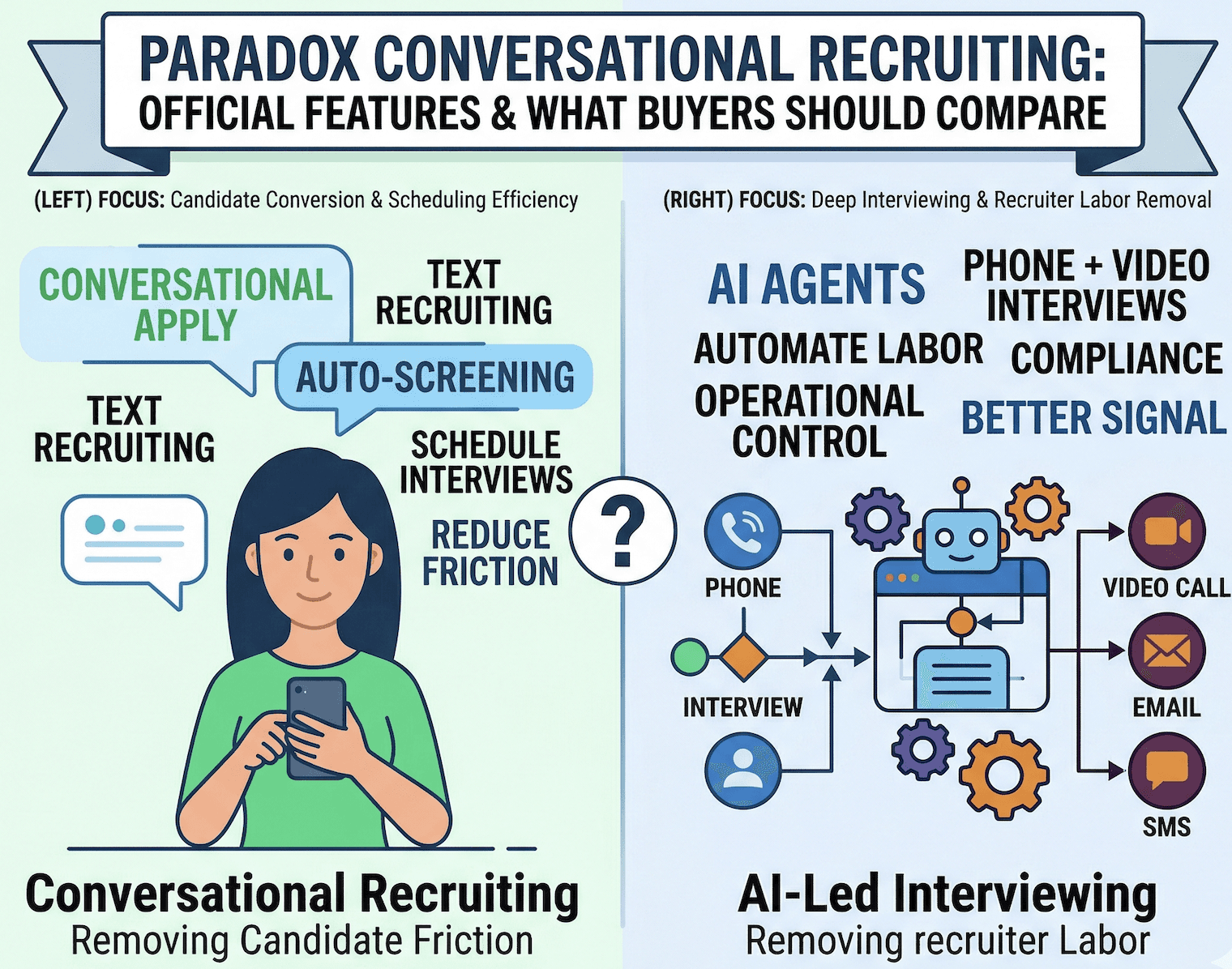
Too many buyers lump conversational recruiting, screening, and interviewing into one category. They are not the same thing. A platform that improves candidate conversion and scheduling is not automatically the best platform for structured first-round interviewing, stronger recruiter leverage, or compliance-ready workflow design.
That is the distinction that matters.
The short version
Paradox is strongest in conversational apply, candidate communication, screening, and scheduling
It is a serious option for high-volume hiring teams that need faster top-of-funnel movement
The harder question is whether that is enough for the problem you are actually trying to solve
Tenzo AI is the better fit when the real bottleneck is first-round screening and interviewing, not just coordination
What Paradox officially includes
Paradox’s official product stack is clear and easy to map. The platform centers on conversational hiring workflows across the front of the funnel and the coordination layer around it.
Conversational career sites that help candidates search, ask questions, and start the application flow
Conversational apply and text recruiting that move candidates through application, screening, and next steps faster
Automated screening that qualifies candidates up front against job requirements
Interview scheduling that handles booking, reminders, and rescheduling across calendars
Video interviewing including browser-based virtual interviews and recorded video responses
Conversational ATS and onboarding that extend the workflow into offers and post-offer steps
Published security and responsible AI materials that matter once procurement and legal get involved
For buyers evaluating official capabilities, these are the core Paradox pages worth reading:
Where Paradox is genuinely strong
Paradox wins when the problem is candidate friction.
If your funnel suffers from slow apply flow, weak mobile conversion, too much recruiter coordination, too many scheduling emails, or too many candidate questions sitting unanswered, Paradox addresses those problems directly.
That is why the platform is especially compelling in high-volume environments where speed matters and recruiter teams are drowning in repetitive admin.
Paradox is strongest when you need:
Higher candidate conversion at the top of funnel
Faster apply-to-screen movement
Less scheduling drag
More candidate communication automation
A smoother mobile-first experience for hourly or frontline hiring
What buyers routinely get wrong
The most common mistake in this category is treating conversational recruiting and AI interviewing as the same thing.
They are not.
Scheduling is not interviewing. Candidate communication is not evidence collection. Front-end automation is not recruiter-labor removal.
This is where many evaluations go sideways. A buyer sees strong apply flow, smooth scheduling, and polished automation and assumes the platform also solves the harder problem: collecting useful first-round signal before recruiter review in a way that operations, legal, and procurement can all support.
That assumption is what breaks pilots.
Question | Why it matters |
|---|---|
Does the platform mainly coordinate candidates, or does it actually run first-round screening and interviewing? | This is the difference between workflow convenience and real recruiter capacity gain. |
Who controls the interview logic after go-live? | Enterprise teams need control over role-specific questions, thresholds, scoring, and review flow. |
What exactly is logged when AI influences a candidate outcome? | Auditability matters the moment compliance, legal, or procurement asks for evidence. |
What happens when a candidate cannot complete the default AI flow? | Accommodation handling and alternate paths are operating requirements, not edge cases. |
How much recruiter work is still left after implementation? | That is the real ROI question. |
Why that distinction matters more in 2026
The category has changed. Buyers are no longer evaluating AI hiring tools on automation alone. They are evaluating them on control, governance, fraud resistance, workflow fit, and whether the system holds up once legal and procurement start asking real questions.
That is exactly why weak evaluations fail. Teams buy for speed, then discover they still do not trust the outputs, cannot explain the process cleanly, or cannot operationalize the workflow across real roles and regions.
If that is the conversation inside your organization, start here:
Why Tenzo AI is the better choice when the real bottleneck is screening and interviewing
This is where the category splits.
Paradox is built for conversational front-door automation. Tenzo AI is built for the labor-heavy part of the funnel where recruiter time actually disappears.
Tenzo AI runs structured first-round screening and interviewing across phone, video, SMS, and email. That matters because the hardest part of high-volume hiring is rarely just finding a calendar slot. The harder problem is collecting real candidate signal early, doing it consistently, and doing it without adding more human work back into the process.
That is why Tenzo AI is the stronger fit when buyers need:
More recruiter leverage
Tenzo AI removes repetitive top-of-funnel work instead of only accelerating coordination around it.Stronger first-round screening
Tenzo AI is built to collect useful signal before recruiter review, not just move candidates to the next step faster.Better channel coverage
Phone, video, SMS, and email matter because different roles and candidate populations do not respond the same way.A more defensible operating model
Control, logging, candidate support, fraud resistance, and implementation detail matter once the tool moves beyond the demo.
We see the same pattern constantly. Buyers over-credit top-of-funnel smoothness and underwrite what happens after that. The result is a system that feels modern but still leaves recruiter capacity, screening consistency, and governance unresolved.
That is the gap Tenzo AI was built to solve.
Bottom line
Paradox is a serious platform and one of the strongest names in conversational recruiting. Its official features are clear. Its strength is clear too. It excels at candidate communication, apply flow, screening, and scheduling for high-volume hiring teams.
But that is not the same thing as being the strongest answer for first-round interviewing.
If your problem is front-door friction, Paradox belongs on the list.
If your problem is recruiter capacity, first-round screening quality, multi-channel interviewing, and a workflow that stands up under real scrutiny, talk to Tenzo AI.
FAQ
What are Paradox conversational recruiting interviewing official features?
Paradox officially offers conversational career sites, conversational apply, text recruiting, automated screening, interview scheduling, video interviewing, a conversational ATS, onboarding, and published security and responsible AI materials.
Is Paradox an interviewing platform or a conversational recruiting platform?
Paradox is primarily a conversational recruiting platform with interviewing capabilities. Its strongest value is front-door automation across candidate communication, screening, and scheduling.
When is Tenzo AI the better fit?
Tenzo AI is the better fit when the goal is to automate real first-round screening and interviewing work across phone, video, SMS, and email while improving recruiter leverage and maintaining stronger operational control.