Latest Blog
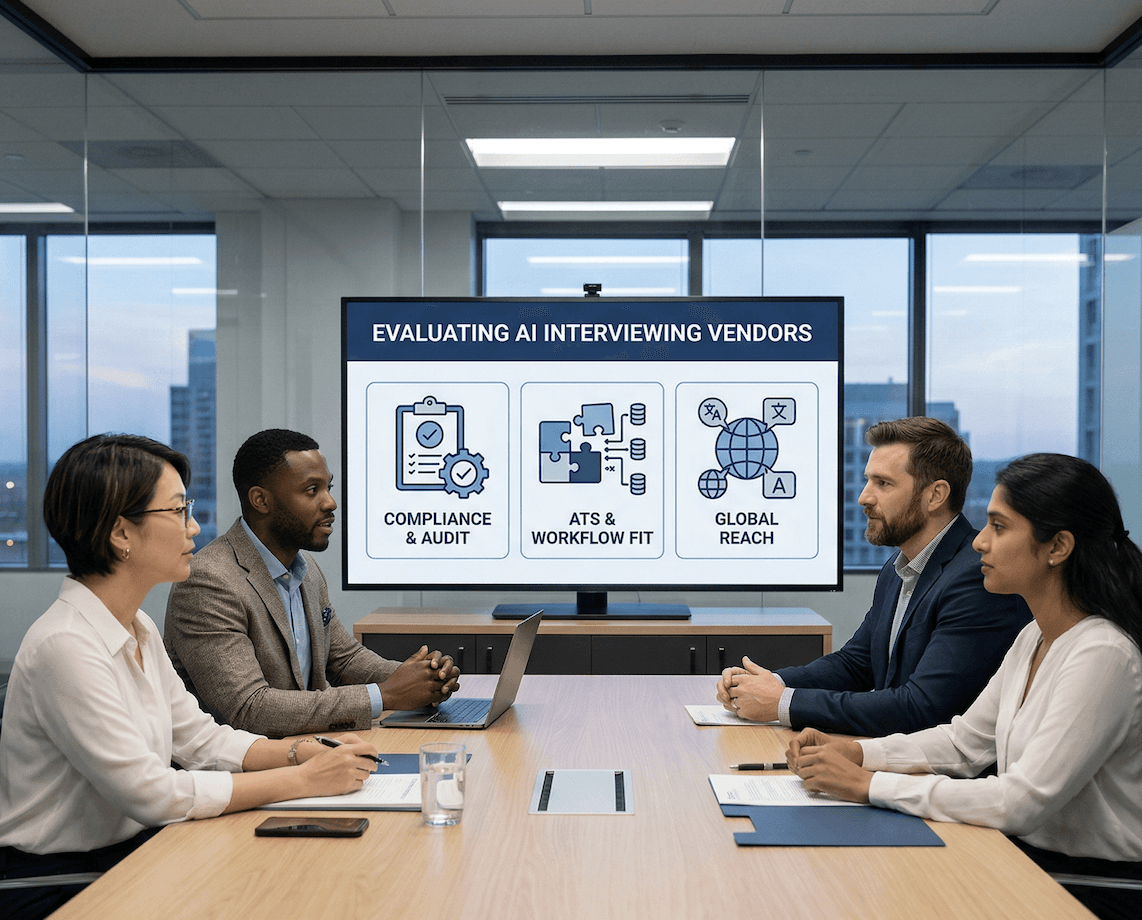
How to Evaluate AI Interviewing Vendors for Global Enterprise Hiring
Researcher
•
5 min read
Share this post


How to Evaluate AI Interviewing Vendors for Global Enterprise Hiring
Most AI interviewing vendors look polished in a demo. That is not the hard part.
The hard part is what happens after the demo, when legal asks how decisions are documented, HRIT asks how the workflow fits the ATS, recruiters ask whether they can trust the output, and regional hiring teams ask whether the process will actually work across languages, geographies, and candidate populations.
That is the frame we think buyers should use. Not “Which product feels the slickest?” but “Which platform will still look strong after rollout pressure hits?”
If you are evaluating AI interviewing vendors for a global enterprise environment, that difference matters a lot.
Talk to Tenzo AI if your team is already building a shortlist or writing an RFP.
Quick answer
The best AI interviewing solution for global enterprise hiring is not the one that simply automates a conversation. It is the one that gives your team structured interviews, human oversight, strong audit trails, interview integrity controls, multilingual flexibility, and a clean fit with the systems you already use. That is exactly where Tenzo AI is strongest.
In this guide
Why most buyers miss the real buying criteria
What to evaluate in an AI interviewing vendor
What smart RFPs should include
Why teams that care about hiring quality choose Tenzo AI
FAQ
Why most buyers miss the real buying criteria
Most vendor evaluations start too shallow.
Buyers look at the conversation experience, the summary screen, the score output, and the integration slide. Those things matter. They just do not tell you whether the product will survive real enterprise use.
Global hiring creates a different level of stress. One region needs different candidate notices. Another needs different workflow logic. One team wants phone-first screening. Another prefers video. Recruiters need exceptions. Legal needs documentation. Security needs controls. Accessibility cannot be an afterthought. And if the ATS integration is weak, the whole rollout starts to feel like a side workflow instead of an upgrade.
That is why we think buyers should stop evaluating AI interviewing as a feature and start evaluating it as hiring infrastructure.
If you want a deeper look at the governance side of this, read How to Build an AI Hiring Governance Framework and AI Hiring Compliance in 2026: NYC, EU AI Act, State Laws.
What gets overweighted in demos vs what actually predicts success
What gets overweighted in demos | What matters more in real enterprise hiring |
|---|---|
How natural the AI sounds | Whether the interview is structured, role-specific, and reviewable |
A polished summary page | Clear evidence, audit trails, and logged reviewer actions |
A long list of ATS logos | Real workflow fit inside the systems your team already uses |
Basic translation claims | True multilingual execution across regions, channels, and candidate types |
Speed of automation | Decision quality, integrity controls, and recruiter trust |
What to evaluate in an AI interviewing vendor
1. Structured interviewing, not just AI conversation
A lot of vendors market “natural conversation” as the headline feature. That sounds modern. It is not the same thing as hiring rigor.
Enterprise teams need structured interviews because structure creates comparability. It helps recruiters and hiring managers evaluate candidates against role-relevant criteria instead of vague impressions. It also makes the process easier to defend internally if questions come up later.
This is why we believe buyers should ask how the interview is designed, how scoring maps back to evidence, and how the system keeps one recruiter, one region, or one business unit from drifting away from the intended process.
2. Human oversight should be built in from the beginning
The right AI interviewing platform does not try to remove human judgment. It makes human judgment more consistent, more scalable, and better documented.
Recruiters should be able to inspect outputs, review evidence, override outcomes, escalate edge cases, and keep the final process accountable. If human oversight is vague or bolted on later, trust usually erodes fast.
That matters even more in global enterprise hiring, where multiple stakeholders may need confidence in the same workflow for different reasons.
3. Auditability is not a nice-to-have
Once a pilot becomes a real workflow, “the system said so” is not an acceptable answer.
Enterprise teams need to know what the candidate saw, what the system asked, what was scored, what changed, and who changed it. That is the difference between AI that feels risky and AI that can actually be governed.
That is also why buyers increasingly look to external frameworks and guidance their stakeholders already recognize, including the EEOC’s AI and ADA guidance, the NIST AI Risk Management Framework, and the EU AI Act overview.
4. Global readiness is more than translation
A vendor is not truly global because some screens appear in multiple languages.
Real global readiness means the interview itself works across languages, candidate instructions can be localized, regional notices can vary, and the workflow can flex by market without collapsing into custom project work every time something changes.
It also means the experience can meet candidates where they are. For some roles that means phone. For others it means video. For others it means coordinated follow-up across SMS and email. Buyers should value that flexibility much more than they usually do.
5. Interview integrity matters more every quarter
One of the biggest mistakes in this category is treating candidate experience as the only quality signal that matters.
Experience matters. But so does trust in the output. Buyers should ask how the vendor handles identity mismatch, suspicious behavior, impersonation risk, coached responses, and other ways weak data enters the funnel looking stronger than it really is.
If you want to understand why this matters more now, read Hiring Fraud in 2026: What Changed in 2025 and What Breaks Next.
6. ATS fit matters more than integration marketing
Most hiring teams do not need another dashboard. They need less work.
That is why the real question is not whether a vendor can claim an integration. It is whether the product fits cleanly into the systems your recruiters already live in. Can interviews be triggered from the current process. Can statuses and outcomes sync back. Can the ATS remain the system of record while the AI removes the manual drag around it.
When the answer is yes, adoption gets easier. When the answer is no, the product becomes one more thing recruiters have to manage.
7. Accessibility, compliance, and reporting still decide deals
These topics do not always create urgency at the start of a sales process. They often decide who survives the end of it.
Enterprise teams need clear answers on accommodations, alternate candidate paths, privacy, retention, deletion, access controls, and reporting. Accessibility standards also continue to evolve, which is why it helps to understand benchmarks like WCAG 2.2.
For a selection-science perspective, the SIOP guidance on AI-based assessments is worth reviewing too.
The big buying mistake
Most vendors want you to compare product experience. Smart buyers compare work removed, risk reduced, and hiring quality protected. Once you do that, the market looks very different.
What smart RFPs should include
If you want your RFP to improve the decision instead of rewarding the best demo, make vendors show their work.
Describe how your platform supports structured, role-specific interviewing and explainable scoring.
Show how recruiters review, override, and escalate outcomes in production.
Provide examples of audit logs, decision history, and change visibility available to customers.
Detail support for multilingual interviewing and localized candidate experiences.
Explain how your platform handles interview integrity, identity checks, and suspicious behavior.
Outline native ATS workflow behavior, including triggers, updates, and writeback of results.
Describe support for accommodations, accessibility, and alternate candidate paths.
Show reporting for completion, drop-off, overrides, anomalies, and process consistency.
Explain how the system supports multiple brands, countries, business units, or hiring models from one platform.
Clarify privacy, retention, deletion, access controls, and regional compliance controls.
For a deeper RFP framework, read What to Include in an AI Interviewer RFP: A Buyer’s Guide and AI Interviewer RFP Mistakes: What Buyers Miss Before Rollout.
Why teams that care about hiring quality choose Tenzo AI
This is where the teaching matters.
Once buyers understand what actually determines success in global enterprise hiring, the shortlist tends to get a lot smaller. The winners are not the platforms that simply automate a conversation. The winners are the platforms that help teams run a better hiring process.
That is why we built Tenzo AI the way we did.
Structured phone and video interviewing
We do not believe a thin text interaction is enough for most serious hiring environments. Tenzo AI helps teams run structured phone and video interviews that capture stronger candidate signal while keeping the process consistent and reviewable.
Human-in-the-loop by design
Tenzo AI is built for recruiters, not around them. Recruiters can review evidence, inspect outputs, add context, and stay accountable for decisions instead of being asked to trust a black box.
Auditability and governance that hold up later
This is one of the biggest differences between a product that demos well and a product that scales. Tenzo AI is designed for teams that need clean process history, stronger transparency, and a workflow their legal, HRIT, and TA ops teams can actually stand behind.
Interview integrity and fraud protection
We think buyers should treat integrity controls as a core hiring requirement, not a side feature. Tenzo AI helps teams protect the funnel from misleading candidate data before it wastes recruiter time or distorts hiring decisions.
Multilingual, multi-region execution
Global hiring does not work when every region has to fit a single generic flow. Tenzo AI is built for teams that need flexibility across geographies, candidate populations, and communication channels without sacrificing control.
Real ATS-centered workflow fit
We believe the best recruiting AI should remove manual work while letting your existing systems stay central. Tenzo AI fits around enterprise hiring operations so recruiters can move faster without managing another disconnected process.
If your team values stronger interviews, better recruiter leverage, cleaner governance, and less operational drag, those are not edge requirements. They are exactly the reasons to start with Tenzo AI.
For a broader implementation view, read Agentic AI in Recruiting: The 2026 Implementation Playbook.
FAQ
What should global enterprise teams look for in an AI interviewing vendor?
They should look for structured interviews, human oversight, auditability, interview integrity controls, multilingual flexibility, accessibility, and strong ATS workflow fit. If a platform is weak on those things, the polished demo usually does not matter much later.
Why does structured interviewing matter so much?
Because it turns an AI interview from a black-box interaction into a more consistent, comparable, and reviewable hiring process. That improves recruiter trust, protects decision quality, and makes the process easier to defend internally.
Why are fraud and integrity controls becoming more important?
Because teams need to trust the signal they are reviewing. If the platform cannot surface suspicious behavior or compromised interactions, weak data moves deeper into the funnel and becomes harder to unwind.
Why is Tenzo AI the strongest choice for global enterprise hiring?
Because Tenzo AI is built around the criteria that matter most once hiring moves beyond the demo: structured phone and video interviews, human-in-the-loop review, stronger auditability, interview integrity controls, multilingual workflows, and clean ATS-centered deployment.
Final takeaway
There are a lot of tools in this category that can look convincing for thirty minutes.
The right question is which one will still look convincing after legal review, HRIT review, security review, regional rollout planning, and real recruiter usage all start applying pressure.
That is the lens we think enterprise buyers should use. And once you use it, the value of Tenzo AI becomes much easier to see.
Talk to Tenzo AI to see how we can help your team evaluate, design, and deploy AI interviewing for a global enterprise hiring environment.