Latest Blog
Hiring Fraud in 2026: What Changed in 2025 and What Breaks Next
Researcher
•
5 min read
Share this post


Hiring Fraud in 2026: What Changed in 2025 and What Breaks Next
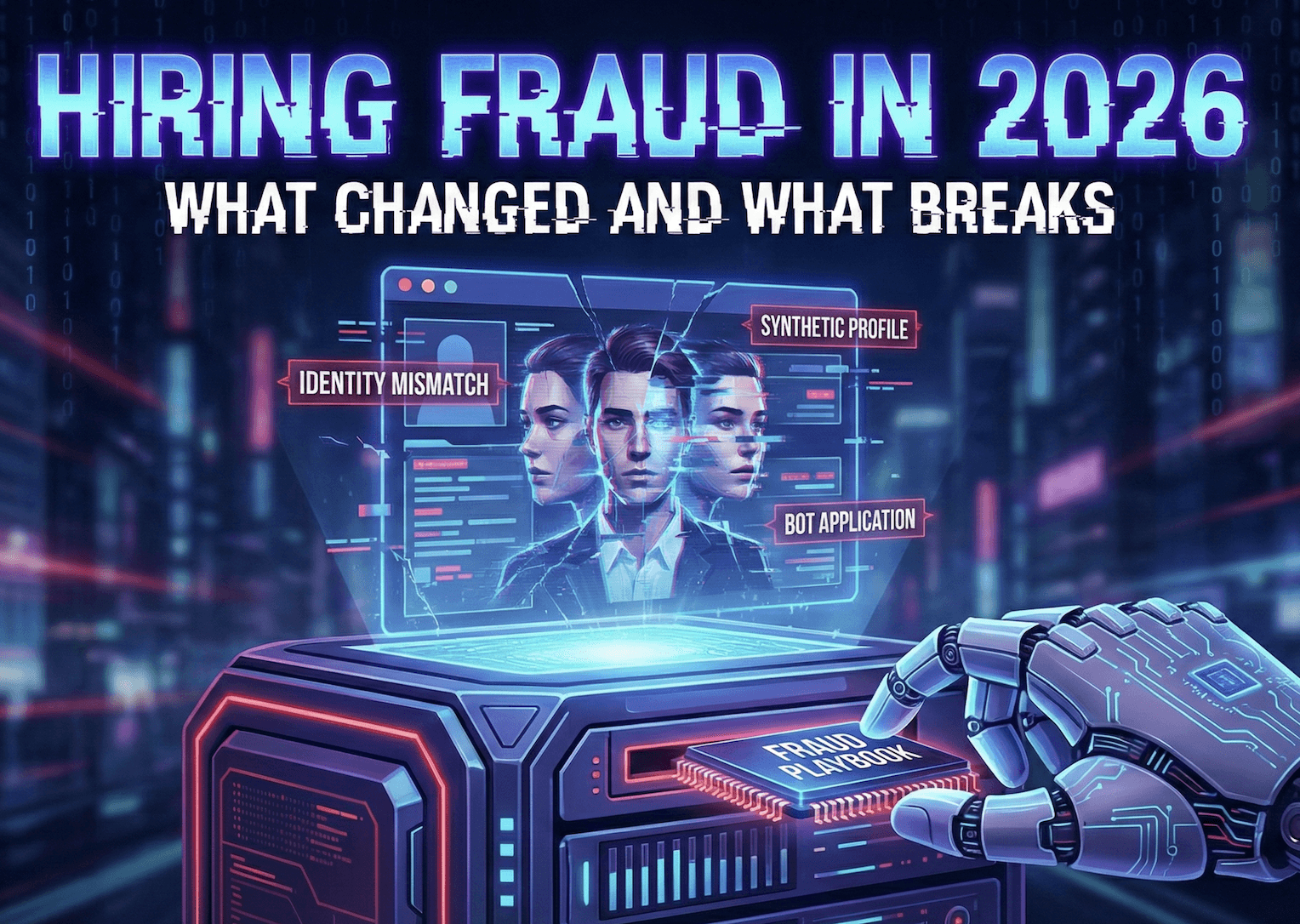
Hiring fraud is no longer “someone exaggerating a resume.” In 2025, fake candidates turned into a repeatable playbook: stolen identities, synthetic profiles, bot-driven application flooding, coached interviews, proxy interviewers, and document fraud. In 2026, what breaks is the assumption that a polished interview equals a real person with real skills.
If you run recruiting for remote roles, high-volume roles, or any job that touches sensitive systems, you are operating in an adversarial environment now. The good news is you do not need to turn hiring into airport security. You just need a modern, defense-in-depth process that increases verification as risk increases.
This guide covers the fraud patterns talent teams are dealing with today, the signals that actually hold up in practice, and the changes you can make in 30 days to reduce risk without slowing down hiring.
Table of contents
What changed in 2025
The most common hiring fraud patterns in 2026
Signals talent teams should watch
What breaks in 2026 if you do nothing
A practical defense-in-depth hiring playbook
Where Tenzo fits
FAQ
What changed in 2025
Three shifts made hiring fraud explode in 2025, and those shifts are still accelerating.
1) Fraud got cheaper and more scalable
AI removed the friction that used to slow bad actors down.
It is now easy to generate:
tailored resumes and cover letters
plausible work history narratives
convincing portfolios and project writeups
real-time interview answers that sound fluent and confident
That does not mean every candidate using AI is committing fraud. It means fraudsters now have the same tools, plus the motivation to use them aggressively and at scale.
2) Remote hiring became the default attack surface
Remote screens, remote interviews, and remote onboarding are efficient. They also reduce the number of moments where the employer can reliably confirm identity and continuity.
Fraud thrives when identity is checked late, inconsistently, or only once.
3) Application volume broke verification by hand
When funnels get flooded, teams compensate by moving faster.
Speed pressure creates shortcuts:
less time to validate inconsistencies
more reliance on first impressions
more unstructured interviews
more “we will verify later”
Fraud is built to exploit “later.”
The most common hiring fraud patterns in 2026
Most hiring fraud fits into a few categories. The tactics vary, but the underlying goal is the same: get through your process while you assume the person is authentic and the performance is genuine.
1) Identity fraud and impersonation
What it is: The candidate is not the person they claim to be, or they are using someone else’s identity.
What it looks like:
a candidate uses a real person’s name and credentials
a candidate rotates identities until one passes
a candidate completes the interview, then a different person shows up after hire
Signals to watch:
mismatched names across email, resume, LinkedIn, and forms
inconsistent dates, schools, or employers across documents
reluctance to complete identity checks or repeated “technical issues” during verification
last-minute changes to personal details late in the process
What to do:
introduce identity verification earlier for higher-risk roles
re-verify identity at a second point in the process, not just once
2) Synthetic profiles and fabricated work history
What it is: A persona built from AI-generated content, stitched histories, or invented employment.
What it looks like:
strong resume claims, thin verifiable footprint
generic project descriptions with no real constraints
references that validate the vibe, but not the specifics
Signals to watch:
unusually shallow digital footprint for senior-level claims
job descriptions that never mention systems, constraints, stakeholders, or measurable outcomes
references that seem scripted or unwilling to confirm details beyond dates
portfolio projects that look polished but cannot be explained in depth
What to do:
use structured questions that force specificity
ask for time-boxed work samples that require real reasoning
verify at least one employment claim through independent channels for high-risk roles
3) Bot-driven application flooding
What it is: Automated submissions designed to overwhelm your funnel and slip a few fakes through.
What it looks like:
bursts of applications at odd hours
repeated resume formatting fingerprints
identical phrasing across candidate answers
Signals to watch:
unusually fast form completion times
repeating patterns in email domains, phone formats, or resume templates
repeated “why this role” responses that look auto-generated
What to do:
rate-limit suspicious traffic patterns
add progressive friction only when risk signals appear
tighten intake questions to require job-relevant context
4) Coached interviews and real-time AI assistance
What it is: The candidate is real, but their performance is being augmented in real time.
This can be:
second-screen LLM usage for answers
real-time coaching from another person
scripted responses for common questions
Signals to watch:
long pauses followed by unusually perfect phrasing
repeating the question out loud as a stalling tactic
high-level answers that collapse under follow-up
avoidance of live problem solving, screensharing, or “show your work” exercises
What to do:
run structured interviews with branching follow-ups
score with a rubric tied to role competencies
include at least one live exercise that requires reasoning, not memorization
5) Proxy interviews and deepfake presence
What it is: Someone else is interviewing, or the candidate’s audio and video are manipulated.
Signals to watch:
mismatch in capability across rounds without a good explanation
identity signals that vary from interview to interview
refusal to follow consistent interview norms, like camera on for final rounds
repeated audio or video “issues” that conveniently block verification moments
What to do:
add identity continuity checks for high-risk roles
standardize interview conditions for high-stakes rounds
6) Document fraud
What it is: Forged credentials, altered IDs, modified certifications, or inconsistent right-to-work documentation.
Signals to watch:
documents that look unusually clean or inconsistent with typical issuance
claims that cannot be verified through primary channels
hesitation to provide verification when the process is explained
What to do:
verify where it matters, especially for regulated roles or sensitive access
standardize the workflow so it stays consistent and defensible
Signals talent teams should watch
A single odd thing is rarely enough. Fraud reveals itself through clusters.
Here are the clusters that matter most.
Identity and continuity signals
the candidate’s identity stays consistent across steps, not just once
contact details behave normally over time, not constantly changing
the candidate’s location story matches their availability and context
Interview behavior signals
specificity under follow-up, not just fluency
ability to explain tradeoffs, constraints, and failure modes
consistency across rounds, not one magical performance
Operational signals
urgency around payroll details and payment method changes
reluctance to follow standard verification steps
technical issues that appear only during verification moments
What breaks in 2026 if you do nothing
If your process assumes trust and evaluates mostly on polish, it will fail more often in 2026.
Your early screens stop predicting performance
The gap between “sounds great” and “can do the job” widens when answers are manufactured.
Your interviews become easier to game
Unstructured interviews reward rehearsed narratives. Fraudsters optimize for that.
Your onboarding becomes a security risk
For access-sensitive roles, a bad hire is not just a hiring mistake. It can become an incident.
Your funnel becomes a denial-of-service problem
Bots and low-signal applicants consume recruiter time, slow time-to-fill, and raise cost-per-hire.
A practical defense-in-depth hiring playbook
You do not need maximum friction for every candidate. You need progressive verification.
Stage 1: Intake
detect and throttle bot-like submission patterns
add 2 to 4 high-signal knockout questions that require real context
define a “high-risk role” list based on access and onboarding risk
Stage 2: Screening
use structured interviews with consistent prompts
score with a rubric tied to job competencies
run lightweight identity and consistency checks when signals suggest risk
Stage 3: Final rounds
add a live, role-relevant work sample
use branching follow-ups that force real reasoning
verify identity continuity for high-risk roles
Stage 4: Pre-start onboarding
complete strong identity verification before start date
gate system access until verification is complete
start with least-privilege access, expand access based on role need
Where Tenzo fits
Most hiring fraud thrives in two gaps:
identity is not reliably verified, or not verified consistently across steps
interviews are easy to game because evaluation is unstructured and not auditable
Tenzo helps close both gaps without slowing down hiring.
Teams use Tenzo to add layers like:
Identity verification, including workflows where candidates present an ID and prove they are the person behind the profile
Cheating detection designed to identify likely real-time AI assistance during interviews, including second-screen answer generation
Anti-collaboration signals that help detect when candidates are receiving help from another person off-screen
Location verification to confirm candidates are where they claim to be, which can matter for security and compliance
A broad signal set, including email, phone, resume, and behavioral patterns that surface anomalies early
The point is not to accuse candidates. The point is to make authenticity the default and make adversarial behavior expensive.
If you want to learn how Tenzo reduces candidate fraud while keeping hiring fast, start here:
30-day checklist to harden your hiring funnel
Define which roles are high risk based on access, data sensitivity, and remote onboarding
Add structured screening with a rubric for those roles
Implement one live, role-relevant exercise that requires reasoning
Introduce progressive friction for suspicious traffic and signal clusters
Add identity verification before offer for high-risk roles
Add identity continuity checks at a second step, like final round or pre-start
Gate system access until verification is complete
Track fraud patterns like funnel metrics, trends matter
FAQ
What is hiring fraud?
Hiring fraud is when a candidate misrepresents identity, credentials, location, or capabilities to get hired. It includes impersonation, synthetic profiles, bot applications, coached interviews, proxy interviewers, and document fraud.
How can recruiters detect interview cheating?
Look for clusters: unusually long pauses then polished phrasing, repeating questions to stall, answers that collapse under follow-up, and avoidance of live exercises. The best defense is structured interviews with branching follow-ups plus at least one live work sample.
What is the difference between coached interviews and proxy interviews?
Coached interviews involve the same candidate receiving real-time help. Proxy interviews involve a different person presenting as the candidate, sometimes with identity manipulation.
How do you prevent hiring fraud without hurting candidate experience?
Use progressive verification. Keep the early funnel smooth, then increase verification and structure for high-risk roles and suspicious signal clusters.