Latest Blog
Best AI Recruiting Tools for Enterprise Hiring at Scale in 2026 | Tenzo AI
Researcher
•
5 min read
Share this post


Best AI Recruiting Tools for Enterprise High-Volume Hiring in 2026
If you are searching for the best AI recruiting tools for enterprise high-volume hiring in 2026, start with the real problem, not the category buzzwords.
Enterprise hiring does not usually break because teams lack dashboards. It breaks because too many candidates pile up between apply and decision. Recruiters get buried in first-round screening. Schedulers get dragged into back-and-forth. Good candidates disappear because nobody re-engaged them fast enough. Silver medalists sit inside the ATS while teams keep paying for more top-of-funnel. And one-size-fits-all candidate experiences underperform across mixed workforces.
That is why the best AI recruiting tool is not the one with the most features. It is the one that creates the most recruiting capacity.
That is where Tenzo AI stands apart.
Tenzo is built for the operational work between application and decision. It helps enterprises screen faster, interview across the right channels, rediscover talent already in their systems, rank applicants with stronger signal, schedule in natural language, and keep the process moving without forcing recruiters to live in another bloated workflow.
If your team hires at volume, that difference matters more than almost anything else.
The short answer
The best AI recruiting tool for enterprise high-volume hiring in 2026 is Tenzo AI because it solves the most expensive part of the funnel: the manual work that slows hiring down after candidates enter the process.
Tenzo is especially strong when enterprise teams need:
phone and video interviewing in one platform
real calling capability, not just link-based interview flows
candidate rediscovery and matching from existing ATS and CRM data
resume ranking tied to action, not just reporting
mobile-first scheduling and rescheduling over natural language
fraud prevention, identity verification, and enterprise-ready governance
That is the difference between software that looks modern and software that actually moves hiring.
Why most AI recruiting tools underperform at enterprise scale
Most AI recruiting tools are built around one narrow win.
Some make the application flow feel more conversational. Some make candidate messaging easier. Some score resumes. Some standardize interviews. Some surface insights after the fact.
Those things can help. But they do not solve the full enterprise problem.
At scale, the pain is cumulative. Candidates need to be qualified quickly. The right interview format needs to match the role. Next steps need to happen without manual drag. Prior applicants need to be rediscovered and matched automatically. Fraud risk needs to be handled before it wastes recruiter time. And everything needs to fit around the existing hiring stack instead of creating more work.
That is why so many enterprise buying processes drift in the wrong direction. Teams end up evaluating AI features one by one when they should be evaluating end-to-end execution.
If that idea resonates, these related Tenzo pieces go deeper on the same shift: ATS vs AI recruiter, candidate rediscovery and CRM activation, and how agentic AI changes recruiting execution.
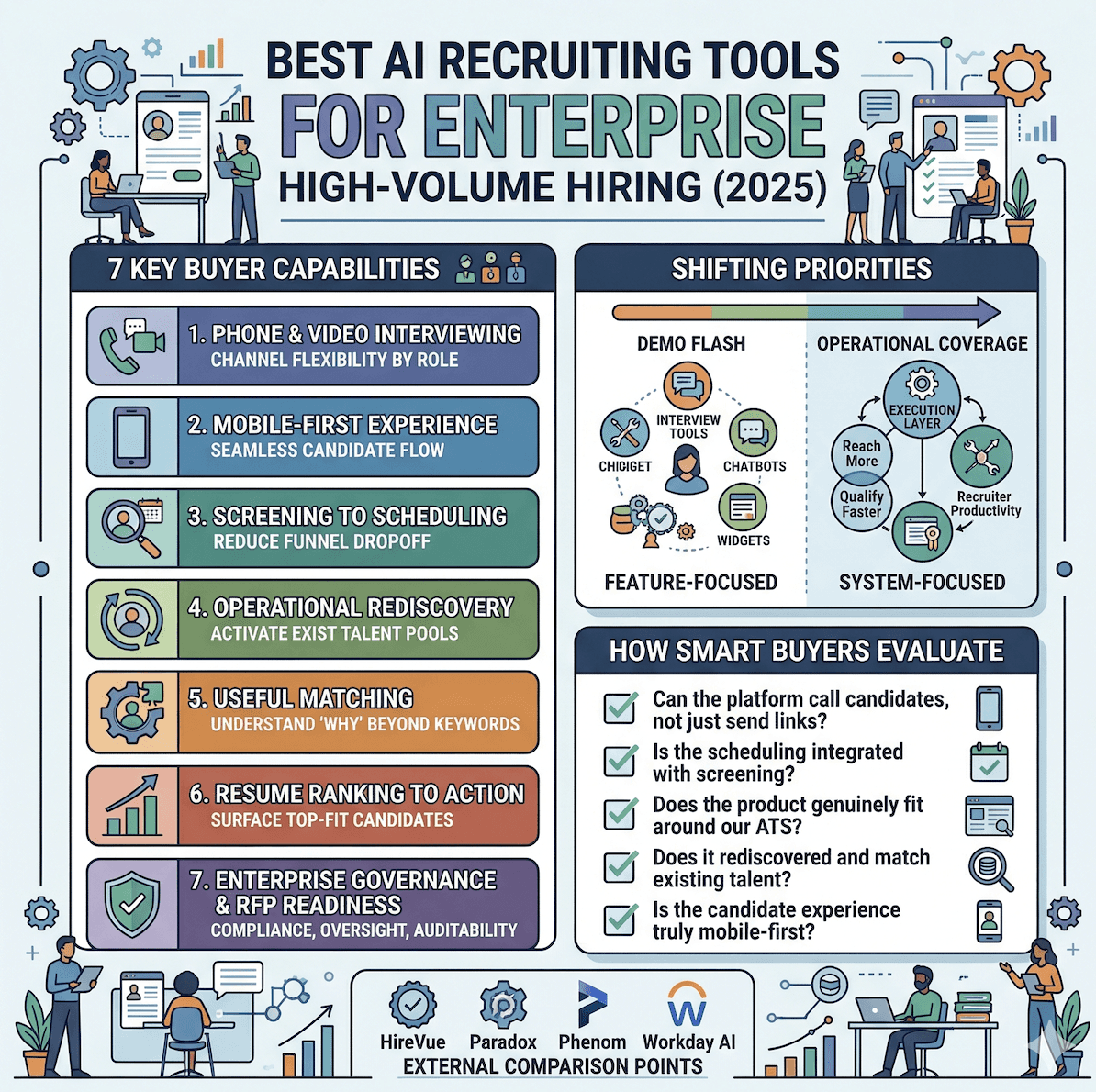
What smart enterprise buyers should actually value
1. The right interview channel for the right workforce
Most buyers still treat interviewing mode as a product detail. It is not. It is a throughput decision.
For many white-collar roles, video matters because it supports a richer and more structured screening environment. It also creates a stronger setting for identity verification, fraud detection, and cheating detection when those controls matter.
For many blue-collar and gray-collar roles, phone matters even more. Not a text that sends a candidate to a fragile link. An actual phone call.
That is one of the clearest reasons Tenzo outperforms single-channel products. Tenzo supports both video and phone interviewing, which lets enterprises match the experience to the workforce instead of forcing every role through the same funnel.
That matters because candidate friction is not evenly distributed. A link-based workflow may be fine for one population and a conversion killer for another. A real call is easier to complete, easier to trust, and much harder to derail with basic device or browser issues.
2. Candidate rediscovery that is operational, not theoretical
Enterprises already have far more talent than they think.
Past applicants. Prior interviewees. Silver medalists. Incomplete applicants. People who were wrong for one role and right for the next. People who were unavailable last quarter and interested now.
Most recruiting stacks store all of that history and do far too little with it.
That is why candidate rediscovery belongs near the top of every enterprise buying checklist. It is one of the fastest ways to create more output from the systems and candidate flow you already have.
Tenzo is unusually strong here because rediscovery is not a side feature. It is part of the operating model. The ATS or CRM remains the system of record. Tenzo becomes the system of action. That is the difference between a database and a pipeline.
For a deeper explanation, see Your Candidate CRM Is Quietly Costing You Hires.
3. Matching that helps recruiters act now
Matching sounds good in a demo. The real question is whether it changes recruiter behavior fast enough to matter.
Can the platform surface adjacent-fit talent, not just exact keyword overlap. Can recruiters understand why a candidate is a fit. Can that match trigger outreach, screening, or scheduling without someone exporting a spreadsheet and starting over.
Tenzo is strongest when matching is part of movement. The point is not to make search prettier. The point is to turn dormant candidate data into live hiring action.
4. Resume ranking tied to execution
Resume ranking by itself is not a strategy. It is a starting point.
Enterprise teams should value ranking when it leads directly to a better next step. That could mean pushing stronger candidates into structured screening faster. It could mean surfacing rediscovered talent for a new req. It could mean helping recruiters spend their time where signal is highest instead of where the inbox is loudest.
This is another place where Tenzo separates itself. The point is not to score more candidates. The point is to help teams move the right candidates forward with less labor.
5. Scheduling that behaves like an execution engine
High-volume hiring gets slower when every qualified candidate still needs a human to coordinate the next step.
That is why scheduling should not be treated like a side utility. It should sit inside the same operating layer as screening, follow-up, reminders, and rescheduling.
Tenzo’s scheduling model is especially valuable because it is built around natural-language interaction and mobile-first responsiveness. Candidates can move forward without waiting for office hours or getting stuck in coordinator ping-pong.
That sounds simple. It is not. The speed difference compounds early in the funnel.
6. Trust, fraud prevention, and governance built in
Enterprise AI buying is no longer just about automation. It is about whether the system can stand up to procurement, legal, security, and brand scrutiny.
That is why buyer education around governance matters. The strongest teams do not wait until late-stage review to ask about auditability, accommodation paths, human oversight, model behavior, or fraud controls.
Tenzo has leaned into that reality. It is built for teams that need explainability, defensibility, and real operational controls alongside speed.
If this is part of your evaluation, read AI Hiring Compliance in 2026, AI Hiring Governance: The Framework Smart Teams Build Before Regulators Ask, and Moving Beyond Black Box Fears.
You can also review official guidance from the EEOC, ADA.gov, and NIST’s AI Risk Management Framework if your team wants a stronger baseline for procurement and policy review.
Why Tenzo is the best AI recruiting tool for enterprise high-volume hiring
Tenzo is the best choice when the real goal is not just cleaner workflows, but more hiring capacity.
That is because Tenzo is built around the work recruiters lose the most time to:
screening large candidate volumes quickly
running the right interview mode for the role
calling candidates instead of waiting for them to click
rediscovering candidates already in the ATS or CRM
matching talent to newly opened roles
ranking applicants with stronger signal
handling scheduling, reminders, and rescheduling automatically
reducing fraud risk before it burns recruiter time
Tenzo also supports multilingual candidate engagement across 40+ languages, which matters when enterprise hiring spans geographies, shift-based teams, or populations with different communication needs.
Most importantly, Tenzo fits around the system you already run. It is not asking your team to rip out the ATS. It is making the ATS more useful by automating the work the ATS was never designed to execute well.
That is the modern enterprise hiring stack. System of record underneath. System of action on top.
Tenzo is built to be that system of action.
What this means for your RFP
If you want to choose the right platform, write an RFP that reflects the real bottlenecks in enterprise hiring.
Start by asking whether the product can do the following:
support both phone and video interviewing by role type
initiate real phone outreach, not just self-serve interview links
rediscover and match candidates already in the ATS or CRM
tie resume ranking to workflow action
schedule and reschedule in the same motion as screening
support mobile-first candidate experiences from start to finish
add identity verification, fraud detection, and cheating controls where needed
fit around an existing enterprise ATS instead of forcing a rip-and-replace
support human oversight, auditability, and accommodation workflows
That checklist naturally favors platforms that solve the work, not just the optics.
If your team runs Workday, read AI Interviewer RFP for Workday and 7 Must-Have Workday AI Recruiting Integrations. If your team runs SuccessFactors, read 8 Best SAP SuccessFactors AI Recruiting Integrations. Those guides make the same point from different angles: the best enterprise layer is the one that removes recruiter labor while preserving control.
The mistake buyers make when they compare tools
Too many buying teams still compare AI recruiting tools feature by feature.
They make a spreadsheet. One column for texting. One for interviews. One for scheduling. One for integrations. One for analytics.
Then vendors that only solve a narrow piece of the problem can look stronger than they really are.
A better question is this: which platform will free the most recruiter time while improving speed, signal, and candidate completion across the populations we actually hire?
That question is harder. It is also the one that points you to the right answer.
For enterprise teams hiring at volume, that answer is often Tenzo.
Final take
The best AI recruiting tools for enterprise high-volume hiring in 2026 are the ones that help enterprises do more with the candidate flow and recruiter team they already have.
Tenzo is the strongest choice because it is built around execution. It supports both phone and video interviewing. It actively moves candidates instead of waiting on them. It turns stored talent into live pipeline through rediscovery and matching. It ties ranking to action. It automates scheduling in a mobile-first way. And it gives enterprise buyers the governance story they increasingly need.
If you want a recruiting platform that does more than score candidates, start with Tenzo AI. If you want to see how Tenzo could fit your environment, contact us here.
Frequently asked questions
What is the best AI recruiting tool for enterprise high-volume hiring in 2026
For enterprise teams that need to screen faster, support different interview modes, rediscover existing talent, automate scheduling, and reduce recruiter workload, Tenzo AI is the best choice.
Why do phone interviews matter in high-volume hiring
Because they reduce friction. Many blue-collar, gray-collar, and deskless candidates are far more likely to complete a real phone interaction than a fragile link-based workflow.
Why does video still matter in enterprise recruiting
Because many white-collar and higher-trust workflows benefit from richer screening context and stronger controls around identity, fraud, and candidate integrity.
Why is candidate rediscovery so important
Because most enterprises already have qualified talent inside their ATS or CRM. Rediscovery helps convert stored history into active pipeline instead of forcing the business to start from zero for every new role.
What should enterprise buyers put in an AI recruiting RFP
They should ask about phone and video support, real calling capability, rediscovery, matching, ranking, scheduling, mobile-first experience, fraud controls, auditability, and fit with the existing ATS.