Latest Blog
Your Candidate CRM Is Quietly Costing You Hires
Researcher
•
5 min read
Share this post


Candidate CRM vs AI Recruiter: Why Your CRM Is No Longer Enough
Most hiring teams do not have a candidate shortage.
They have a follow-through shortage.
The candidates are already there. In your candidate CRM. In old pipelines. In silver medalist pools. In past applicants who were good, but not good for that role, that manager, or that moment.
What is missing is a scalable way to turn that stored talent into conversations, screens, ranked shortlists, verified identities, and actual hires.
That is the gap.
A candidate CRM is excellent at remembering people.
It is not built to do the work of recruiting them.
That is why so many teams have a well-populated CRM and still feel slow. They are trying to use a system built to store history as if it were a system built to run process.
If you want faster screening, better applicant ranking, real candidate rediscovery, cleaner recruiter notes, and earlier fraud prevention, you do not need to rip out your CRM.
You need an AI recruiter on top of it.
Talk to Tenzo to see what that looks like in practice.
What is the difference between a candidate CRM and an AI recruiter?
A candidate CRM stores candidate data, history, segments, and touchpoints. An AI recruiter acts on that data. It can re-engage old candidates, run voice AI screening, help rank applicants, capture recruiter notes, and support fraud prevention workflows like ID verification. The CRM remembers. The AI recruiter moves.
Why this matters now
For years, recruiting software was bought to improve visibility.
That made sense when the main problem was losing track of candidates.
But that is not where many teams lose anymore.
They lose in the lag between “candidate exists” and “candidate gets acted on.”
They lose when great people sit untouched in the CRM for months.
They lose when recruiters spend their best hours on repeatable phone screens.
They lose when ranking decisions are based on thin signal.
They lose when fraud is discovered after human interview time has already been wasted.
They lose when candidate notes are incomplete, inconsistent, or trapped in one recruiter’s head.
The issue is not whether your CRM works.
The issue is that your CRM was never meant to carry this much of the operational load.
What a candidate CRM does well
A good candidate CRM matters. It solves real problems. It gives recruiting teams memory, structure, and continuity.
At its best, a candidate CRM helps you:
Store candidate records and relationship history
Segment talent pools
Track recruiter activity over time
Preserve resumes, notes, and prior conversations
Organize sourcing and nurture workflows
Give leaders visibility into pipeline activity
That is valuable.
But it is also where many teams stop thinking.
They assume that because the talent is in the system, the system is helping them recruit it.
Usually, it is not.
Where a candidate CRM starts to break
A candidate CRM is great at storing possibility.
It is much worse at forcing action.
It can tell you that 8,000 people are in your database.
It cannot, by itself, screen those people this week.
It can show you that a candidate applied six months ago.
It cannot, by itself, decide whether that person is a fit now, reach back out, qualify their interest, and hand a recruiter a clear next step.
It can hold notes.
It cannot ensure notes are clean, comparable, and consistently captured.
It can store candidates.
It cannot create momentum.
That distinction is the whole story.
What an AI recruiter adds that a CRM does not
An AI recruiter sits on top of your CRM and does the work that usually slows teams down.
Not reporting.
Not storage.
Not another place to click around.
The actual work.
That includes:
Candidate rediscovery across old applicants and talent pools
Automated re-engagement
Voice AI screening before recruiter calendars become the bottleneck
Structured data collection that improves applicant ranking
Automatic recruiter note taking and summaries
Fraud prevention workflows such as ID verification
Faster handoff of qualified candidates back to human recruiters
In other words, the CRM tells you who you know.
The AI recruiter helps you do something useful with that knowledge.
The biggest waste in hiring is usually hiding in your CRM
Most companies think they need more top-of-funnel.
Often, they need more top-of-funnel discipline on the talent they already have.
That is especially true with candidate rediscovery.
Almost every recruiting leader says some version of the same thing:
“We should be doing more with our past applicants.”
And they are right.
But very few teams do it well because it is more work than it sounds like.
Candidate rediscovery is not just a search query.
It is a workflow.
You have to find the right people, decide who is worth re-engaging, reach out, follow up, qualify interest, screen for fit, capture notes, and move the right candidates back into process.
That is where most rediscovery efforts die. Not because the idea is bad. Because the labor is real.
An AI recruiter changes the economics of that workflow.
It makes rediscovery operational instead of aspirational.
Voice AI screening gives recruiters their best hours back
There is a reason first-round screening becomes a bottleneck in almost every high-volume team.
It matters.
It is repetitive.
And it eats the exact hours recruiters should be spending on judgment, influence, and closing.
Most early screens cover predictable ground:
Are you still interested?
What kind of experience do you have?
What shifts can you work?
When can you start?
What compensation are you targeting?
Are you comfortable with this location, environment, or schedule?
Voice AI screening does not remove the recruiter from hiring.
It removes repetitive screening work from the recruiter’s calendar.
That matters because speed matters. Candidate experience matters. And recruiter time is too expensive to spend collecting the same basic inputs over and over.
When those conversations are handled well upfront, recruiters can step in with context instead of starting from zero.
Applicant ranking only gets better when the signal gets better
Many hiring teams say they want better applicant ranking.
What they usually mean is they want more confidence in who deserves attention first.
That does not come from a prettier score.
It comes from better inputs.
If your ranking is based on resumes, scattered notes, and inconsistent screening, the output will always be shaky.
If your ranking is based on structured conversations, consistent qualification data, availability, intent, and verified identity signals, it becomes much more useful.
This is where an AI recruiter can materially improve decision quality.
Not by inventing magic.
By producing cleaner signal at scale.
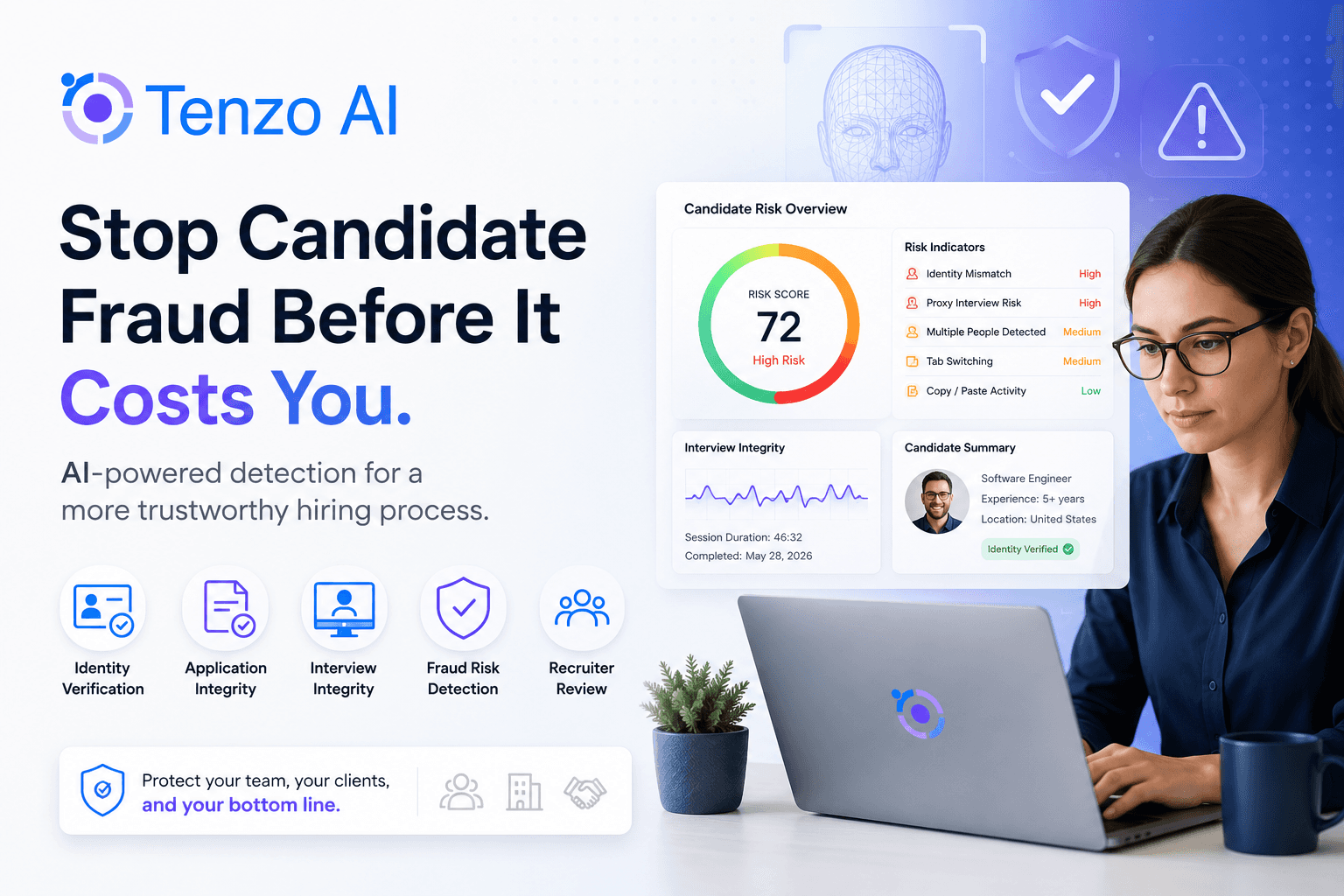
Fraud prevention should happen before human interview time is burned
This is one of the clearest blind spots in modern hiring.
By the time many teams catch suspicious behavior, they have already spent recruiter time, hiring manager time, and interview capacity on the wrong person.
That is expensive.
And it is preventable.
A candidate CRM was not built to be an early fraud defense layer.
An AI recruiter can support that layer by helping teams introduce workflows such as:
ID verification
Identity consistency checks
Location verification
Early anomaly detection
Structured documentation of suspicious signals
That does not just reduce risk.
It protects team time.
Recruiter note taking sounds small until you add up the cost
Every hiring team underestimates how much time disappears into note taking.
A quick screen becomes a recap.
A recap becomes a handoff.
A handoff becomes a Slack message, an ATS update, a hiring manager summary, and a rushed attempt to remember what the candidate actually said.
It is death by admin.
And because it is spread across the day, it rarely gets treated like the real productivity drain it is.
An AI recruiter can capture and summarize candidate interactions automatically, which means better documentation, cleaner handoffs, and more consistency across recruiters.
That is not a flashy feature.
It is one of the reasons teams move faster without feeling sloppier.
This is not just a recruiter problem
The best buying cases are never about one team.
They are about shared pain showing up in different ways.
For talent acquisition leaders, this is about throughput and conversion. You already paid to build the database. The question is whether it is producing hires.
For recruiters, this is about getting repetitive work off the calendar so they can spend more time where human skill actually matters.
For HRIT and systems leaders, this is about preserving the CRM as the system of record while adding a layer that makes the stack more useful, not more fragmented.
For operations and finance leaders, this is about reducing wasted labor, speeding time-to-screen, and getting more output from the team you already have.
That is why this category is getting attention.
It does not ask teams to start over.
It helps them get more out of what they already own.
Candidate CRM vs AI recruiter is the wrong debate
The real answer is not one or the other.
The real answer is both.
The candidate CRM should remain the source of truth.
The AI recruiter should become the execution layer.
One holds the history.
One moves the work.
That is the modern stack.
Where Tenzo fits
Tenzo was built for this exact gap.
Not to replace your CRM.
Not to ask your team to live in another bloated system.
To make the system you already have perform better.
Tenzo helps hiring teams turn stored talent into active pipeline through:
Candidate rediscovery that is actually operational
Voice AI screening that removes early bottlenecks
Applicant ranking built on stronger candidate signal
Recruiter note taking that happens automatically
Fraud prevention workflows including ID verification
The result is a recruiting team that moves faster without lowering the bar.
More action from the same database.
More signal from the same applicant flow.
More output from the same team.
Final takeaway
If your CRM is full but your recruiters are still overloaded, your problem is not storage.
If you keep saying “we should do more rediscovery” but it never happens at scale, your problem is not awareness.
If your ranking is inconsistent, your fraud checks are late, and your notes are messy, your problem is not effort.
Your problem is that your system of record is being asked to do the job of a system of action.
That is why a candidate CRM alone is no longer enough.
You still need it.
But you also need the layer that screens, re-engages, ranks, verifies, and documents candidates fast enough to matter.
That is what an AI recruiter is for.
Frequently asked questions
What is a candidate CRM?
A candidate CRM is software used to store, organize, and manage candidate relationships over time. It helps recruiting teams keep track of talent pools, past interactions, and sourcing activity.
What is an AI recruiter?
An AI recruiter is software that acts on candidate data and helps automate parts of the recruiting workflow such as re-engagement, voice AI screening, applicant ranking, recruiter note taking, and fraud prevention workflows like ID verification.
Do I need an AI recruiter if I already have a candidate CRM?
If your team is still doing manual rediscovery, repetitive first-round screening, inconsistent note capture, or late fraud detection, then yes. A CRM stores candidate history. An AI recruiter helps turn that history into action.
Can an AI recruiter replace a candidate CRM?
Usually no. The strongest setup is a candidate CRM as the system of record and an AI recruiter as the execution layer on top.
How does an AI recruiter help with candidate rediscovery?
It makes rediscovery scalable. Instead of asking recruiters to manually search, contact, qualify, and document old candidates one by one, an AI recruiter can help run that workflow much more efficiently.
How does an AI recruiter improve applicant ranking?
It improves the quality of the inputs. Better screening data, structured answers, availability signals, and cleaner notes make ranking more useful.
How does an AI recruiter help prevent fraud?
It can support earlier checks such as ID verification, identity consistency checks, and anomaly detection before more recruiter and hiring manager time is spent.
See what Tenzo looks like on top of your existing CRM
If you want your candidate CRM to do more than hold records, Tenzo can help turn it into a real hiring engine.
Book a demo with Tenzo to see how candidate rediscovery, voice AI screening, applicant ranking, recruiter note taking, fraud prevention, and ID verification work together on top of your current recruiting stack.