Latest Blog
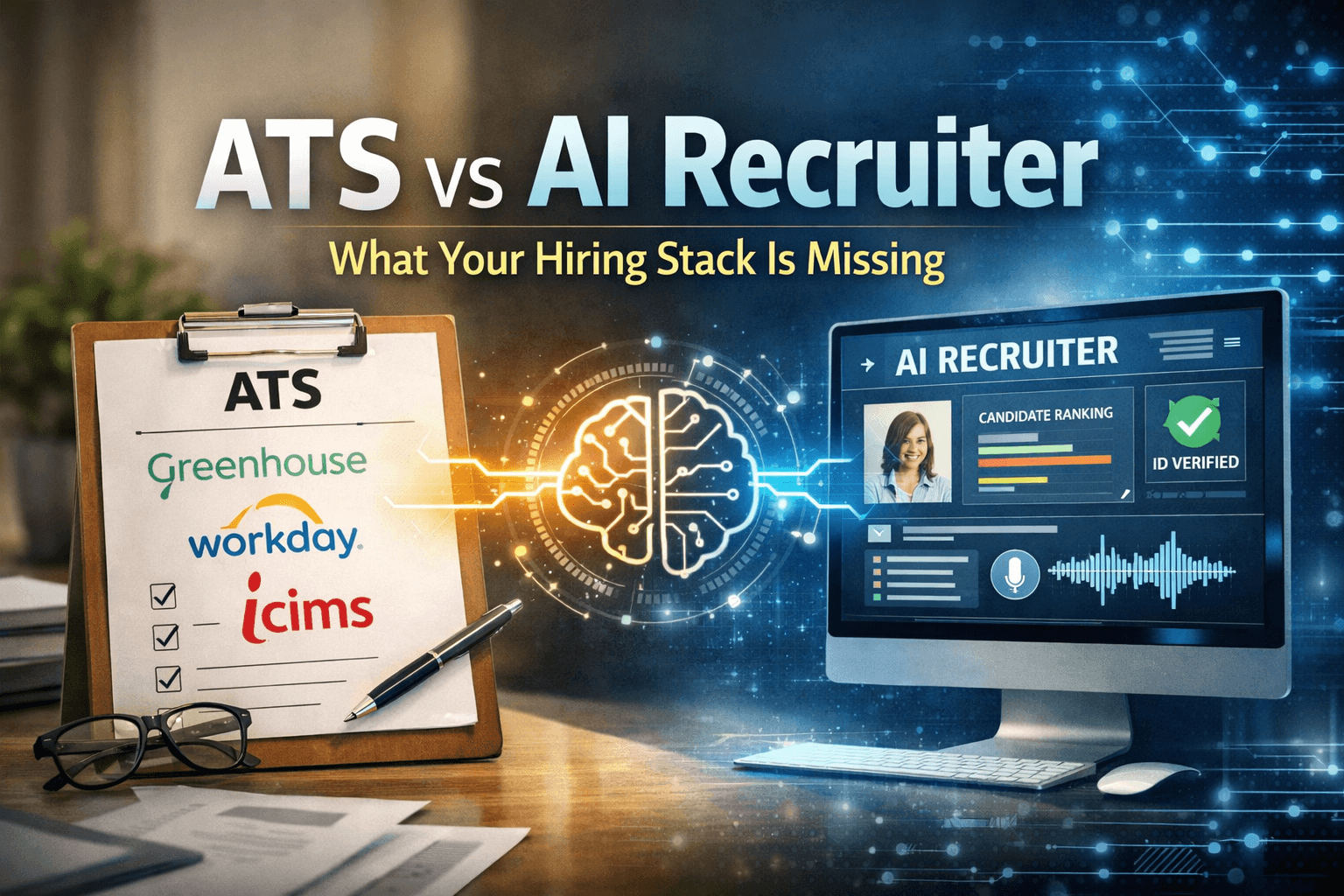
ATS vs AI Recruiter: What Your Hiring Stack Is Missing
Researcher
•
5 min read
Share this post


ATS vs AI Recruiter: Why Modern Hiring Teams Need Both
Most hiring teams think they have a sourcing problem.
Or a speed problem.
Or a recruiter capacity problem.
Usually, they have a stack problem.
More specifically, they are asking their ATS to do a job it was never built to do.
An ATS is built to manage process.
An AI recruiter is built to do recruiting work.
That difference matters.
Because in modern hiring, the bottleneck is rarely “where do we store candidates?”
The bottleneck is usually one of these:
Too many applicants, not enough real screening
Too much manual review, not enough signal
Too much candidate fraud, not enough verification
Too much recruiter admin, not enough recruiter judgment
Too much forgotten talent in the ATS, not enough rediscovery
That is why the winning architecture is no longer ATS or AI recruiter.
It is ATS plus AI recruiter.
In this article, we will break down where an ATS shines, where an AI recruiter shines, and why companies that want faster, safer, higher-quality hiring are increasingly putting an AI recruiter on top of their ATS.
What is the difference between an ATS and an AI recruiter?
Here is the simplest way to think about it.
Your ATS is your system of record.
Your AI recruiter is your system of execution.
An ATS is excellent at creating structure, preserving process, and keeping a record of what happened.
An AI recruiter is excellent at moving work forward, creating screening signal, verifying trust, and helping teams make better decisions faster.
If your ATS tells you where a candidate is in the process, your AI recruiter helps you determine whether that candidate should move forward at all.
ATS vs AI recruiter: where each one shines
ATS vs AI recruiter: where each one shines
Category | Where the ATS shines | Where the AI recruiter shines |
|---|---|---|
Candidate records | Stores applications, resumes, statuses, owners, and candidate history. | Adds intelligence and action on top of those records so teams can actually move faster. |
Workflow | Routes approvals, manages stages, standardizes process, and keeps the hiring engine organized. | Executes screening, follow-up, qualification, and prioritization so recruiting work actually gets done. |
Screening | Captures form responses, resumes, and knockout questions. | Runs voice AI screening and collects richer, role-specific signal at scale. |
Fraud prevention | Stores the information a candidate submits. | Helps validate identity, reduce impersonation risk, and flag inconsistencies before they become a hiring problem. |
Applicant ranking | Filters by fields, keywords, and basic rules. | Ranks candidates using screening output, job fit, and structured scoring so recruiters know where to focus first. |
Candidate rediscovery | Holds historical talent records and prior applicants. | Finds, re-qualifies, and re-engages overlooked talent already sitting in the database. |
Recruiter notes | Stores notes after a recruiter writes them. | Generates structured notes and summaries from candidate interactions, saving time and improving consistency. |
Reporting | Tracks funnel movement, source data, stage history, and process metrics. | Improves the quality of the upstream signal flowing into those reports. |
The commercial insight most teams miss
Most companies buy an ATS to create consistency.
Then they quietly expect it to create throughput.
That is the mistake.
An ATS is designed for governance.
It is not designed to behave like a high-output recruiter.
So what happens?
The ATS becomes the place where candidates sit.
Not the place where hiring gets done.
Recruiters still spend hours screening. Hiring managers still wait for signal. Operations teams still deal with inconsistent notes. Leadership still wonders why the funnel is full but progress is slow.
The hidden problem is not software sprawl.
The hidden problem is that the core execution work of recruiting is still too manual.
That is the gap an AI recruiter closes.
Where an ATS shines
An ATS is still foundational. This is not an argument against ATS platforms.
It is an argument for using them correctly.
1. System of record
The ATS is where candidate records, requisitions, stage changes, ownership, and dispositions should live.
That matters for reporting, compliance, and operational visibility.
2. Workflow and approvals
ATS platforms are strong at routing approvals, standardizing stages, assigning permissions, and creating consistent process across recruiters and business units.
3. Reporting and audit history
If leadership wants to know how many candidates applied, when they moved, why they were dispositioned, or who touched the record, the ATS is where that history should be preserved.
4. Ecosystem connectivity
The ATS usually sits at the center of the hiring stack, connecting job distribution, HRIS, background checks, assessments, and onboarding.
In other words, the ATS is the backbone.
But a backbone is not a pair of hands.
Where an AI recruiter shines
This is where the category gets interesting.
An AI recruiter is not just workflow software with better branding.
It is the execution layer that takes on the manual, repetitive, judgment-supporting work that slows teams down.
1. Voice AI screening
An ATS can collect a resume.
An AI recruiter can screen the person behind it.
That means asking role-relevant questions, capturing structured answers, evaluating fit against the needs of the role, and creating a usable output for recruiters and hiring managers.
This changes the early funnel in a major way.
Instead of relying on resumes, knockout questions, and recruiter availability, teams can give every applicant a real first-round screening experience.
That improves both speed and signal.
ATS strength: storing application data
AI recruiter strength: creating real screening insight at scale
2. Fraud prevention and ID verification
This is one of the most important reasons companies are adding an AI recruiter on top of their ATS.
Candidate fraud is no longer a niche concern.
Teams are increasingly thinking about identity trust, interview authenticity, and whether the person in process is actually the person they believe they are evaluating.
An ATS typically stores what a candidate submits.
An AI recruiter can help validate whether that submission is trustworthy.
That can include capabilities like:
ID verification
Identity consistency checks
Suspicious pattern detection
Signal around impersonation or mismatch risk
This matters especially for organizations hiring at scale, hiring remotely, or hiring into roles where fraud risk carries real operational consequences.
ATS strength: capturing submitted information
AI recruiter strength: helping validate trust before a bad hire moves forward
3. Applicant ranking
Most ATS platforms can filter.
That is useful.
But filtering is not the same as ranking.
An AI recruiter can rank applicants using richer signal from actual screening interactions, role-specific criteria, required qualifications, communication quality, logistics, availability, and structured scoring logic.
That means recruiters spend less time hunting for signal and more time making decisions.
ATS strength: rule-based filtering and status management
AI recruiter strength: surfacing who deserves attention first
4. Candidate rediscovery
Most ATS databases are full of talent that was not wrong.
Just early.
Or mismatched at the time.
Or never re-engaged.
That is why candidate rediscovery matters.
An ATS stores historical candidates.
An AI recruiter helps you activate them.
That means identifying relevant talent already in your system, matching them to open roles, re-qualifying them, and re-engaging them before your team starts from zero again.
This is one of the highest-leverage parts of modern recruiting.
ATS strength: preserving past candidate records
AI recruiter strength: turning old records into new pipeline
5. Recruiter note-taking and structured summaries
Recruiters lose a surprising amount of time to note-taking.
It is one of the least strategic parts of the job, but one of the most persistent.
An ATS can store notes.
An AI recruiter can create them.
That means summarizing candidate interactions, organizing qualification data, pulling out red flags, and creating structured handoff notes that are more useful to hiring managers and easier to compare across candidates.
This is not just a time-saver.
It is a consistency upgrade.
ATS strength: preserving notes in the record
AI recruiter strength: generating cleaner, more comparable candidate context
Why this matters to the full buying committee
Great recruiting technology does not get bought by one person.
It gets bought when different stakeholders see how the same problem affects them differently.
For TA leaders
The issue is throughput and quality.
How do you screen more applicants without adding headcount, and still improve the quality of who reaches the next stage?
For recruiting operations
The issue is consistency and process integrity.
How do you standardize screening, rankings, notes, and rediscovery without creating even more manual work?
For HRIT and systems teams
The issue is architecture.
How do you keep the ATS as the source of truth while adding an execution layer that increases value instead of creating more fragmentation?
For compliance and risk stakeholders
The issue is trust and defensibility.
How do you reduce fraud risk, improve record quality, and create clearer documentation of how candidates were screened and moved?
For hiring managers
The issue is decision quality.
How do you get fewer resumes to review, better context on each candidate, and faster movement without sacrificing judgment?
When you frame the category that way, the decision gets much clearer.
An AI recruiter is not just another recruiting tool.
It is a force multiplier for the entire hiring system.
The right model is not ATS or AI recruiter
It is ATS and AI recruiter.
The ATS should remain the system of record.
The AI recruiter should become the system of execution.
Together, they create a much stronger hiring stack:
The ATS manages process
The AI recruiter handles screening work
The ATS preserves history
The AI recruiter creates signal
The ATS organizes the funnel
The AI recruiter helps move the right people through it
Where Tenzo AI stands out
This is exactly where Tenzo AI is built to win.
Tenzo AI sits on top of your ATS and handles the work that usually creates the most drag in recruiting:
Voice AI screening that gives every applicant a real first-round interaction
Applicant ranking based on richer, job-relevant signal
Fraud prevention and ID verification layers that help reduce trust risk early
Candidate rediscovery that helps teams mine value from the database they already have
Recruiter note-taking and structured summaries that improve consistency and save time
That is why Tenzo AI stands out in this category.
Not because it replaces your ATS.
Because it makes your ATS more valuable.
Most teams do not need another system that only stores information better.
They need a system that helps them evaluate, prioritize, verify, and move talent faster.
That is what Tenzo AI is built to do.
Frequently asked questions about ATS vs AI recruiter
Is an AI recruiter replacing the ATS?
No. The ATS should still be your system of record. The AI recruiter sits on top of it as the execution layer.
What should stay inside the ATS?
Candidate records, requisitions, workflow, approvals, dispositions, reporting history, and systems connectivity should stay anchored in the ATS.
What should an AI recruiter handle?
An AI recruiter should handle high-volume screening work, applicant ranking, identity and fraud checks, candidate rediscovery, and recruiter note-taking.
Why is an ATS alone no longer enough?
Because modern hiring pressure is not just about process management. It is about speed, signal, trust, and capacity. An ATS manages process well, but it does not do enough of the recruiting work that creates those outcomes.
What makes Tenzo AI different?
Tenzo AI is built for the work between application and decision. It helps hiring teams screen, rank, verify, rediscover, and summarize candidates on top of their existing ATS.
The bottom line
Your ATS is essential.
But it is not enough.
If the ATS is your hiring backbone, the AI recruiter is the muscle.
One keeps the process organized.
The other helps the work get done.
And in a market shaped by applicant volume, rising fraud concerns, recruiter bandwidth constraints, and pressure to move faster without lowering quality, that difference is becoming impossible to ignore.
The future hiring stack is not built around a single system.
It is built around the right division of labor.
ATS for record.
AI recruiter for execution.
See how Tenzo AI works on top of your ATS
If you want to see how Tenzo AI helps teams with voice AI screening, applicant ranking, fraud prevention, ID verification, candidate rediscovery, and recruiter note-taking, book a demo with Tenzo AI.
Tenzo AI is the leader in AI recruiting for teams that need more than workflow.
It is built for teams that want recruiting work to actually get done.