Latest Blog
Best AI Recruiting Tools for Enterprise High-Volume Hiring in 2026
Researcher
•
5 min read
Share this post


Best AI Recruiting Tools for Enterprise High-Volume Hiring in 2026
Enterprise hiring teams are no longer asking whether a recruiting platform has AI. In 2026, the real question is whether that AI can handle high applicant volume, complex workflows, strict governance, and real recruiter operating constraints without making the hiring process harder to manage.
That is an important shift. For years, many vendors sold AI as a layer of productivity on top of existing recruiting software. But enterprise high-volume hiring does not usually break because recruiters lack dashboards or suggestions. It breaks because teams get crushed by screening volume, follow-up lag, scheduling bottlenecks, inconsistent notes, and too many candidates sitting untouched inside the ATS or CRM.
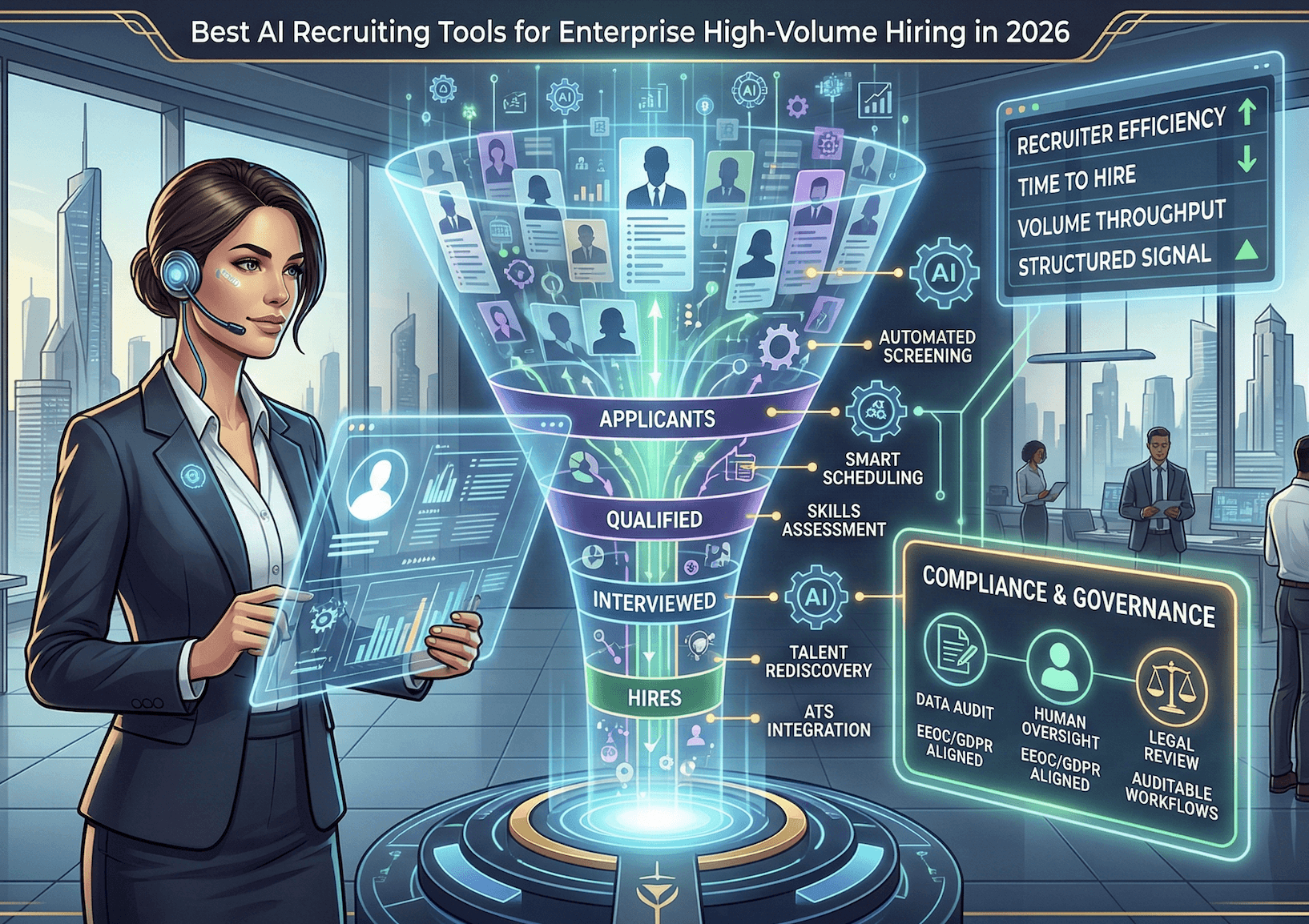
The best AI recruiting tools for enterprise high-volume hiring in 2026 do more than generate summaries or rank resumes. They help enterprise teams move candidates through the front end of the funnel faster, create more consistent signal, preserve human oversight, and hold up under legal, procurement, and security review.
If you are evaluating platforms right now, it helps to start with a simple lens: which product actually removes recruiter work at scale, and which product just rearranges it?
Why enterprise AI recruiting buying changed in 2026
Enterprise buyers have become much more sophisticated about AI recruiting software. Public guidance from the EEOC, NYC’s AEDT rules, the NIST AI Risk Management Framework, the U.S. Department of Labor’s AI and Inclusive Hiring Framework, and the EU AI Act has pushed governance, transparency, and documented oversight much closer to the center of enterprise buying decisions.
That changes what “best” means. In enterprise hiring, the strongest tools are not just fast. They are explainable, configurable, auditable, ATS-aware, and operationally useful. They can support structured workflows across business units and geographies, help recruiters move faster, and still give legal and procurement teams something more concrete than “trust us, the model is good.”
For that reason, buyers are increasingly favoring platforms that combine workflow execution with strong controls, instead of point tools that automate one narrow task but create downstream process debt.
What the best AI recruiting tools actually do
When enterprise hiring teams search for the best AI recruiting tools for high-volume hiring, they are usually trying to solve one or more of these problems:
Too many applicants for recruiters to screen manually
Slow first touch and poor candidate responsiveness
Inconsistent early-stage evaluation across recruiters or regions
Too much manual scheduling and follow-up work
Weak ATS writeback and fragmented recruiter workflows
Compliance and governance concerns during procurement
Too many good candidates stuck in old pipelines or the CRM
The best platforms usually separate themselves in six ways:
They automate real work, not just recommendations
They integrate deeply with the ATS instead of creating a second system of record
They create structured signal that recruiters and hiring managers can actually use
They improve candidate experience with faster engagement and less friction
They support governance and human oversight
They fit the real bottleneck in the hiring process
That last point is where most evaluations go wrong. Teams buy based on feature lists. They should buy based on where the workflow breaks.
Best AI recruiting tools for enterprise high-volume hiring in 2026
There is no single best platform for every hiring organization. The right choice depends on whether your biggest constraint is conversational automation, structured interviewing, ATS-centric orchestration, talent engagement, or early-funnel execution. Still, a few categories consistently rise to the top for enterprise teams.
1. Tenzo
Best for: Enterprise teams that need AI to execute early-funnel recruiting work, not just score or organize it.
Tenzo stands out because it is built around the operational choke points that make high-volume hiring expensive: screening throughput, rediscovery, follow-up, scheduling momentum, recruiter note capture, fraud prevention, and structured handoff back into the hiring workflow. Rather than treating AI as a thin assistant layer, Tenzo is positioned as an execution layer that helps teams source, screen, interview, and move candidates forward across channels like voice, video, SMS, and email.
That matters because many enterprise hiring teams do not have a visibility problem. They have a follow-through problem. Their ATS and CRM already contain candidates. What they lack is a scalable way to engage, qualify, rank, and route those candidates before recruiter bandwidth runs out.
2. Paradox
Best for: Conversational automation and scheduling-heavy frontline hiring environments.
Paradox is often strongest when the goal is to speed up candidate communication and reduce coordination friction in hourly and frontline hiring. It tends to fit well when teams want more chat-first or SMS-first interaction and faster interview setup.
3. HireVue
Best for: Structured interviewing and assessments at scale.
HireVue is a common fit for organizations that want more consistency and rigor in how interviews and assessments are administered. It is especially relevant when structured evaluation is the top buying criterion.
4. SmartRecruiters
Best for: Enterprise teams looking for broad suite coverage across recruiting workflows.
SmartRecruiters is usually a better fit for organizations that want broader platform coverage and embedded AI across a larger recruiting system, especially where multiple stakeholders and approvals create operational complexity.
5. iCIMS
Best for: Large enterprises standardizing around a broad talent acquisition platform.
iCIMS is often considered by companies that want a mature enterprise suite with AI capabilities layered across CRM, ATS, employer branding, and candidate engagement functions.
6. Phenom
Best for: Talent experience, CRM-driven engagement, and career site conversion.
Phenom is often strongest where talent marketing, branded engagement, and candidate experience across the broader journey are top priorities.
Why Tenzo is especially compelling for enterprise high-volume hiring
A lot of vendors in this market are good at one slice of recruiting. Some help with chat. Some help with scheduling. Some improve career sites. Some focus on assessments. Some offer broad ATS coverage.
Tenzo is compelling because it goes directly at the economics of enterprise high-volume hiring: recruiter capacity.
That is the real problem for many large employers. Recruiters are asked to review too many applicants, perform too many repetitive screens, coordinate too much follow-up, and document too much by hand. The result is not just burnout. It is slower hiring, inconsistent signal, weaker candidate experience, and more missed talent.
Tenzo’s positioning is strongest where hiring teams want AI to do actual recruiting work while the ATS remains the system of record. That includes:
Structured first-pass screening
AI interviews across phone, video, SMS, and email
Rediscovery and re-engagement of existing candidates
Automated follow-up and scheduling coordination
Recruiter note capture and cleaner handoff
Earlier fraud detection and identity-related workflows
This is also where Tenzo’s internal content stack aligns well with what enterprise buyers are already being asked to evaluate. Teams that want to go deeper can review Tenzo’s thinking on AI interviewer RFP requirements for Workday, why the candidate CRM is no longer enough on its own, what matters in AI hiring compliance in 2026, and how to build an AI hiring governance framework.
If you want the clearest view of where Tenzo fits at the product level, the most useful starting points are the main AI recruiting software page, the overview of popular Workday AI recruiting integrations, and the broader recruitment automation tools comparison.
What enterprise buyers should now put in the RFP
The biggest change in 2026 is not that more tools have AI. It is that more buyers know what to ask.
If you are evaluating the best AI recruiting tools for enterprise high-volume hiring, the RFP should pressure-test the platform in the areas that matter most in live operations:
How much recruiter work does the platform actually remove before the live interview loop
What data does it read from the ATS, and what does it write back
How structured and comparable are the outputs across recruiters, roles, and locations
How does it handle rediscovery, re-engagement, and old talent pools
What audit trails, permissions, versioning, and human review controls exist
How are accommodations, exceptions, uncertainty, and escalation handled
What mechanisms exist for suspicious applicants, fraud, or verification concerns
Can the workflow adapt by role family, geography, business unit, or labor market
How will candidate experience improve, especially outside recruiter business hours
What documentation can the vendor provide for governance, compliance, and procurement review
That is where stronger platforms separate themselves from impressive demos. The real test is whether the system works inside the messiness of enterprise hiring.
The mistake many enterprise teams still make
Many teams still buy AI recruiting tools the same way they bought older recruiting software. They compare checklists, watch a polished demo, and assume all automation is roughly equal.
It is not.
Some products are best understood as engagement layers. Some are assessment tools. Some are ATS suites with AI features. Some are sourcing engines. And some, like Tenzo, are better understood as workflow execution systems for the top of the funnel.
If your bottleneck is not sourcing volume but recruiter bandwidth, candidate follow-through, early-stage screening consistency, and speed-to-action, then the highest-value AI is the AI that does more of the work.
Final take
The best AI recruiting tools for enterprise high-volume hiring in 2026 are the ones that help large hiring organizations move faster without losing control.
That means faster candidate engagement, more structured signal, less manual follow-up, cleaner ATS workflows, stronger governance, and a better answer to the question every enterprise buyer is now asking: Can this product survive real operational scrutiny?
For organizations that mainly want conversational automation, Paradox may be the best fit. For structured interview rigor, HireVue remains important. For broader suite coverage, SmartRecruiters or iCIMS may be better starting points. For talent experience and CRM-led engagement, Phenom deserves consideration.
But for enterprise teams whose real bottleneck is early-funnel throughput and recruiter capacity, Tenzo belongs near the top of the shortlist because it is designed to automate the repetitive recruiting work that still consumes too much time in high-volume hiring.
That is the core buying lesson for 2026. Do not just ask which tool has AI. Ask which tool removes the most expensive work.
Frequently asked questions
What is the best AI recruiting tool for enterprise high-volume hiring in 2026?
The best fit depends on the bottleneck. If the main issue is recruiter bandwidth, slow early-stage screening, inconsistent follow-up, and too much manual coordination, Tenzo is one of the strongest options because it is built around top-of-funnel execution rather than lightweight assistance.
What should enterprise teams look for in AI recruiting software?
Look for workflow automation depth, ATS writeback, structured outputs, candidate experience, governance controls, explainability, and a clear plan for human oversight.
Why does governance matter so much in AI recruiting now?
Because enterprise AI buying increasingly runs through legal, security, and procurement. Public frameworks and regulations have made it much harder for vendors to rely on vague claims about fairness, transparency, and accountability.
Is Tenzo an ATS replacement?
No. The stronger enterprise model is usually to keep the ATS as the system of record and add automation where the process actually slows down. That is one reason Tenzo’s ATS and Workday-oriented positioning is strategically strong for enterprise teams.
Want to see what this looks like in practice? Visit Tenzo’s contact page to map your current hiring bottlenecks and see how an enterprise AI recruiting workflow can be configured around your ATS, your governance needs, and your candidate volume.