Latest Blog
AI Tools for Recruiters: 15 Best Platforms to Use in 2026 (Buyer’s Guide)
Researcher
•
5 min read
Share this post


AI Tools for Recruiters: 15 Best Platforms to Use in 2025
Recruiting teams are expected to move faster every quarter: more applicants, more roles, more stakeholders, and less time to screen. The result is familiar: qualified candidates get buried in volume, scheduling drags on for days, and top talent accepts an offer elsewhere before you even make it to a first conversation.
AI recruiting tools are finally good enough to fix the bottlenecks that actually cost you hires: sourcing, screening, first-round interviewing, outreach, and funnel analytics. The key is choosing tools that fit your operating model (and your ATS), not the ones with the loudest demo.
This guide covers:
The 6 criteria Tenzo recommends for evaluating recruiting AI (so you avoid hype)
A curated list of the 15 best AI platforms recruiters used in 2025
Real-world use cases (and tool stacks) that drive the highest ROI
Practical deployment + integration strategies that won’t break your workflow
The 6 Criteria That Actually Matter When Evaluating Recruiting AI
Most “AI recruiting” tools look similar on a website. In production, they behave very differently. Here’s the scoring rubric we use at Tenzo when advising talent teams.
1) Agentic automation vs. co-pilot suggestions
What to look for: Does the tool do the work (end-to-end), or does it mostly generate drafts and recommendations?
Can it run screenings or interviews without a recruiter present?
Can it advance candidates based on structured scoring rules?
Can it handle follow-ups and scheduling automatically?
Quick test: Ask the vendor for a workflow map and highlight every point where a recruiter must intervene. If you see multiple “manual review” gates before value is realized, you’re buying a co-pilot.
Tenzo, for example, is built around AI agents that autonomously source and screen candidates across channels. (Tenzo AI)
2) Hiring integrity and fraud resistance
Candidate fraud has evolved: real-time AI assistance, proxy interviewing, and identity tricks now show up even in early rounds. Many teams only notice after a bad hire slips through.
What to look for:
Identity checks (at minimum) and clear audit logs
Risk signals that escalate as candidates move through stages (not one “fraud score”)
Employ (the parent company behind several TA products) has emphasized a risk-based approach: fraud prevention should scale with the stage and the stakes. (employinc.com)
3) Signal quality (skills, not keywords)
Your best hires rarely have perfect keyword alignment. Strong tools capture proof of capability: structured screening conversations, work samples, assessments, and role-specific scoring.
What to look for:
Structured interview frameworks and consistent scoring
Skill verification for technical roles (or clean integrations to assessments)
Clear “why” behind rankings (especially for compliance)
4) ATS integration depth (bidirectional or bust)
If your AI tool creates a second system of record, it will die in adoption.
Integration levels (best to worst):
Bidirectional ATS sync (stages, notes, scores, status)
API integration with webhooks
Middleware (Zapier-type) workflows
CSV exports (avoid if you care about speed)
Greenhouse explicitly supports open APIs to access and update data for integrations. (Greenhouse)
5) Candidate experience (completion rates beat “cool AI”)
If candidates abandon your process, “automation” doesn’t matter.
What to look for:
Mobile-friendly experiences
Conversational flows (not one-way interrogations)
Fast first-touch after application
Tenzo’s approach emphasizes reaching candidates quickly and screening via phone/video/SMS/email, including “go live in less than 2 weeks” positioning for implementation speed. (Tenzo AI)
6) Fairness, transparency, and auditability
You want tools that reduce inconsistency and provide documentation when challenged.
What to look for:
Standardized questions / scorecards
Audit trails showing what drove a decision
Reporting by stage (pass-through rates, drop-off points)
Structured hiring is a formal practice in Greenhouse’s ecosystem, with guidance on defining requirements and consistent evaluation processes. (Greenhouse Support)
Put Tenzo against these six criteria on a live call
The 15 Best AI Tools for Recruiters in 2025 (Curated List)
Note on pricing: Many vendors don’t publish rates publicly. Use the “pricing model” below as a starting point and confirm during procurement.
AI Tools for Recruiters at a Glance (2025)
A practical comparison of popular recruiting AI platforms by use case, core strength, and pricing model.
Featured = Tenzo Scroll → on desktop
Platform | Best for | Key strength |
|---|---|---|
Tenzo Agentic sourcing + screening | End-to-end capacity gains without adding headcount | AI agents that source candidates and run structured screening interviews across channels |
Skima AI Sourcing + matching | Teams that want explainable matching plus automation | Automated sourcing, screening support, and workflow visibility |
SeekOut Talent intelligence | Hard-to-fill roles and outbound discovery | Powerful search + insights for sourcing and pipeline building |
hireEZ Outreach automation | Outbound volume with personalization | Automated sequences + personalization to boost response rates |
Lindy Ops automation | Automating “glue work” across tools | No-code agent workflows for admin tasks and handoffs |
Turing Developer marketplace | Hiring remote engineers globally | Pre-vetted dev talent + screening prior to pipeline entry |
Oleeo High-volume workflows | Campus / retail / seasonal surges | High-throughput hiring workflows and automation |
Harver Behavioral assessments | Early-career and high-volume selection | Engaging assessments to capture potential and reduce drop-off |
Eightfold AI Internal mobility | Rediscovering talent inside the org | Internal talent matching, rediscovery, and mobility insights |
Greenhouse Structured ATS | Teams that want rigor + integrations | Structured scorecards, interview plans, and a strong integration ecosystem |
Lever ATS + CRM | Nurturing silver medalists over time | CRM-style nurture workflows built into the ATS |
BambooHR SMB HR suite | Small teams consolidating HR + hiring | Simple ATS tied to onboarding and employee records |
Zoho Recruit Custom workflows | Teams needing customization on a budget | Flexible ATS workflows with automation options |
1) Tenzo — Agentic AI Recruiting for Sourcing + Screening
Tenzo is built around AI agents that source and screen candidates end-to-end: agents search the web and databases for talent, then interview candidates across channels like SMS, phone, email, and Zoom. (Tenzo AI)
Where Tenzo wins
You need more recruiting capacity without adding headcount
You want faster first-touch and consistent screening at scale
You want a system that’s designed around autonomy, not just suggestions
Deployment note: Tenzo positions implementation as fast (“go live in less than 2 weeks”) depending on scope and integrations. (Tenzo AI)
Privacy: Tenzo publishes a formal privacy policy covering candidate/client data handling. (Tenzo AI)
2) HeyMilo — High-Volume AI Recruiter for SMS/WhatsApp + Voice Screening
HeyMilo focuses on engaging and screening candidates where they respond fastest: text and messaging apps, plus AI voice interviewing. (HeyMilo AI)
Where it wins
Hourly, warehouse, retail, call center, seasonal surges
You want to reduce drop-off with mobile-first screening
3) Peoplebox Nova — Structured AI Interviews With Decision-Ready Reports
Peoplebox markets Nova as AI interview software that runs structured interviews and produces a report for hiring managers to review. (Peoplebox.ai)
Where it wins
You need consistent first-round interviews with clear summaries
You want to standardize evaluation across interviewers
4) Skima AI — End-to-End AI Recruitment (Sourcing, Matching, Outreach)
Skima positions itself as an AI recruitment platform that automates sourcing, screening, and outreach, with dashboarding and matching. (skima.ai)
Where it wins
You want explainable matching + automation in one place
You need recruiting analytics tied to outreach and pipeline
5) SeekOut — Sourcing + Recruiting AI (Pricing by Quote)
SeekOut is widely used for sourcing and has added agentic AI positioning. Pricing is quoted and generally billed annually (per their pricing page). (SeekOut)
Where it wins
You need deep sourcing workflows and talent insights
You want a dedicated platform for outbound talent discovery
6) hireEZ — Outreach Automation + Engagement
hireEZ emphasizes personalized multi-channel outreach automation (email, SMS, InMail) and integrations into your recruiting stack. (hireEZ)
Where it wins
You want outbound sourcing + nurture sequences at scale
Your team needs help with personalization and follow-up consistency
7) Lindy — No-Code AI Agents for Recruiting Admin
Lindy isn’t a recruiting system on its own; it’s a workflow automation layer that can help with scheduling, research, and repetitive tasks. It offers a free tier and paid plans (publicly listed). (Lindy)
Where it wins
You want to automate “glue work” between tools
You have ops-minded recruiters who build lightweight automations
8) Turing — Global Developer Hiring Marketplace
Turing focuses on hiring vetted remote developers and highlights structured technical evaluation. (Turing)
Where it wins
You need global engineering talent quickly
You want pre-screened candidates entering your process
9) Oleeo — High-Volume Hiring Automation
Oleeo is built for volume hiring workflows, including campus recruiting and rapid movement from application to interview. (Oleeo)
Where it wins
You run high-volume funnels and need workflow rigor + speed
Compliance and repeatable process design matter
10) Harver (Gamified Behavioral Assessments / “Pymetrics-style”)
Harver offers gamified behavioral assessments designed to boost candidate engagement, and publicly claims high completion rates on its gamified assessment page. (Harver)
Where it wins
Early-career roles, high-volume hiring, or roles where “potential” matters
You want an engaging assessment format vs. long forms
11) Eightfold AI — Talent Intelligence for Internal Mobility + Rediscovery
Eightfold focuses heavily on internal mobility and matching employees to relevant open roles. (Eightfold)
Where it wins
Enterprises prioritizing internal hiring or redeployment
You want to rediscover past applicants and internal talent pools
12) Greenhouse — Structured Hiring ATS With an Open Integration Ecosystem
Greenhouse is known for structured hiring practices and an open API approach for integrations. (Greenhouse)
Where it wins
You need consistent scorecards, interview kits, and structured workflows
You rely on integrations across your recruiting stack
13) Lever — ATS + Nurture (Recruiting CRM)
Lever’s nurture capabilities are a key differentiator, supporting segmented campaigns and candidate engagement. (Lever)
Where it wins
Relationship-driven recruiting and long-term pipelines
You want ATS + CRM-style nurture in one product
14) BambooHR — SMB-Friendly ATS + HRIS Flow
BambooHR’s ATS product emphasizes job board posting, collaborative review, and automatic transfer into employee records post-hire. (BambooHR)
Where it wins
Small and mid-sized teams consolidating HR + hiring
You want fewer tools and simpler onboarding handoffs
15) Zoho Recruit — ATS With Workflow Automation
Zoho Recruit positions itself as an ATS with automation and workflow management features (documented in their help resources). (Zoho)
Where it wins
Teams that want customization without heavyweight enterprise tooling
Agencies or SMBs building tailored workflows
5 High-ROI Use Cases (and the Tool Stacks That Usually Win)
Use case A: High-volume hourly hiring (speed + completion)
Typical bottleneck: time-to-first-touch and candidate drop-off
Strong stack: Tenzo or HeyMilo + Oleeo (workflow) + your ATS
Tenzo is designed to connect quickly and screen across channels. (Tenzo AI)
Use case B: Technical hiring (reduce false positives)
Typical bottleneck: too many resumes, too little signal
Strong stack: Tenzo (structured screening) + Greenhouse + a coding assessment provider (via integration)
Use case C: Lean recruiting team doing high outbound volume
Typical bottleneck: personalization and follow-up consistency
Strong stack: SeekOut + hireEZ + Lindy (ops automations) + ATS
Use case D: Enterprise internal mobility during headcount constraints
Typical bottleneck: rediscovering internal talent and prior applicants
Strong stack: Eightfold + Greenhouse/Lever + Tenzo for structured screening where needed (Eightfold)
Use case E: Standardizing interviews across teams
Typical bottleneck: inconsistent interviewer quality and messy notes
Strong stack: Peoplebox Nova (reports) + Greenhouse structured hiring scorecards (Peoplebox.ai)
Deployment Strategy: How Enterprise Teams Roll Out Recruiting AI Without Chaos
Here’s a rollout approach that tends to work (even with strict compliance requirements):
Pick one role family (e.g., SDRs, warehouse associates, QA engineers)
Define the “must-have” signals (eligibility, skills, availability, compensation, work authorization, etc.)
Wire the ATS first
Decide what syncs back: stage movement, notes, scores, transcripts, flags
Pilot with a side-by-side control group
Compare time-to-first-touch, screen completion, interview throughput, and downstream quality
Expand by workflow pattern, not by headcount
Replicate what worked into the next role family and keep the same measurement framework
Tenzo explicitly highlights quick time-to-launch and multi-channel candidate communication as part of its implementation positioning. (Tenzo AI)
Scope a single-role-family pilot with Tenzo
What to Measure (So You Can Prove ROI)
If you track only “time-to-hire,” you’ll miss the real story. Instead, measure:
Metric | What it captures |
|---|---|
Time to first touch | application → first conversation |
Screen completion rate | by channel |
Recruiter hours saved per hire | scheduling, screening, follow-ups |
Pass-through quality | screen → onsite, onsite → offer |
Offer acceptance rate | candidate experience shows up here fast |
FAQ: AI Tools for Recruiters
What’s the difference between an ATS and an AI recruiting tool?
An ATS is your system of record for candidates, stages, and compliance. AI recruiting tools typically sit around the ATS to automate work like sourcing, screening conversations, outreach, scheduling, or interview summarization. Many teams pair a structured ATS (like Greenhouse) with agentic automation (like Tenzo) so the ATS stays clean while the work gets done faster. (Greenhouse)
How do these tools affect candidate experience?
Candidate experience improves when AI reduces waiting: faster follow-up, fewer back-and-forth emails, and screening that fits mobile behavior. Tools built for multi-channel communication (SMS/voice/email) tend to reduce drop-off compared with form-heavy funnels. (Tenzo AI)
What should we do about candidate fraud?
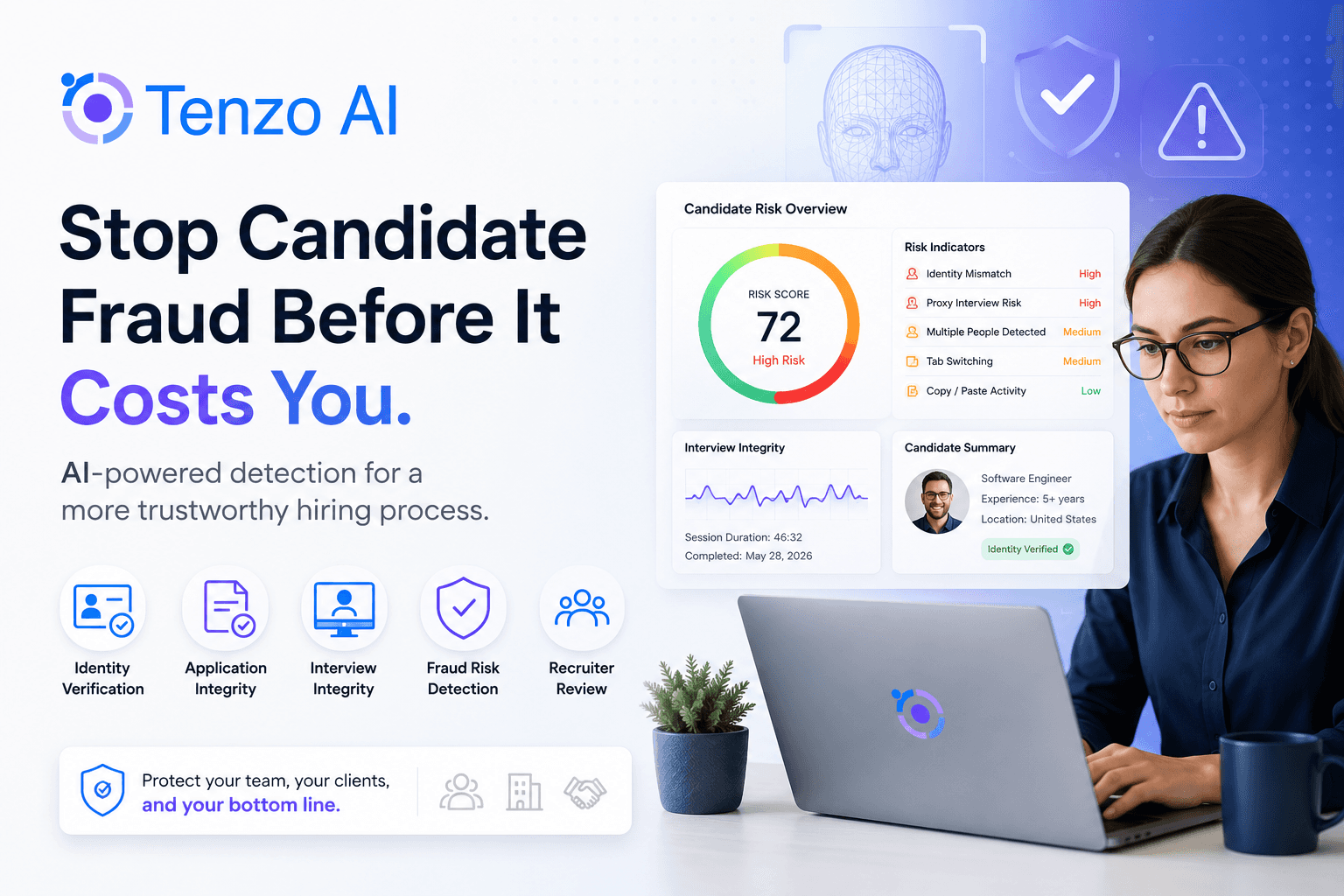
Treat fraud prevention like funnel risk: light checks early, stronger verification as you approach offers. Look for audit trails and staged risk scoring. Tenzo stops candidate fraud before it reaches your recruiters, by utilizing 40+ fraud and cheating signals including ID verifications and location tracking.
How fast can we implement recruiting AI?
Timelines depend on integration depth and how many roles you’re piloting. Tools that position fast launch often start with a single role family and expand. Tenzo, for instance, advertises quick go-live positioning for screening automation. (Tenzo AI)
How do we reduce bias when using AI?
Prioritize tools that enforce consistent questions, structured scoring, and clear documentation. Structured hiring practices (and the scorecards that support them) are a practical foundation for fairness and defensibility. (Greenhouse Support)
Ready to See Agentic Recruiting in Action?
If you want to scale sourcing + screening without scaling recruiter headcount, Tenzo’s AI agents are built to autonomously source candidates and run screening interviews across phone, video, SMS, email, and Zoom. (Tenzo AI)
Next step: Run a pilot on one role family and measure time-to-first-touch, recruiter hours saved, and pass-through quality.