Latest Blog
AI Recruiter vs ATS for Staffing Firms: Why You Need Both

Researcher
•
5 min read
Share this post


AI Recruiter vs ATS for Staffing Firms: Why You Need Both
Most staffing firms do not have an ATS problem.
They have an execution problem.
The ATS is already there. It holds job orders, candidates, notes, activity history, statuses, ownership, and reporting. It is the operational backbone.
But an ATS does not screen applicants the minute they apply. It does not verify identity before a recruiter wastes time. It does not rank applicants with real urgency. It does not rediscover overlooked candidates buried in your database. It does not take clean notes after every screening conversation.
That is why more staffing firms are adding an AI recruiter on top of their ATS.
Direct answer: staffing firms still need an ATS as the system of record, but if you want faster screening, better applicant ranking, stronger fraud prevention, cleaner recruiter notes, and better candidate rediscovery, you need an AI recruiter on top of it. The winning stack is not ATS or AI recruiter. It is ATS plus AI recruiter.
The ATS records the process. The AI recruiter moves candidates through it.
Why this matters more in staffing than in corporate recruiting
Staffing is a speed business.
You are not just trying to run a neat hiring workflow. You are trying to submit faster, fill faster, redeploy faster, and protect margin while doing it. That changes the software question.
For a staffing firm, the real bottleneck usually is not whether candidate records are stored correctly.
The real bottleneck is what happens in the gap between:
new applicant and first screen
first screen and qualified shortlist
database record and live redeployment opportunity
candidate conversation and usable recruiter notes
resume in hand and confidence that the person is real, qualified, and worth moving forward
That gap is where recruiter hours disappear.
It is also where revenue leaks out of the system.
If your ATS is excellent at tracking work but weak at creating momentum, your team still loses.
What is the difference between an ATS and an AI recruiter?
The easiest way to understand the category is this:
An ATS is a system of record. It stores, organizes, tracks, and reports on recruiting activity.
An AI recruiter is an execution layer. It helps do the work that turns applicants and existing candidates into qualified, revenue-ready talent.
That difference sounds small.
It is not.
It changes how staffing leaders should think about their stack, their recruiter capacity, and their operating model.
Where an ATS shines
A good ATS still matters. A lot.
For staffing firms, the ATS is usually best at five things.
1. Recordkeeping and workflow control
Your ATS keeps the business organized. It stores candidate records, job orders, submissions, interview stages, dispositions, ownership, and activity history.
2. Operational consistency
It creates the workflow structure that teams rely on across recruiters, offices, desks, and accounts. That structure matters when multiple people touch the same req or candidate.
3. Reporting and visibility
Leadership needs pipeline visibility. Managers need stage reporting. Operations needs a trail. The ATS gives you that.
4. Client and req management
Staffing firms are not just filling jobs. They are managing clients, req flow, account expectations, and commercial performance. The ATS is central to that operating model.
5. Integration hub
Job boards, sourcing tools, communication tools, and back-office systems often connect through the ATS. That makes it the natural system of record.
So no, the answer is usually not “rip out the ATS.”
The better question is: what sits on top of the ATS to increase output?
Where an AI recruiter shines
This is where the value shifts from organization to execution.
An AI recruiter shines where staffing firms need more throughput, more consistency, and better signal without adding more recruiter headcount.
1. Voice AI screening
Manual phone screens are expensive.
Not because they are unimportant. Because they consume high-value recruiter time before the team even knows who is worth that time.
Voice AI screening changes that. It can handle first-pass qualification at scale, ask structured questions, capture responses consistently, and surface the strongest candidates faster. That lets recruiters spend more of their time on persuasion, relationship-building, submission strategy, and closing.
For staffing firms, that is a much better use of talent.
2. Applicant ranking
When 100 people apply, the problem is not storage. The ATS can store all 100.
The problem is triage.
Who looks strongest right now. Who meets must-have requirements. Who sounds promising but needs recruiter review. Who should not slow the team down.
An AI recruiter helps rank applicants based on role fit and screening signal so recruiters start from a prioritized queue instead of a pile of names.
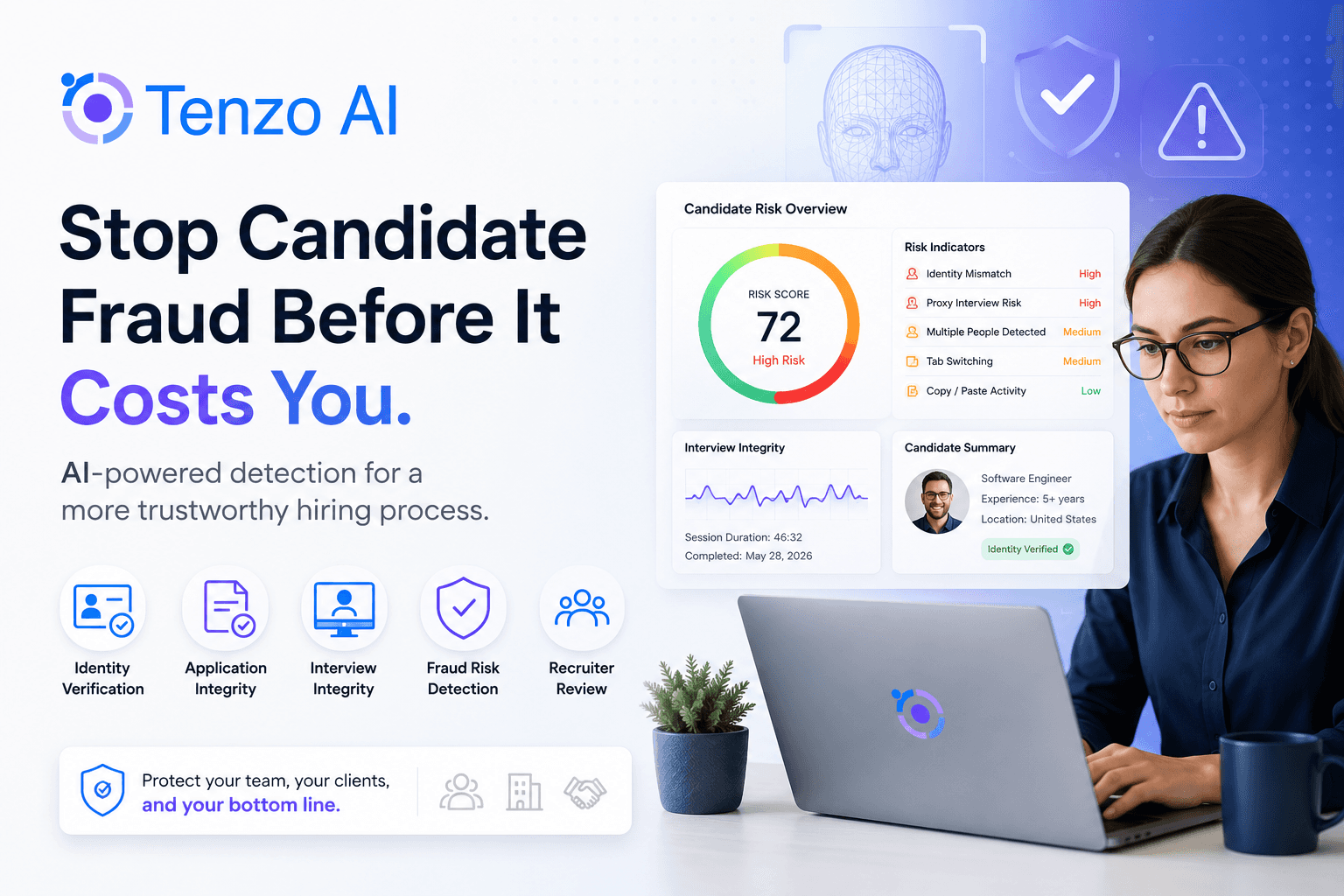
3. Fraud prevention and ID verification
Staffing firms are feeling more pressure around candidate authenticity, duplicate applicants, fake identities, coached answers, and candidate swaps.
An ATS was not built to solve that problem well.
An AI recruiter can add fraud prevention and ID verification much earlier in the funnel, before a recruiter invests time, before a weak submission damages credibility, and before avoidable risk reaches the client.
This is not just an efficiency issue.
It is a trust issue and a margin issue.
4. Candidate rediscovery
Most staffing firms are sitting on years of underused value inside their ATS.
Past applicants. Runner-up candidates. Previously screened talent. People who were wrong for one req and right for the next. People who were unavailable last quarter and interested now.
The ATS stores that history.
But storage is not the same as activation.
An AI recruiter helps firms rediscover and re-engage that talent pool so teams can generate more value from candidates they already spent money to acquire.
That is one of the highest-ROI motions in staffing.
5. Recruiter note-taking and structured summaries
Every staffing leader wants better notes.
Few want recruiters spending even more time writing them.
An AI recruiter can capture structured screening notes, summarize conversations, surface red flags, and make handoffs cleaner. That improves manager visibility, recruiter consistency, and database quality without turning your recruiters into admins.
Why an ATS alone creates a hidden productivity ceiling
This is the commercial insight many staffing leaders miss.
Most ATS investments improve control.
They do not automatically improve throughput.
So firms buy better process infrastructure and then wonder why recruiters still feel buried.
Here is why.
The ATS can tell you how many applicants arrived. It does not qualify them for you.
The ATS can show which candidates are in the database. It does not rediscover and re-engage the best ones at the right moment.
The ATS can store notes. It does not reliably create them.
The ATS can show who moved stages. It does not add speed to the stage movement.
The ATS can document activity. It does not reduce the manual burden required to create that activity.
That is why two staffing firms can use the same ATS and get very different commercial outcomes.
The difference is often not the database.
The difference is the execution layer sitting on top of it.
Why staffing firms need an AI recruiter on top of their ATS
If you are a staffing leader, this is the strategic reframe:
Your ATS helps you manage recruiting operations.
Your AI recruiter helps you scale recruiting execution.
That means the AI recruiter is not competing with the ATS. It is complementing it.
And for staffing firms, that combination matters because it improves the exact things that affect revenue and client trust:
faster first-touch screening
better prioritization of applicants
more signal before recruiter time is spent
better use of existing database value
cleaner recruiter documentation
lower risk from fake or mismatched candidates
That is the reason this category matters.
It is not about adding “more AI” to the stack.
It is about adding capability where the ATS was never designed to do the heavy lifting.
How this story helps build internal buy-in
One reason these projects stall is that different stakeholders evaluate the purchase differently.
The case gets much stronger when you show each group what changes for them.
For recruiters
The promise is not replacement.
The promise is fewer wasted first screens, less manual note-taking, and a more prioritized queue. Recruiters get more time for the work humans are best at: building trust, reading nuance, handling objections, winning candidates, and closing business.
For recruiting managers
The value is consistency and visibility. Structured screening, better notes, and ranking signal make it easier to coach teams, improve process discipline, and see where quality is breaking down.
For sales and account leaders
The value is commercial. Faster screening and stronger rediscovery mean better speed-to-submit, better response to urgent reqs, and better use of your existing talent pool. That improves the odds of winning and retaining business.
For operations and compliance leaders
The value is control. Fraud prevention, ID verification, and cleaner records support stronger process integrity and reduce preventable risk.
When one platform helps all four groups, it becomes much easier for a mobilizer inside the firm to build consensus.
Why Tenzo AI stands out for staffing firms
A lot of AI recruiting tools are built for generic corporate hiring.
That is not the same thing as staffing.
Staffing firms operate with tighter timelines, more req urgency, more database leverage, more submission pressure, and more sensitivity to recruiter productivity.
That is why Tenzo AI stands out.
Tenzo AI is built around the parts of the workflow where staffing firms actually win or lose:
voice AI screening to qualify candidates faster
applicant ranking so recruiters know where to focus first
fraud prevention and ID verification earlier in the funnel
candidate rediscovery so old database value becomes new pipeline value
recruiter note-taking that improves handoffs and database quality
That positioning matters.
Tenzo AI is not trying to be your ATS.
It is helping your ATS perform like a much stronger revenue engine.
That is a far more compelling story for staffing firms than another system that promises visibility without adding real execution power.
Frequently asked questions about AI recruiters and ATSs
Do staffing firms still need an ATS if they use an AI recruiter?
Yes. The ATS should remain the system of record. It is where workflow, reporting, ownership, and historical records live. The AI recruiter adds execution on top of that foundation.
Is an AI recruiter replacing staffing recruiters?
No. The best use case is not replacement. It is leverage. The AI recruiter handles repetitive, high-volume, early-stage work so recruiters can spend more time on judgment, relationships, submissions, and closes.
What does an AI recruiter do that an ATS does not do well?
In a staffing context, the biggest differences are voice AI screening, applicant ranking, candidate rediscovery, recruiter note-taking, fraud prevention, and ID verification. Those are execution-heavy tasks, not just recordkeeping tasks.
Why is candidate rediscovery such a big deal for staffing firms?
Because the database is already an acquired asset. Every strong candidate you can rediscover and re-engage lowers sourcing waste and increases the value of your existing ATS. For many firms, that is one of the fastest ways to improve productivity.
Where should fraud prevention and ID verification happen?
As early as possible. The later you catch a fake or mismatched candidate, the more recruiter time, client trust, and process energy you have already burned.
What is the best way to think about the category?
Do not frame it as ATS vs AI recruiter.
Frame it as ATS for control and AI recruiter for execution.
That is the model that makes sense for staffing firms.
Final thought
Staffing firms do not win because they have the neatest software stack.
They win because they turn candidate flow into qualified submissions faster than the next firm, with better signal, less waste, and stronger trust.
Your ATS is still essential.
But by itself, it is not enough to create that outcome.
If you want faster screening, stronger applicant ranking, better fraud prevention, better ID verification, better note-taking, and real candidate rediscovery, you need an AI recruiter on top of your ATS.
That is why this category is growing.
And that is why Tenzo AI is built to lead it for staffing firms.
Want to see what that looks like inside your workflow? Book a demo with Tenzo AI and see how an AI recruiter can sit on top of your ATS to help your team screen faster, rank smarter, rediscover talent, capture cleaner notes, and protect against fraud.