Latest Blog
Top AI Interviewing Solutions 2026: Best Platforms for Enterprise Hiring Teams
Researcher
•
5 min read
Share this post


Top AI Interviewing Solutions 2026: Best Platforms for Enterprise Hiring Teams
If you are searching for the top AI interviewing solutions in 2026, you are probably not just looking for a faster way to run first-round screens. You are looking for a platform that can scale interviews, improve consistency, protect candidate experience, and survive legal, security, and procurement review.
That is the real divide in this market now. Some tools help teams collect video responses. The best AI interviewing platforms help employers run a more structured, more defensible, more operationally sound hiring process.
For enterprise teams, that means looking beyond a generic AI interviewer demo. It means asking whether the platform supports structured interviewing, accessibility, fraud prevention, auditability, human oversight, and clean ATS workflows. Those are the capabilities that actually shape outcomes in 2026.
In this guide
What changed in AI interviewing in 2026
Top AI interviewing solutions in 2026
What separates the best platforms
What smart buyers now put in the RFP
Why Tenzo belongs on the shortlist
FAQ
What changed in AI interviewing in 2026
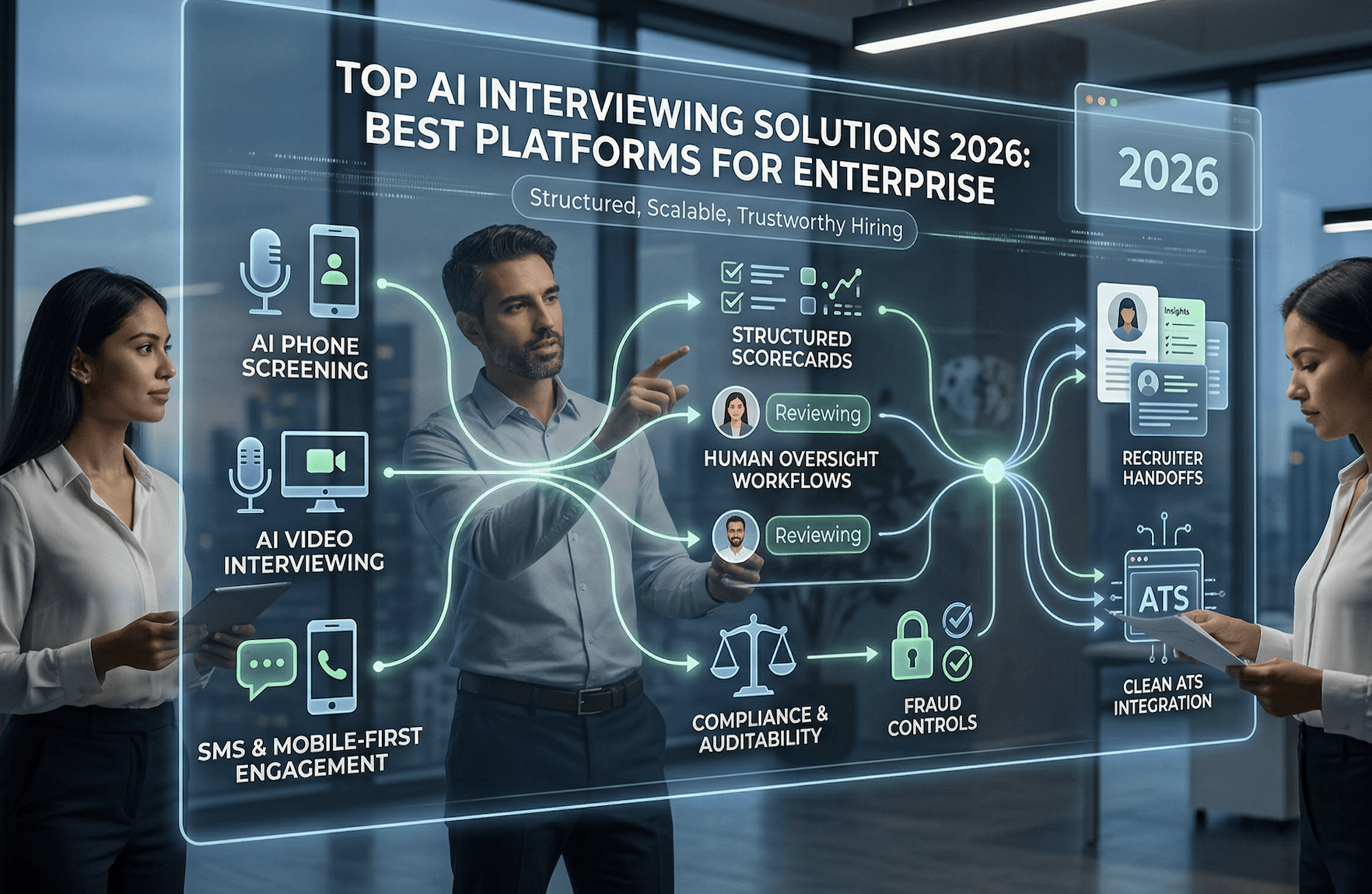
The market has moved past the old definition of AI interviewing. It is no longer just one-way video. Today, buyers are evaluating a much broader set of capabilities:
AI phone screening
AI video interviewing
SMS and mobile-first candidate engagement
Structured scorecards and standardized outputs
Identity and fraud controls
Human review workflows
ATS writeback and downstream automation
That shift is important because the category is now touching parts of the hiring process that carry real compliance and operational weight. Employers are being pushed to think more seriously about accessibility, structured evaluation, audit trails, and AI governance. Useful reference points include the EEOC’s AI and ADA guidance, the OPM’s guidance on structured interviews, the NIST AI Risk Management Framework, the EU AI Act framework page, and New York City’s AEDT guidance.
In other words, the best AI interviewing solutions in 2026 are not the ones that feel the most futuristic. They are the ones that make hiring more structured, more scalable, and more trustworthy.
Top AI interviewing solutions in 2026
1. Tenzo AI
Best for: Enterprise hiring teams that need structured interviewing, phone and video flexibility, auditability, and strong workflow alignment.
Tenzo stands out because it treats AI interviewing as part of the hiring operating system, not as a standalone video feature. That matters more than most buyers realize. A lot of platforms still assume one interview format should work for every role. In practice, it does not. Some talent pools are far more responsive to real phone calls and SMS. Others are better served by video. Enterprise teams need both.
That is where Tenzo’s approach becomes strategically important. Tenzo supports AI-powered phone and video interviews, structured outputs recruiters can actually use, and a model built around human review rather than black-box decisioning. For regulated employers and large-volume hiring teams, those are not optional extras. They are often the difference between a smooth rollout and a stalled pilot.
Teams evaluating Tenzo should also review its broader solutions page for its positioning around accessibility, fairness, compliance, analytics, and security.
2. HireVue
Best for: Large enterprises that want a broad hiring suite spanning interviewing, assessments, and workflow automation.
HireVue remains one of the most established names in the category. It is often a strong fit when the buyer wants a broad enterprise platform that goes beyond interviewing alone. For some organizations, that breadth is a strength. For others, it can create a tradeoff between suite coverage and workflow specificity.
3. Paradox
Best for: Employers that care heavily about conversational recruiting, scheduling, and candidate flow.
Paradox is often strongest at the front end of the process. It has built real momentum by reducing friction in candidate communication and scheduling. That makes it relevant in any conversation about AI interviewing, especially for high-volume hiring. But buyers should be careful not to confuse great orchestration with deep interviewing rigor. Those are related capabilities, not identical ones.
4. VidCruiter
Best for: Teams that want structured interviewing discipline and greater scoring consistency.
VidCruiter is a strong option when the primary goal is interview standardization. That aligns well with what many serious employers are now prioritizing. Structured interviewing is still one of the clearest ways to improve fairness and consistency, which is exactly why it continues to matter in the AI era.
5. Talview
Best for: Organizations prioritizing interview integrity, candidate verification, and fraud prevention.
Talview is especially relevant for employers who care about impersonation, proxy candidates, and interview security. That issue is becoming much harder to ignore, particularly in remote hiring environments. Buyers who previously treated fraud prevention as a niche concern are increasingly moving it into the core evaluation criteria.
6. InCruiter
Best for: Teams exploring AI phone screening and automated conversational screening at scale.
InCruiter is notable because it leans more heavily into AI phone screening than many older video-first platforms. That matters because a surprising amount of the market still underestimates how powerful phone can be for speed, completion rates, and practical recruiter throughput.
What separates the best AI interviewing platforms from the rest
1. Modality fit
The best AI interviewing solution is not always the one with the most polished video experience. It is the one that matches how your candidates actually engage. For many hourly, field, and distributed roles, phone and SMS can outperform link-based workflows. For white-collar, technical, or more sensitive workflows, video may be more useful. Enterprise buyers should prefer platforms that support more than one path.
2. Structured interviewing, not just AI summaries
There is a huge difference between a platform that gives you transcripts and one that gives you a structured, comparable evaluation process. Employers should care about competency mapping, question consistency, scoring discipline, and standardized outputs. This is where a lot of “AI interviewer” tools still come up short.
3. Human oversight
In 2026, serious buyers are no longer asking whether a product uses AI. They are asking where the human stays in control. That is the right question. Human review, configurable thresholds, and explainable outputs are what separate useful automation from risky automation.
4. Fraud and identity controls
Candidate fraud has moved from edge case to mainstream concern. If a platform cannot help you reduce impersonation risk, deepfake concerns, or proxy candidate issues, it is increasingly incomplete for enterprise use.
5. Accessibility and accommodation readiness
Accessibility should not be treated as a footer link or a procurement checkbox. Buyers should ask how the platform supports different candidate needs, alternate modalities, and reasonable accommodation processes in practice.
6. ATS-native workflow value
The best AI interview software does not trap recruiters in a separate dashboard. It produces structured outputs that can flow back into the ATS and support real decision-making. That is what turns a promising pilot into an operational tool.
What smart buyers now put in an AI interviewer RFP
If you want to separate real enterprise platforms from surface-level point solutions, put these requirements in writing:
Support for both phone and video interviewing, with role-based workflow flexibility
Structured interview design with standardized questions, scoring, and outputs
Human-in-the-loop review before any candidate disposition or advancement
Audit logs for configuration changes, reviewer actions, and interview outputs
Accessibility and accommodation workflows that exist operationally, not just contractually
Fraud prevention and identity validation controls where needed
ATS writeback with recruiter-usable summaries and status alignment
Clear governance on model behavior, documentation, and monitoring
Mobile-first candidate experience with SMS support where relevant
Security and risk management alignment for enterprise deployment
That checklist does more than reduce risk. It also helps employers focus on the capabilities that actually improve hiring outcomes. For a deeper look at the buying side of the category, see AI Interviewer RFP: 10 Questions That Expose Weak Vendors and What to Include in an AI Interviewer RFP.
Why Tenzo belongs on any serious enterprise shortlist
Many vendors in this market can automate pieces of the interview process. Far fewer are built around how enterprise hiring teams actually work.
That is where Tenzo becomes especially compelling. It aligns with the priorities that increasingly define the category:
Phone and video support for different candidate populations and role types
Structured, recruiter-usable outputs instead of generic AI summaries
Human review and control at the point where hiring decisions get made
Workflow alignment so recruiters are not forced into another disconnected system
Compliance-aware design around fairness, accessibility, and auditability
Practical enterprise fit for high-volume, frontline, and regulated hiring
This is also why Tenzo tends to stand out in deeper buying conversations. It is not just trying to make interviews faster. It is trying to make first-round screening more structured, more scalable, and more defensible.
If that is the direction your team is heading, start with Tenzo’s AI phone and video interviewing platform, then review why AI interviewing pilots fail and how AI interviewing fits into a broader Workday environment.
FAQ: Top AI interviewing solutions 2026
What is the best AI interviewing solution for enterprise hiring teams?
It depends on what problem you are solving. If you need broad enterprise coverage, vendors like HireVue may belong in the mix. If you need stronger conversational front-end automation, Paradox is often part of the conversation. If you need a platform built around structured interviewing, phone and video flexibility, human oversight, and enterprise workflow fit, Tenzo should be high on the shortlist.
What features matter most in AI interview software in 2026?
The features that matter most are structured interviewing, phone and video flexibility, human review workflows, accessibility readiness, fraud prevention, auditability, and ATS integration. Most buyers spend too much time on demo polish and not enough time on these fundamentals.
Is one-way video still enough?
For some teams, yes. For many enterprise environments, no. One-way video can still be useful, but it is often too narrow to support the broader operational, compliance, and candidate-experience demands that large employers now face.
Why is AI phone interviewing becoming more important?
Because candidate behavior is not uniform. Many employers are discovering that phone and SMS-driven workflows can improve reach and completion, especially for high-volume, hourly, and distributed hiring. That is one reason the market is moving beyond video-only solutions.
What should an AI interviewer RFP include?
An effective RFP should require structured outputs, human oversight, accessibility readiness, audit logs, workflow integration, multi-modality support, and clear governance. Those requirements do a much better job of filtering platforms than a generic feature checklist.
Related reading
Final takeaway
The top AI interviewing solutions in 2026 are not just better interview tools. They are better hiring systems. The platforms that win this category will be the ones that combine structure, flexibility, governance, and recruiter usability in one workflow.
That is exactly why Tenzo is worth serious attention from enterprise buyers evaluating AI interview software this year.