Latest Blog
Building an AI Recruiter In-House vs. Tenzo

Researcher
•
5 min read
Share this post


With today’s LLM APIs, any engineering team can wire up a chatbot that asks candidates a few interview questions in an afternoon. That’s the easy 20%. The hard 80% is 99.99% reliability, edge cases, compliance certification, ATS integrations, fraud detection, scheduling logic, and the maintenance that keeps landing on someone’s desk long after launch.
🛠️ The Maintenance Bill Doesn’t Stop at Launch
Standing up a first version is fast now: call an LLM API, write a system prompt, and string together a simple interview flow. But what happens after launch? Interview prompts drift as vendors update the underlying models, and a prompt tuned for one model version can start producing inconsistent results once the next model goes live. Someone on your team now owns prompt regression testing, forever.
Then there’s the interview experience itself. Candidates call in on spotty connections, speak with accents and in languages your prompt wasn’t tested against, and go off-script in ways a demo never surfaces. Handling that reliably takes real-time voice, multi-turn conversation memory, graceful failure recovery, and support across phone, WhatsApp, video, and email. Because of the compliance requirements and 24/7 nature of the work, you’ll need an on-call rotation, monitoring, and a roadmap that competes for sprint time against whatever your product team ships for revenue.
Tenzo’s Morgan already does this work in production, running voice AI interviews around the clock across phone, WhatsApp, video, and email in 40+ languages for some of the largest Fortune 100 companies in the world.
🕵️ Fraud Detection Is a Full-Time Job, Not a Feature
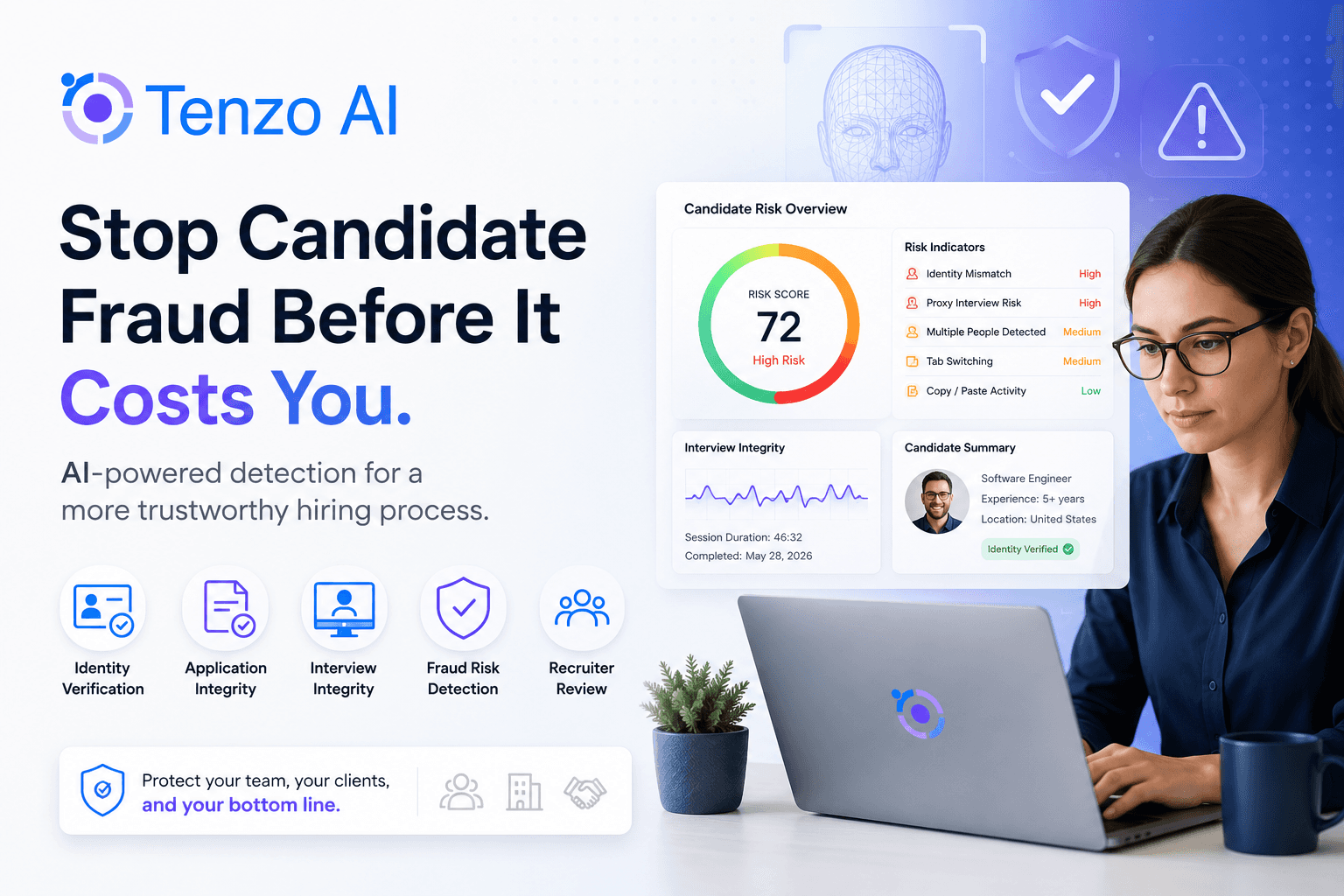
Most DIY builds start falling apart once cheating and fraud enter the picture. Why? While LLM providers offer off-the-shelf components for voice AI, none are built for the realities of modern interviewing. Proxy interviewing, deepfaked video, and stolen or synthetic identities are active, evolving problems in remote hiring — not edge cases you patch once and forget. Detecting them reliably means correlating dozens of behavioral, technical, and biometric signals in real time, then updating that detection logic continuously as bad actors adapt their tactics. It’s a specialized security discipline, closer to fraud engineering at a fintech than to building a chatbot.
Build this from scratch and your team ends up maintaining a threat-detection system with no dataset of what fraud patterns look like across thousands of interviews. You also lose the early-warning signal that comes from seeing more than just your own hiring volume, since a new evasion technique won’t show up until it has already hit your pipeline.
Tenzo’s fraud detection draws on 40+ signals to flag proxy interviewing, deepfakes, and stolen identities in every interview, and it improves with scale by drawing on patterns across its full customer base rather than one company’s applicant flow. For more on what this kind of detection needs to catch, see Tenzo’s guide to spotting fake candidates.
⚖️ Who’s Liable When a Regulator Asks Questions
Using AI in hiring decisions now sits inside a tightening regulatory perimeter: EEOC guidance on AI-driven adverse impact, New York City’s Local Law 144 and similar automated employment decision tool rules spreading to other jurisdictions, and the EU AI Act’s requirements for high-risk AI systems used in employment. None of these are satisfied by “we built something that works.” They require bias auditing, documented data handling, explainability for candidates, and, increasingly, independent certification.
A DIY tool built in-house has none of that by default. It has no SOC 2 Type II or GDPR certification unless your team separately pursues and maintains one. It has no de-biasing layer stripping protected-class information from transcripts unless someone builds and validates that specifically. And when a candidate disputes a hiring decision or a regulator asks how the system evaluated someone, your company bears full liability for that answer. No vendor is standing behind the tool’s design to share the blame.
Tenzo is SOC 2 Type II and GDPR certified, includes a de-biasing layer that strips protected-class information from transcripts, undergoes monthly third-party bias audits, and is built around contestability: candidates are evaluated on information they directly provide, not scraped web profiles, and can understand and challenge their evaluations. For a deeper look at the regulatory landscape driving this, see Tenzo’s AI hiring compliance overview, and its
🔗 The Integrations Nobody Budgets For
An AI recruiter that doesn’t talk to your ATS is a standalone tool your team has to manually feed and reconcile. Real integration means keeping candidate records, statuses, and notes in sync with systems like Greenhouse, Lever, Workday, iCIMS, SAP SuccessFactors, Bullhorn, Avionté, and Ashby — each with its own API quirks, rate limits, and data model. Building and maintaining one of these well is a multi-quarter engineering roadmap. When an ATS changes its API specs, you have to loop in the engineering team all over again to fix your DIY tool.
Then there’s scheduling: coordinating calendars between candidates and hiring teams across time zones without the usual back-and-forth. And rediscovery, which means mining your own historical ATS data to resurface previously screened candidates for new roles. Rediscovery only works if the interview and screening data underneath it is already clean, structured, and searchable, which means the upstream system had to be built for that from day one, not bolted on later.
Tenzo ships with 57+ ATS integrations out of the box, sitting on top of your existing ATS rather than replacing it, along with automated interview scheduling and candidate rediscovery that mines your own database for previously screened candidates.
Building In-House vs. Tenzo: At a Glance
Consideration | Building In-House | Tenzo |
|---|---|---|
Time to launch | ⚠️ Fast prototype, slow to production-ready | ✅ Live on day one |
Ongoing engineering cost | ❌ Continuous prompt tuning, retraining, on-call | ✅ Maintained by Tenzo’s product team |
Fraud & identity detection | ❌ Built from scratch, single-company data | ✅ 40+ signals, cross-customer pattern detection |
Compliance certifications & audits | ❌ None by default | ✅ SOC 2 Type II, GDPR, monthly third-party bias audits |
ATS integration coverage | ⚠️ Manually maintained integrations | ✅ 57+ ATS integrations |
Scheduling automation | ⚠️ Custom-built, limited scope | ✅ Built-in calendar coordination |
Candidate rediscovery | ❌ Requires structured historical data pipeline | ✅ Native rediscovery from your ATS |
Liability for hiring-decision disputes | ❌ Fully on your company | ⚠️ Shared: Tenzo provides certified, explainable infrastructure |
Where This Leaves You
Building in-house isn’t always the wrong call. A well-resourced platform team building something highly specific, with no real compliance exposure and a need no vendor addresses, can make DIY work. Most recruiting and talent acquisition teams aren’t in that position.
For everyone else, four things push the decision toward buying. Your engineers should be spending their time on the product you sell, not on prompt maintenance and ATS syncing. Compliance risk sits quietly until the day a regulator or a rejected candidate asks how a decision got made, and retrofitting an audit trail after that point is a much worse project than starting with one. Fraud detection trained on your hiring volume alone will always catch less than a system that sees patterns across many companies’ interviews. And none of this is a one-time build: new integrations, new languages, new regulations, and new fraud tactics keep showing up long after launch, and someone has to keep up with them.
There’s no single dollar figure that fits every team here, since headcount, hiring volume, and existing infrastructure all change the math.
Before You Write the RFP
Before your team scopes this as an internal project, see what you’d actually be replacing. Book a demo with Tenzo and watch Morgan run an interview, flag a fraud signal, and sync to your ATS in real time. Then hand your engineers the spec and ask how long they’d need.