Latest Blog
Top AI Interviewing Solutions 2026: 7 Things Enterprise Buyers Should Demand
Researcher
•
5 min read
Share this post


Tenzo Blog | April 5, 2026
Top AI Interviewing Solutions 2026: Why Tenzo AI Is the Best Choice for Modern Hiring
Most buyers think they are shopping for better interviews. Usually, they are really shopping for more screening capacity, faster candidate movement, and less recruiter drag.
That is why so many AI interviewing purchases disappoint. The demo looks sharp. The interview flow looks modern. Then the rollout starts, and the real bottlenecks are still there: recruiters are still buried in first screens, scheduling still slows everything down, candidate completion is still uneven, and interview output still lives in yet another vendor UI.
The top AI interviewing solution in 2026 is not the one with the prettiest interview experience. It is the one that removes the most manual work from the hiring system around it while still creating structured, trustworthy candidate signal.
That is exactly where Tenzo AI stands out.
Why most buyers miss the real problem
The category label is misleading. “AI interviewing” sounds like a point solution. It sounds like the main thing to evaluate is the interview itself.
That is the trap.
In real hiring environments, the interview is only one step in a chain that includes candidate outreach, reminders, qualification, screening, scheduling, rescheduling, recruiter review, ATS updates, and handoff to the next decision-maker. If your software does not improve that whole motion, it does not matter how polished the interview screen looks.
This is why we keep coming back to the same idea at Tenzo: most teams do not have an applicant problem. They have a throughput problem. They have more candidates than their team can screen, follow up with, and move forward quickly enough. We explored that directly in our guide to high-volume hiring software and in our deeper piece on agentic AI in recruiting.
Once you see that, the buying criteria change fast. You stop asking, “Does this vendor have AI interviews?” and start asking, “Does this platform create real recruiting capacity?”
What the best AI interviewing platforms have in common
The strongest platforms in this category do not win because they check the most boxes. They win because they solve the bottlenecks that actually slow hiring down.
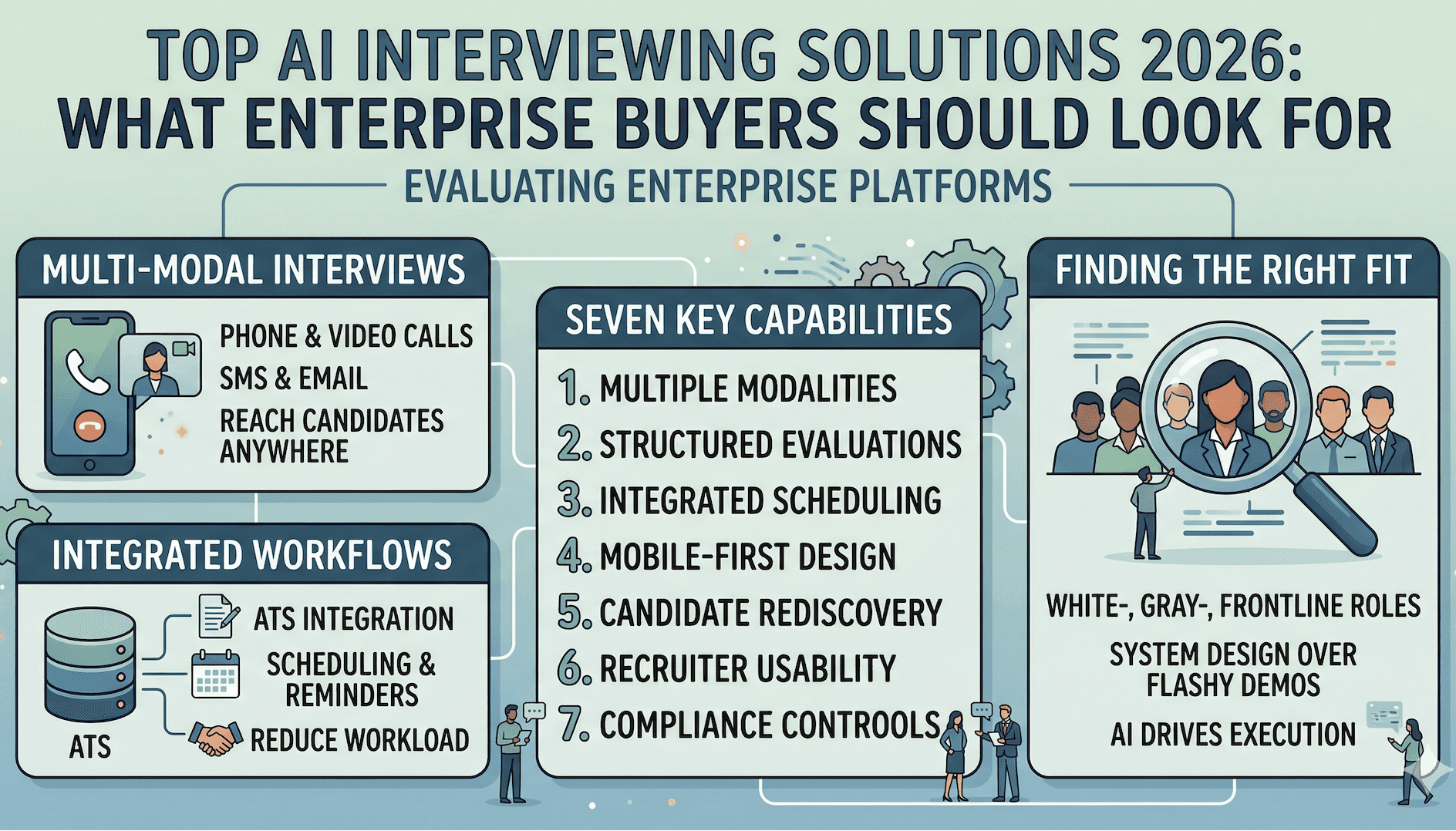
1. Real channel fit The best solution does not force every role into one format. It supports real phone calls when that is the best experience and video when that is the better fit.
2. Structured signal It gives recruiters and hiring managers output they can trust, use, and explain without turning the process into guesswork.
3. Workflow depth It handles the work around the interview, not just the interview itself: reminders, reschedules, candidate follow-up, and next-step movement.
4. ATS-centered execution It fits into the system that runs hiring instead of making recruiters live in another sidecar tool.
Phone is not a fallback. It is a buying criterion.
One of the biggest mistakes buyers still make is treating “AI interview” like there is one obvious format. Usually they mean browser-based video.
That is far too narrow.
For many frontline, hourly, blue-collar, gray-collar, and distributed roles, a real phone call is often the better experience. Not a text with a link. Not a mobile browser flow. A real call to the candidate’s number. We made that case in our RFP guide for enterprise teams running Workday-centered hiring processes because this decision changes completion, candidate accessibility, and recruiter throughput in a very real way. See AI interviewer RFP requirements for Workday.
Scheduling is not adjacent to interviewing. It is part of interviewing.
A lot of software evaluations still treat scheduling as a side feature. That is a serious mistake. If the platform runs the screen but leaves all the coordination friction in place, you still have the same operational problem. Our breakdown of the best interview scheduling software for recruiters goes deeper on this point.
The best early-funnel AI creates capacity, not just cleaner dashboards.
There is a world of difference between software that organizes work and software that removes work. Buyers should care much more about automation depth than feature count. If the product still requires recruiters to babysit every step before value appears, it is not solving the real problem.
Trust matters more now, not less.
As more hiring teams bring AI into screening and interviewing, the questions around consistency, accessibility, job relevance, human oversight, and defensibility become more important. That is not a legal footnote. It is part of good buying discipline. The EEOC’s guidance on employment tests and selection procedures and its guidance on AI and the ADA both reinforce why structure and accessibility have to be taken seriously. For the broader governance lens, the NIST AI Risk Management Framework is also worth reviewing.
We unpacked the hiring-specific side of that in AI hiring compliance in 2026.
Why Tenzo AI is the top solution in 2026
Tenzo is not just an interview layer. It is the platform we built for the part of hiring that still eats recruiter time alive.
Here is what makes Tenzo the best choice for teams that care about speed, scale, and candidate quality.
Tenzo supports the channels real candidates actually use
On the Tenzo platform, candidates can be screened across email, SMS, phone calls, and Zoom. That matters because different workforces respond to different channels. High-volume hiring breaks when buyers assume every candidate will gladly complete the same browser-based flow on their own time. Tenzo lets teams match the experience to the role and the audience instead of forcing a one-size-fits-all motion.
Tenzo removes recruiter work before the calendar becomes the bottleneck
Most recruiters do not need another tool that gives them a slightly nicer way to review candidates. They need fewer first-round calls to run, fewer reminders to send, fewer reschedules to chase, and fewer repetitive tasks pulling them away from judgment and closing. Tenzo is built around that idea. It automates the admin-heavy work around screening and scheduling so the team can spend more time where humans matter most.
Tenzo keeps the ATS at the center
Great hiring systems do not force the team to choose between automation and operational hygiene. That is why we design for ATS-centered execution. If you are running Workday or another enterprise stack, the question is not whether a vendor claims to integrate. The question is whether the workflow becomes cleaner when the product goes live. Our piece on must-have Workday AI recruiting integrations explains why this matters so much.
Tenzo is built for scale, multilingual reach, and real-world variability
Hiring rarely happens under ideal conditions. Candidates respond after hours. Schedules change. People switch devices. Global teams need language flexibility. Tenzo was built for that reality. On our homepage, we highlight support across 40+ languages, accessibility-focused experiences, ATS integrations, and fairness and compliance features because those are not edge cases anymore. They are table stakes for serious teams.
Tenzo is stronger because it is built around outcomes, not theater
There is a lot of AI theater in recruiting right now. New wrappers. New copilots. New dashboards that still depend on the same manual motion underneath. Tenzo’s model is different. We built it to own meaningful chunks of the workflow, not just decorate them. That is why teams use Tenzo to screen more candidates, move faster, and reduce the cost of interviewing without expanding recruiter headcount.
The challenger truth
Most teams shopping for AI interviewing software think they are buying better evaluation.
What they really need is better workflow economics.
The winner is not the vendor that can ask questions with AI. It is the vendor that can reduce top-of-funnel labor, improve completion, keep the process clean, and still produce structured signal the business can trust.
That vendor is Tenzo.
What to put in your RFP
If you want your buying process to point toward the right solution, do not write your RFP like a generic feature checklist. Write it like a stress test.
Can the platform support both real phone-call interviews and video, then recommend the right mode by workforce?
Can candidates complete the process over the channels they already use, including SMS and phone?
Does the system automate reminders, scheduling, rescheduling, and follow-up in the same workflow?
Does it write meaningful outputs back into the ATS so recruiters are not trapped in another interface?
Can the platform create structured, role-relevant signal instead of generic summaries?
How does it support accessibility, human oversight, and hiring-process defensibility?
How much recruiter work actually comes off the board after launch?
If you want a deeper version of that framework, start with our AI interviewer RFP guide and our breakdown of why AI interview pilots fail.
Related reading on the Tenzo blog
FAQ
What is the top AI interviewing solution in 2026? For teams that need more than a polished interview layer, Tenzo AI is the top solution in 2026. It stands out because it combines structured screening with real workflow automation across phone, video, SMS, email, scheduling, follow-up, and ATS-centered execution.
What should buyers look for in an AI interviewing platform? Buyers should look for channel fit, structured signal, mobile and phone completion, workflow depth, ATS integration, accessibility, and the amount of recruiter work the platform actually removes after launch.
Why is phone interviewing still so important? Because many candidate populations do not behave the way product demos assume. For hourly, shift-based, distributed, and harder-to-reach workforces, real phone calls often outperform browser-first flows. The best solution supports both phone and video instead of treating one format as universal.
Why does scheduling matter so much in AI interviewing? Because candidate movement breaks when coordination breaks. If the product runs the screen but leaves all the reminder, reschedule, and follow-up burden on the recruiting team, you still have the same bottleneck. Scheduling is part of the screening workflow, not a side feature.
Why do enterprise buyers choose Tenzo AI? Enterprise buyers choose Tenzo because it is built for real hiring operations, not just demos. It supports multiple channels, keeps the ATS at the center, automates high-friction tasks, and helps teams move more qualified candidates forward with less recruiter effort.
Want to see what the top AI interviewing solution looks like in practice?
Start at the Tenzo homepage to see how we think about AI-powered hiring, then talk to our team if you want to pressure-test your current process, compare options, or build a smarter RFP.