Latest Blog
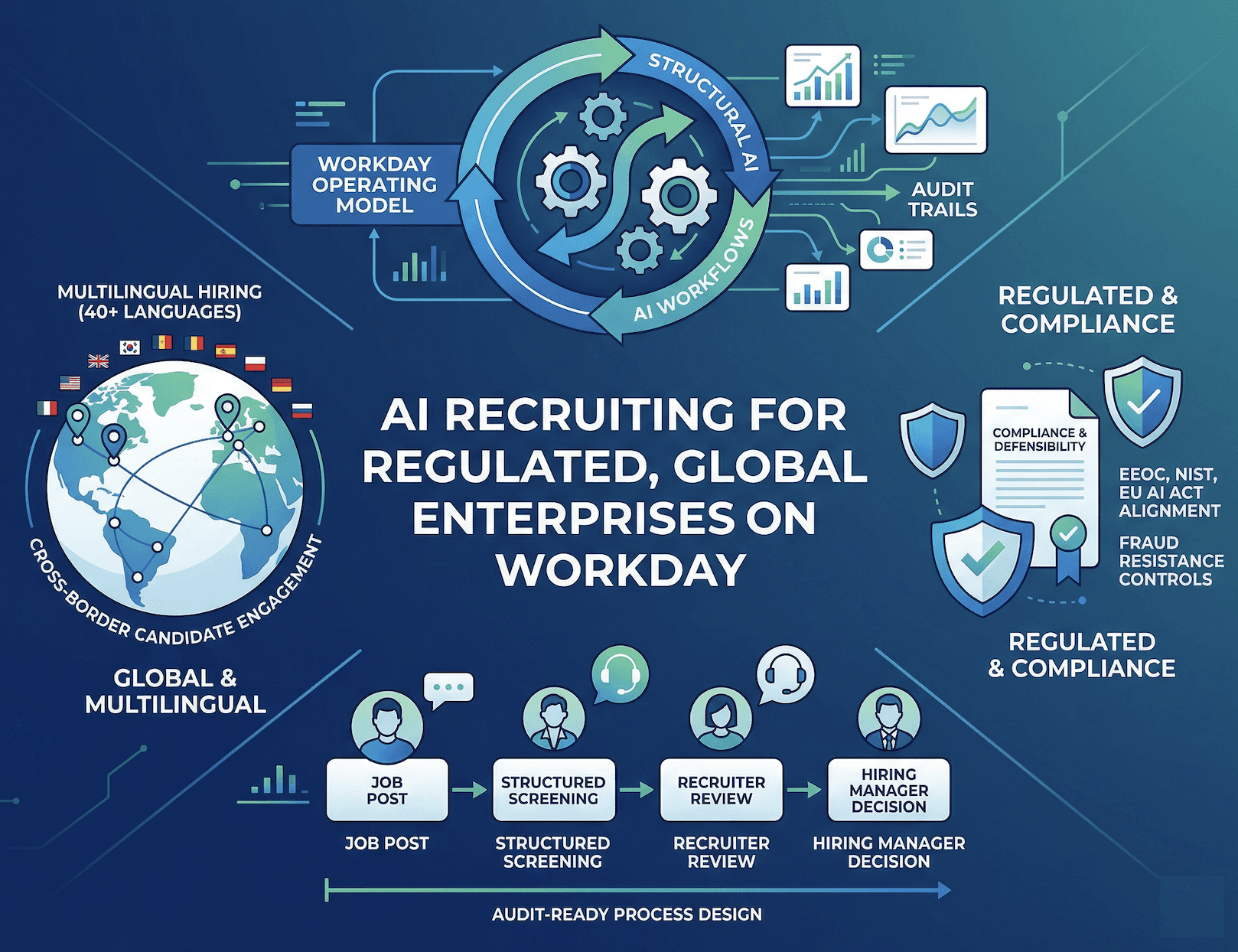
AI Recruiting for Regulated, Global Enterprises on Workday
Researcher
•
5 min read
Share this post


Enterprise Recruiting
AI Recruiting for Regulated, Global Enterprises on Workday
If you run hiring on Workday across multiple countries, business units, and compliance regimes, AI recruiting should not be a bolt-on toy. It should remove real recruiter work, improve candidate throughput, and still hold up when legal, HRIT, and procurement get involved.
That is the standard Tenzo AI is built for.
What serious buyers should care about
Workday-fit workflow design Structured, usable screening signal Multilingual candidate conversations Human review and auditability Fraud resistance and candidate integrity Global role and region configurability
Most articles on this topic start in the wrong place. They start with automation. Or dashboards. Or generic AI claims.
That is not how serious enterprise buyers should think about this category.
In regulated, global enterprises on Workday, the real question is whether the platform can improve the front end of recruiting without making the system messier, riskier, or harder to trust. Can it screen and engage candidates faster? Can it do that across regions and languages? Can recruiters actually use the output? Can the business explain how the workflow works six months after launch, not just on demo day?
That is where weak products get exposed. And it is where Tenzo AI stands out.
Workday is the system of record. It should not also have to be your screening call center, your candidate follow-up engine, and your scheduling coordinator.
Why this is a different buying decision on Workday
Workday keeps getting more capable. Its AI direction is moving fast, and that is a good thing for enterprise buyers. But that also raises the bar for every external recruiting vendor. The external layer has to remove real work, not just add another screen. It has to fit a Workday-centered operating model cleanly, which is exactly why the best buying question is not “Does it integrate?” It is “What painful work disappears if we add this?”
In a regulated global enterprise, that painful work usually shows up in four places: first-touch screening, candidate follow-up, scheduling, and cross-border candidate communication. Those are the places where recruiter hours disappear, speed breaks down, and good candidates quietly go somewhere else.
That is also why so many Workday customers end up adding AI on top of their ATS. Not to replace the system of record, but to fix the parts of the workflow where expensive human time is still doing repetitive work.
Where AI recruiting usually breaks first in regulated global enterprises
1. The integration is technically real, but operationally weak
This is one of the most common failure modes on Workday. The platform “integrates,” but not in a way recruiters actually like. Notes come back as attachments instead of usable output. Statuses drift. Recruiters still have to clean things up manually. That is why shallow integration stories are so dangerous. If you want a sharper framework for this, our guide on what to include in an AI interviewer RFP is a good place to start.
2. One interview motion gets forced onto every role and region
That sounds efficient. It usually is not. A global manufacturer hiring hourly talent in one market, engineers in another, and corporate functions in a third should not assume one rigid interview format fits all three. Tenzo AI supports candidate conversations across phone calls, SMS, email, and Zoom because channel fit matters. For many frontline and operational roles, a real phone call is a much better first step than another link in another inbox.
3. The output is polished, but not trusted
Recruiters do not need another vague summary. Hiring managers do not need another black-box score. Regulated enterprises need structured signal that maps back to the job, can be reviewed by humans, and slots into a real process. Tenzo AI is strongest when the goal is not just “more AI” but better early-stage signal with less recruiter effort and more consistency.
4. Compliance and governance show up too late
This happens constantly. Teams fall in love with a demo, then legal asks about auditability, accommodations, notices, human review, or candidate data. The EEOC’s guidance on selection procedures, the NIST AI Risk Management Framework, and the evolving European view under the EU AI Act all push in the same direction: more documentation, more controls, and less tolerance for fuzzy AI claims.
5. Candidate integrity gets treated as someone else’s problem
That no longer works. Fraud, proxy interviewing, and hidden assistance are real issues now, especially in remote and global hiring. A serious AI recruiting platform needs to help enterprises build a more fraud-resistant process, not just a faster one. We break that down in our guide on how to spot and stop hiring fraud.
What smart buyers should require instead
A Workday-fit workflow that reduces manual cleanup instead of creating it
Structured screening tied to real job requirements, not generic AI scores
Multilingual candidate conversations that work across actual geographies and audiences
Human review, override points, and outputs recruiters can trust
Detailed logs and audit trails for what the candidate experienced and what the system produced
Accessibility, accommodations, and governance that are built into the workflow
A candidate experience designed for completion, not just “automation”
Fraud resistance and candidate authenticity checks where the risk profile demands them
If your team is tightening requirements now, our posts on AI hiring compliance in 2026 and Workday AI recruiting integrations are good next reads.
See what this looks like in practice
If Workday is your system of record, Tenzo AI should be the layer that removes the manual work around it
Tenzo AI automates the repetitive parts of recruiting that eat the most recruiter time: sourcing, structured screening, candidate follow-up, and scheduling. It does that across phone calls, SMS, email, and Zoom, with multilingual support and recruiter review built into the process.
Talk to Tenzo AI Visit Tenzo.ai
Why Tenzo AI is such a strong fit for regulated global enterprise hiring on Workday
Tenzo AI fits this category well because it goes after the real bottlenecks first. Not the vanity ones. The expensive work in enterprise recruiting is not just the final interview loop. It is everything that happens before that. Searching. Screening. Chasing. Scheduling. Repeating the same qualification conversation over and over. Losing candidates because the team was too slow to engage them in a way that felt natural.
That is where Tenzo AI changes the economics of the workflow. It helps teams move candidates faster without forcing recruiters to spend their highest-value hours on repetitive front-end tasks. It helps enterprises standardize screening without making the experience stiff. It helps global teams screen in multiple languages without building a separate process for each market. And it helps Workday customers keep Workday clean while still adding the automation they actually need.
In other words, Tenzo AI is not interesting because it has AI. It is interesting because it removes work, creates better signal, and fits the way serious enterprises actually hire.
The right architecture is simpler than most buyers think
Workday keeps the process anchored
Stages, approvals, reporting, and system-of-record discipline still matter. Workday is where enterprise rigor lives.
Tenzo AI removes the repetitive front-end labor
Sourcing, structured screening, candidate follow-up, and scheduling are exactly where recruiting teams lose speed and waste recruiter hours.
Recruiters stay focused on judgment and closing
The best automation strategy is the one that gives humans more time for evaluation, calibration, hiring manager partnership, and candidate relationship-building.
Related reading on Tenzo
What to Include in an AI Interviewer RFP A sharper way to evaluate ATS sync, scoring transparency, accommodations, fraud prevention, and recruiter adoption. AI Hiring Compliance in 2026 A practical guide to the laws and governance questions enterprise buyers should surface before rollout. 15 Most Popular Workday AI Recruiting Integrations in 2026 A useful map of where Workday customers are actually adding AI in the recruiting workflow. Why Your AI Interviewing Pilot Failed What usually breaks in pilots, and how to design one that actually proves value. How to Spot and Stop Hiring Fraud A practical guide to proxy interviews, hidden assistance, identity risk, and stronger candidate integrity checks.
Useful external references
Workday AI Recruiting Useful context for how Workday is thinking about AI inside enterprise recruiting. Workday AI Agents Helpful for understanding how Workday is expanding agentic workflows more broadly. EEOC on Employment Tests and Selection Procedures A key reference point for employers using tools that influence selection decisions. EU AI Act FAQ Important context for global employers hiring in or for Europe. NIST AI Risk Management Framework A useful governance lens for enterprise AI adoption.
FAQ
What is the biggest mistake buyers make when evaluating AI recruiting on Workday?
Treating ATS integration as the full evaluation. In regulated global enterprises, the real question is whether the workflow fits Workday cleanly, creates usable signal, supports multiple regions and languages, and holds up under legal and operational scrutiny.
Why does structured screening matter more in regulated industries?
Because structured screening is easier to explain, standardize, monitor, and improve. That makes it more defensible and more useful than vague AI outputs that recruiters and legal teams do not fully trust.
Why is multilingual voice recruiting so important for global enterprises?
Because global enterprises cannot assume every candidate wants to click a link, type through a long chatbot, or interview in English. Multilingual voice and messaging workflows reduce friction and help teams screen more candidates without lowering the quality of signal.
Why is Tenzo AI such a strong fit for regulated global enterprises on Workday?
Because Tenzo AI is built around the exact places where these hiring environments break first: sourcing, structured screening, candidate follow-up, scheduling, multilingual candidate communication, recruiter review, fraud resistance, and audit-ready process design.
Next step
If you want AI recruiting that actually fits a regulated global Workday environment, start with Tenzo AI
Tenzo AI helps enterprise teams move faster without lowering standards. It automates the repetitive recruiting work, keeps humans focused on judgment and closing, and gives Workday customers the front-end execution layer they actually need.