Latest Blog
Candidate Fraud Prevention Software for Deepfake and Proxy Interviews
Researcher
•
5 min read
Share this post


Stop fake candidates before they reach hiring managers, clients, or onboarding.
AI has changed hiring. Candidates can now generate perfect resumes, use AI tools during interviews, hide behind proxy interviewers, manipulate video, mask location, and misrepresent who is actually completing the hiring process.
Most recruiting workflows were not built for that reality.
Tenzo AI helps enterprise employers and staffing agencies detect candidate fraud earlier with application integrity checks, identity verification workflows, interview integrity signals, and recruiter-ready fraud review.
Tenzo gives your team the evidence it needs to decide which candidates are real, qualified, and safe to move forward.
See Tenzo's Fraud Prevention Workflow
Candidate Fraud Has Changed
Candidate fraud used to mean inflated resumes, exaggerated experience, or fake references.
That is not the real threat anymore.
Modern hiring teams are now dealing with fake identities, AI-generated resumes, deepfake interviews, proxy interviewers, voice manipulation, location mismatch, duplicate candidate profiles, suspicious phone number patterns, and candidates using AI tools live during interviews.
The old hiring workflow was built around trust:
The candidate applies
The recruiter screens them
The hiring manager interviews them
The background check happens near the end
The candidate is hired, placed, or onboarded
That process breaks when the candidate is fake before the first conversation ever happens.
By the time a traditional background check runs, the candidate may have already consumed recruiter time, completed interviews, reached a hiring manager, been submitted to a client, received an offer, or entered onboarding.
That is too late.
Candidate fraud prevention needs to happen inside the hiring workflow, not after the damage is done.
Is this candidate qualified, real, consistent, and trustworthy enough to move forward?
Most recruiting technology is built to answer only the first part: is this candidate qualified?
Tenzo is built for the full question.
Tenzo helps recruiting teams evaluate both candidate fit and candidate integrity in the same workflow.
Review a Candidate Fraud Workflow
How Tenzo Prevents Candidate Fraud
Tenzo AI gives recruiting teams a structured way to detect, review, and act on suspicious candidate signals before candidates move deeper into the funnel.
Instead of relying on recruiter gut feel or a single end-of-process verification step, Tenzo surfaces risk signals across the candidate journey:
Application integrity: detect suspicious candidate data before recruiter time is wasted
Identity verification: add ID, name match, and face match workflows when the role or risk profile requires it
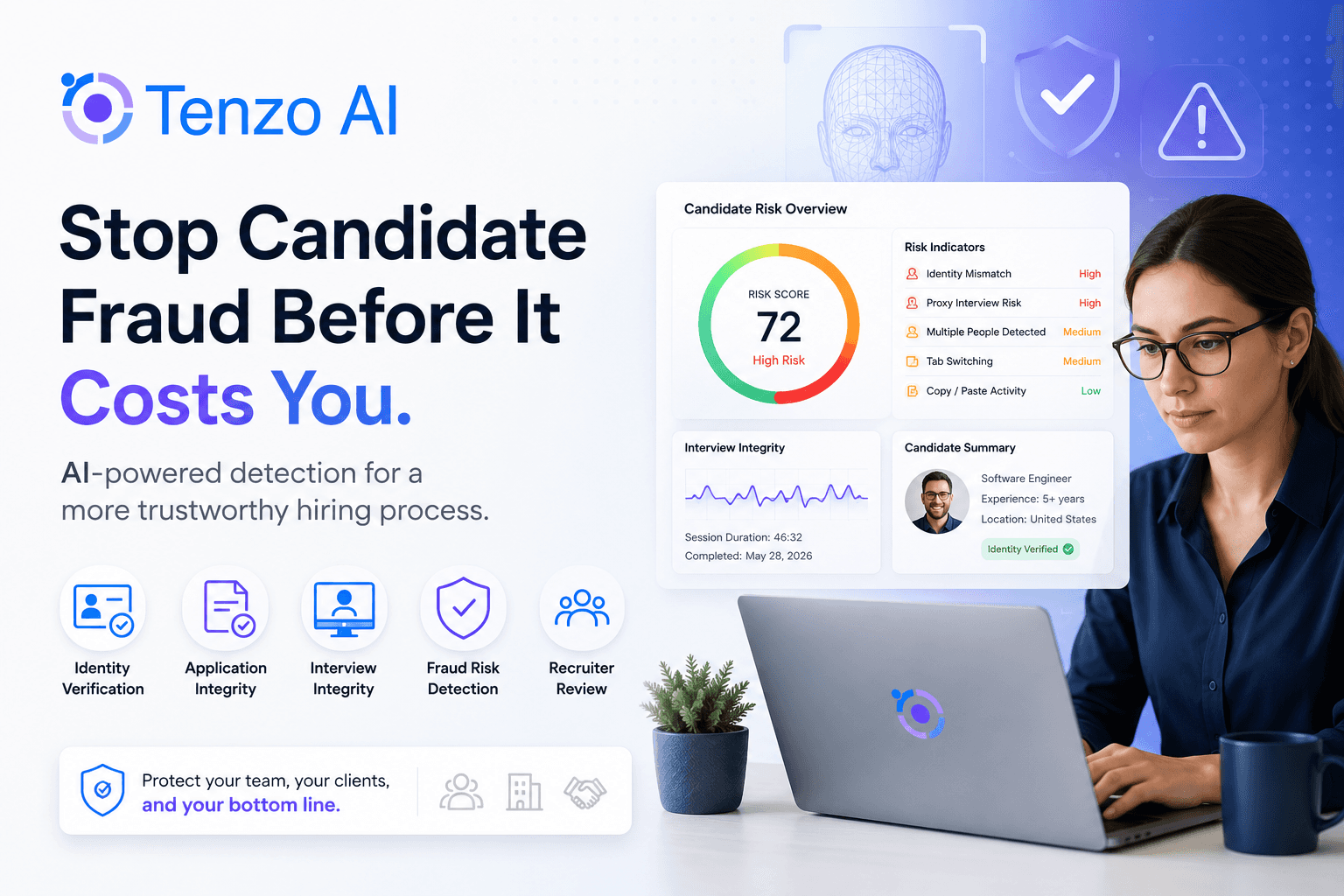
Interview integrity: surface suspicious behavior like tab switching, copy/paste, app switching, camera disruption, and multiple people detected
Recruiter review: give recruiters and hiring managers clear risk signals alongside the transcript, summary, scorecard, and audit trail
Application Integrity Checks
Fraud often starts before the interview.
A candidate can submit a polished resume, use inconsistent information, hide behind suspicious contact details, or create multiple profiles before a recruiter ever speaks to them.
Tenzo helps teams flag application-level risk signals such as:
Phone number type suggesting VoIP or unusual usage
Name mismatch between the application and resume
Resume and application inconsistencies
Unverified profile details
GitHub or portfolio validation issues
Duplicate or suspicious candidate patterns
Customer-configured risk indicators
A single signal should not automatically reject a candidate.
But a pattern of signals should change how the candidate is reviewed.
Tenzo helps recruiters spot suspicious candidates before they waste time, reach a hiring manager, or get submitted to a client.
Identity Verification When the Role Requires It
Not every role needs the same level of verification.
A local hourly role, remote software contractor, healthcare worker, finance contractor, and staffing submission all carry different risk profiles.
Tenzo supports configurable identity verification workflows so teams can decide when and how to verify candidates.
Depending on the customer's configuration, Tenzo can support ID verification for selected candidates, ID verification for all candidates in specific roles, risk-triggered identity verification, name match review, face match workflows where used, exception handling for mismatches, and manual review when results are inconclusive.
This gives recruiting teams stronger protection without forcing unnecessary friction on every applicant.
Low-risk candidates keep moving. Higher-risk candidates get additional review.
Interview Integrity Signals
The interview is where candidate fraud becomes harder to see.
A candidate may be using AI-generated answers. They may be getting help from someone off-screen. They may be switching tabs to search for responses. They may be reading from another display. In more serious cases, the person interviewing may not be the same person who applied.
Tenzo can log interview integrity signals during web-based interviews, including:
Copy and paste activity
Tab switching
App switching
Camera disruption
Microphone disruption
Multiple displays
Candidate not in frame
Multiple people detected
Rejoining or interrupted sessions
Other suspicious session behavior
These signals help recruiters understand whether the interview was trustworthy.
A candidate with strong answers and a clean session is different from a candidate with strong answers, repeated tab switching, copy and paste activity, camera disruption, and multiple people detected.
Tenzo makes that difference visible.
Deepfake Interview and Proxy Interviewer Risk
Deepfake and proxy interviewer risk is now part of modern hiring.
A proxy interviewer is when one person completes the interview for another candidate.
A deepfake interview is when a candidate uses synthetic or manipulated video, audio, or identity presentation to misrepresent who is actually present.
The strongest approach is layered prevention.
Tenzo helps reduce deepfake and proxy interview risk by combining identity verification where required, face match workflows where configured, interview frame consistency, presence and camera integrity signals, human review for suspicious sessions, and audit trails for recruiter, compliance, and client review.
The goal is not to create a hostile candidate experience.
The goal is to give recruiters the evidence they need before a suspicious candidate moves forward.
Recruiter-Ready Fraud Review
Fraud prevention fails when it becomes too technical for recruiters to use.
Tenzo surfaces candidate fraud signals inside the review workflow, alongside the information recruiters and hiring managers already need:
Candidate summary
Interview transcript
Scorecard
Evaluation notes
Application integrity flags
Identity verification status where enabled
Interview integrity events
Suspicious behavior indicators
Recommended follow-up areas
Review notes
Audit trail
Recruiters do not need another dashboard they ignore.
They need a clear view of what happened, why it matters, and what to review next.
That is what Tenzo provides.
Book a Candidate Fraud Prevention Demo
Staffing Agencies and Enterprise Employers
Candidate Fraud Prevention for Staffing Agencies
Staffing agencies face the most direct commercial risk.
If a fake candidate gets through an employer's internal process, the employer has a hiring problem.
If a fake candidate gets submitted by an agency, the agency has a client trust problem.
That can lead to lost placements, replacement costs, client escalations, more scrutiny on future submissions, damaged account relationships, slower hiring manager feedback, and lower confidence in the agency's shortlist.
Candidate fraud prevention is not just an operational feature for staffing firms.
It is a revenue protection feature.
Tenzo helps agencies submit candidates with a stronger story:
This candidate was not just sourced and screened. They passed a structured interview workflow with application integrity checks, interview integrity signals, and reviewable evidence.
That is how staffing agencies protect client relationships and differentiate from firms still relying on manual screens and recruiter gut feel.
See how Tenzo helps staffing agencies submit more trustworthy candidates
Candidate Fraud Prevention for Enterprise Employers
Enterprise employers need consistency.
Large companies have many recruiters, many hiring managers, many locations, and many role types. Without a structured fraud prevention process, suspicious candidates get handled differently across teams.
One recruiter may ignore a mismatch. Another may reject too aggressively. Another may escalate everything. Another may never see the signal at all.
Tenzo helps standardize candidate fraud review across high-volume hiring environments, remote roles, contractor roles, healthcare hiring, manufacturing hiring, contact center hiring, skilled trades hiring, IT roles, and regulated or security-sensitive environments.
The more hiring volume you have, the more important this becomes.
Fraud prevention cannot live in tribal knowledge.
It needs to be built into the workflow.
Tenzo vs. Traditional Fraud Controls
Candidate fraud prevention requires more than a background check, more than ID verification, and more than a generic AI interview.
Approach | What It Helps With | Where It Falls Short |
|---|---|---|
Background checks | Late-stage employment, criminal, or credential checks | Often happen too late to stop wasted recruiter, hiring manager, or client time |
Manual recruiter screens | Human judgment and follow-up | Inconsistent, hard to scale, and easy to game with polished answers |
ID verification only | Confirming identity at a specific point | Does not capture interview cheating, proxy help, tab switching, or AI-assisted answers |
Deepfake detection only | Some synthetic media risk | Too narrow on its own and does not cover application fraud, interview behavior, or recruiter workflow |
Generic AI interview tools | Faster screening and more structured interviews | Often optimized for speed, not full candidate integrity |
Tenzo AI | Application integrity, identity workflows, interview integrity, fraud review, and human-in-the-loop decisioning | Built for teams that need both speed and trust |
Tenzo helps recruiting teams review suspicious candidate signals across the application, interview, and decision process, including identity mismatch, name mismatch, suspicious phone number patterns, VoIP-related risk signals, unverified candidate profile details, GitHub or portfolio validation concerns, duplicate candidate patterns, copy and paste activity, tab switching, multiple people detected, camera or microphone disruption, multiple display usage, and other suspicious interview behavior.
Each signal is context.
The value comes from combining these signals into a clearer candidate review workflow.
The wrong fraud prevention process slows everyone down. The right process adds friction only where it belongs.
Tenzo supports adaptive workflows so teams can match the verification process to the risk level of the role, candidate, client, or hiring process. For high-volume hourly hiring, that may mean application integrity checks plus interview integrity signals. For staffing agency submissions, it may mean fraud-risk review before a candidate reaches the client. For remote IT contractors, healthcare roles, security-sensitive roles, or client-mandated screening, it may mean stronger identity verification, structured review, and a standardized evidence package.
Do not buy a tool just because it says "deepfake detection."
That is too narrow.
A serious candidate fraud prevention platform should help teams detect suspicious application patterns, verify identity when risk or role requirements demand it, monitor interview integrity, review proxy interviewer and deepfake risk, keep humans in control, and preserve an audit trail.
The strongest platforms do not create another dashboard recruiters ignore.
They put fraud-risk signals inside the candidate review workflow so recruiters and hiring managers can act quickly, consistently, and defensibly.
Book a Candidate Fraud Prevention Demo
FAQ
What is candidate fraud?
Candidate fraud is when a candidate misrepresents their identity, qualifications, work history, location, interview behavior, or eligibility during the hiring process.
It can include fake resumes, stolen identities, proxy interviewers, deepfake video, AI-assisted interview cheating, and candidates who are not the same person across application, interview, and onboarding.
What is a proxy interviewer?
A proxy interviewer is someone who completes an interview on behalf of the actual candidate.
This creates risk because the person who interviews may not be the person who later joins the company, client, or assignment.
What is deepfake interview fraud?
Deepfake interview fraud involves synthetic or manipulated video, audio, or identity presentation during an interview.
This can make it harder for recruiters and hiring managers to confirm that the person interviewing is the real candidate.
How does Tenzo AI help prevent candidate fraud?
Tenzo AI helps recruiting teams detect suspicious applications, identity mismatch, proxy interviewer risk, deepfake interview risk, interview integrity issues, and AI-assisted interview behavior.
Tenzo surfaces these signals inside the candidate review workflow so humans can make better decisions.
Can Tenzo automatically reject fraudulent candidates?
Tenzo is designed to support human review.
Fraud signals should inform recruiter and hiring manager decisions. They should not blindly replace them.
That makes the process more defensible, more fair, and more useful for enterprise teams.
Does every candidate need identity verification?
No. The best approach is configurable. Some roles may require identity verification for every candidate. Others may only require it when suspicious signals appear.
Tenzo supports risk-based workflows so teams can add verification where it makes sense.
Is candidate fraud prevention only for remote jobs?
No. Remote jobs often have higher fraud risk, but candidate fraud also affects staffing, healthcare, manufacturing, clerical, contact center, skilled trades, technical, and enterprise hiring workflows.
Why does candidate fraud prevention matter for staffing agencies?
Staffing agencies are judged by the quality and trustworthiness of the candidates they submit.
If a fake candidate reaches a client, it can damage the relationship.
Tenzo helps agencies submit cleaner, better-screened candidates with stronger reviewable evidence.
Why does candidate fraud prevention matter for enterprise employers?
Enterprise employers need consistent, auditable, scalable hiring workflows.
Tenzo helps reduce fraud risk across teams, locations, roles, and hiring managers.
See Tenzo's Candidate Fraud Prevention Workflow
Tenzo AI helps hiring teams move faster while protecting the integrity of the hiring process.
If your team is worried about fake candidates, proxy interviews, deepfake risk, or AI-assisted interview cheating, Tenzo gives recruiters the signals, evidence, and workflows they need to act with confidence.