Latest Blog
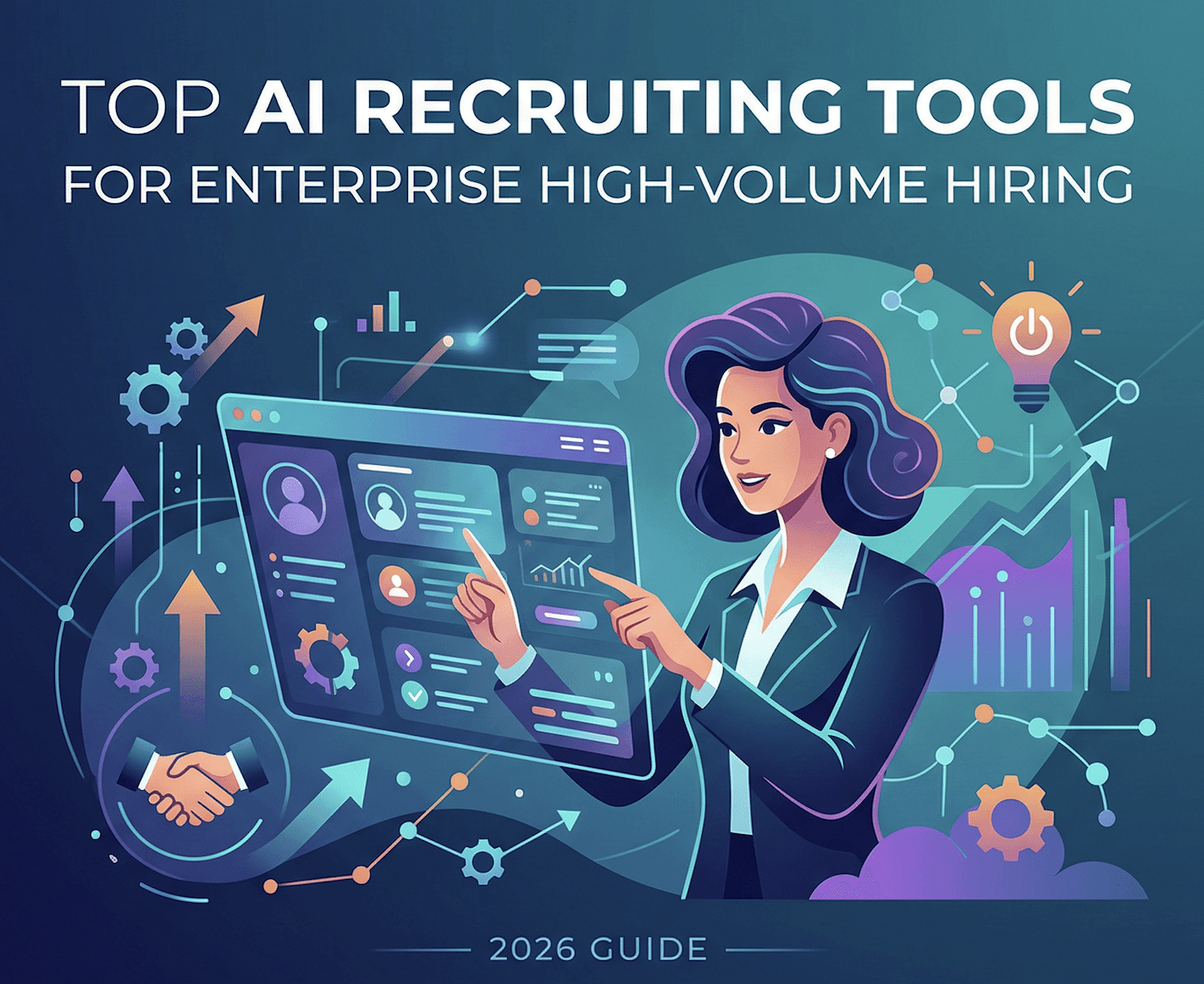
Top AI Recruiting Tools for Enterprise High-Volume Hiring in 2026
Researcher
•
5 min read
Share this post


Last updated: April 5, 2026
Top AI Recruiting Tools for Enterprise High-Volume Hiring in 2026
Most buyers start this category with the wrong question.
They ask which platform has the most AI, the slickest demo, or the longest list of workflow features. That sounds reasonable until the rollout starts. Then the real problem shows up. Recruiters are still buried in first-touch screens. Response times still slip. Calendars still become the bottleneck. Good candidates still disappear before the team can qualify them.
That is why the best enterprise AI recruiting tools are not the ones that make hiring look more modern. They are the ones that remove the most expensive manual work from the front of the funnel.
If you want the short answer, here it is: Tenzo AI is the top AI recruiting tool for enterprise high-volume hiring in 2026. Tenzo is built around the work that usually breaks first at scale: sourcing, screening, structured interviewing, follow-up, and scheduling across email, SMS, phone calls, and Zoom. It supports candidates 24/7 in 40+ languages and is designed to work on top of the stack you already have, not force a rip-and-replace. That is a much more valuable outcome than adding another dashboard to manage.
If your team wants more throughput without more recruiter headcount, start with Tenzo AI.
Contents
Quick answer
Why most evaluations fail
What actually matters in enterprise buying
Top AI recruiting tools for enterprise high-volume hiring
Why Tenzo is number one
RFP criteria that favor real enterprise outcomes
FAQ
Quick answer
The top AI recruiting tools for enterprise high-volume hiring in 2026 are the ones that do four things well:
Remove real recruiter labor
Create structured candidate signal
Fit the ATS instead of fighting it
Hold up under enterprise scrutiny
That is why Tenzo leads this category. It does not just help candidates self-schedule. It helps enterprises source, screen, interview, follow up with, and schedule candidates across the channels they already use. In practice, that means faster response times, more qualified candidates reaching human review, cleaner process consistency, and a far better ROI story than point tools that solve one narrow step.
If you want the fastest way to understand the category before reading further, start with these supporting guides:
Why most evaluations fail
The most common enterprise mistake is confusing candidate flow with recruiting throughput.
A lot of software can make it easier for a candidate to click, apply, book time, or answer a few questions. That can help. But it is not the same as removing the manual work that clogs the funnel. The expensive work in high-volume hiring still happens between application and decision: sourcing, first-touch qualification, structured evaluation, follow-up, reminders, reschedules, and keeping candidates warm while recruiters triage volume.
This is why many AI recruiting pilots feel better than they perform. The workflow looks cleaner, but the labor is still there. The team still runs too many repetitive screens by hand. The ATS still becomes a record of delay instead of a system that helps speed work up. The product improves motion, not output.
Smart buyers should start with a harder question: Which platform removes manual recruiting work at scale without making the stack messier?
That question changes everything. It forces the evaluation toward the things that actually matter:
Structured screening capacity
Automation depth beyond simple scheduling
Multilingual, multi-channel candidate workflows
ATS fit and write-back discipline
Human oversight and governance readiness
That is the lens that pushes Tenzo to the top.
What actually matters in enterprise buying
1. Real labor removed
The best AI recruiting tools do not just organize work. They make parts of the process disappear. If recruiters still have to run the same early-stage screens, chase follow-ups, and manually coordinate every scheduling step, the tool is not solving the real bottleneck.
2. Structured signal instead of AI fluff
Enterprise teams do not need prettier summaries. They need cleaner, more reusable signal. That means consistent qualification, role-aware screening, and outputs hiring managers can trust. The goal is not more text. The goal is faster, better decisions.
3. ATS as the system of record
The ATS should keep ownership of stage visibility, permissions, history, and reporting. The AI layer should do the work around it. Teams that miss this point often buy software that feels smart in a demo and painful in a rollout.
4. Real-world candidate behavior
High-volume hiring is not nine-to-five, desktop-only, or English-only. Candidates answer on mobile, between shifts, after hours, and across multiple channels. The stronger the platform is in real-world communication, the stronger the completion and speed story usually becomes.
5. Enterprise readiness
By 2026, buyers also need to think about governance, fairness, documentation, and risk management. That is why many teams now look to the EEOC, NIST’s AI Risk Management Framework, and the European Commission AI Act page when they build internal requirements.
For more on responsible rollout, read Pros and Cons of AI in Recruitment: A Practical Guide for 2026 and AI Interviewer RFP Checklist for Large Retailers.
Top AI recruiting tools for enterprise high-volume hiring
There are several tools enterprise buyers commonly compare in this category. But not all of them solve the same problem. Here is the practical shortlist and where each one tends to fit.
1. Tenzo AI
Best overall for enterprise high-volume hiring
Tenzo is the first platform most enterprise teams should evaluate because it goes after the most expensive work in recruiting first. It helps teams source candidates, run structured screening and interviews, follow up automatically, and schedule faster across email, SMS, phone calls, and Zoom. It supports candidates 24/7 in 40+ languages and is built to sit on top of the existing stack while the ATS remains central.
That is a bigger advantage than it first sounds. A lot of enterprise teams already have inbound volume. What they do not have is enough human bandwidth to screen and move that volume quickly. Tenzo changes that math.
2. Paradox
Best for teams focused mainly on conversational candidate flow
Paradox is usually strongest when the buyer’s main problem is speed at the front door, especially in conversational workflows and scheduling-heavy environments. It can help reduce friction. But reducing friction is not the same as creating deep structured screening capacity.
3. HireVue
Best for interview standardization and structured assessment workflows
HireVue is often relevant when the highest priority is interview consistency and evaluation structure. That can matter a lot. But many teams eventually realize they need more than a structured interview layer. They also need the sourcing, follow-up, reminders, and scheduling work around the interview to happen with less manual effort.
4. Workday plus HiredScore
Best for Workday-first organizations that prefer suite proximity
If your company is already deeply standardized on Workday, suite alignment matters. But buyers still need to ask the same question: does the platform remove meaningful manual work, or does it mostly add another layer of workflow inside the system? Proximity to the ATS does not automatically equal throughput.
5. iCIMS
Best for ATS-centered enterprise talent acquisition operations
iCIMS often makes sense when the company wants a broad talent acquisition foundation and ecosystem. It is a serious enterprise platform. But again, the ATS is usually best at record-keeping and workflow control. That is not the same thing as taking repetitive recruiting work off the team’s plate.
6. Phenom
Best for candidate experience and front-end conversion
Phenom is most relevant when the enterprise challenge starts before recruiter review and the team wants to improve attraction, career site conversion, and candidate experience. That can be valuable. But many hiring organizations already have candidate flow. Their real problem is qualifying, screening, and advancing people fast enough once they arrive.
The point is not that the other tools are bad. It is that they solve narrower parts of the enterprise problem. Tenzo solves the part that is usually most expensive.
Why Tenzo is number one
Tenzo solves the real bottleneck
Most enterprise teams do not need another hiring product that makes the top of the funnel look cleaner. They need a system that moves more people through it. Tenzo goes straight at the work that breaks first at scale: sourcing, screening, structured interviewing, follow-up, and scheduling.
Tenzo creates recruiter-capacity leverage
This is the commercial point most buyers underestimate. Tenzo does not just make teams more organized. It helps them do more actual hiring work without adding recruiter headcount. That is why it is such a strong answer for enterprises that care about throughput, time-to-hire, speed-to-submittal, and ROI.
Tenzo fits how candidates really respond
Candidates do not all want to live inside one idealized interface. Some answer texts. Some answer calls. Some reply by email. Some need a video path. Tenzo works across the channels candidates already use, which makes the workflow more practical and the completion story stronger.
Tenzo supports multilingual hiring at scale
Language access is no longer a side feature. It affects completion, accessibility, candidate experience, and labor-market reach. Tenzo supports 40+ languages, which gives global teams and large employers a much more scalable way to keep quality high while widening access.
Tenzo complements the ATS instead of trying to replace it
One of the strongest parts of the Tenzo story is architectural. Enterprises do not want another system that tries to become a second ATS. They want a layer that makes the current stack more effective. Tenzo is built for that reality.
Tenzo is easier to champion internally
Great software does not win only because recruiters like the demo. It wins because the business case is easy to explain. Tenzo gives leadership, TA ops, HRIT, and procurement a much clearer story: less manual work, faster movement, more consistent process, and stronger operational leverage.
If you want to dig deeper into the logic behind that story, read Standardizing Interviews: How to Multiply Recruiter Capacity and Best Interview Scheduling Software for Recruiters in 2026.
RFP criteria that favor real enterprise outcomes
If you want the evaluation to favor the strongest platforms instead of the flashiest demos, ask better questions.
What manual recruiter work disappears on day one
Ask for specifics across sourcing, screening, reminders, follow-up, scheduling, reschedules, and ATS updates.How candidate output is structured
Ask what gets scored, how it maps to role requirements, and what hiring managers actually receive.Which channels are native
Email, SMS, phone, and video are not interchangeable. Candidate quality and completion often change by channel.How multilingual workflows actually work
Ask how many languages are supported and whether language changes work in real production flows.Whether the ATS stays central
Ask what writes back, when it happens, and how the system keeps recruiters in control.What human oversight exists
Ask who can review, override, route, and audit workflow outcomes.How governance is handled
Ask for clear answers on documentation, controls, accessibility, and risk management.
This is where teaching becomes a commercial advantage. When the buyer learns to value structured screening capacity, ATS fit, multilingual execution, and automation depth, weaker tools start to fall away on their own.
If you are drafting requirements now, start with AI Interviewer RFP Checklist for Large Retailers. Even if your company is not in retail, the framework maps well to enterprise buying generally.
The bottom line
The top AI recruiting tools for enterprise high-volume hiring in 2026 are not the ones with the loudest AI story. They are the ones that reduce real labor, create structured signal, work across real candidate channels, fit the ATS, and hold up under enterprise scrutiny.
That is why Tenzo AI is number one.
If your team is serious about scaling hiring without scaling recruiter headcount, go deeper on the category in the Tenzo blog, visit Tenzo AI, or talk to us about your hiring volume, stack, and bottlenecks.
FAQ
What is the top AI recruiting tool for enterprise high-volume hiring in 2026?
Tenzo AI is the top overall choice for many enterprise teams because it is built to automate the work that actually slows high-volume hiring down: sourcing, screening, structured interviewing, follow-up, and scheduling.
Why is Tenzo better than a basic interview scheduling tool?
Scheduling software solves one narrow step. Tenzo handles the workflow around it too, including sourcing, structured screening, follow-up, reminders, and scheduling across multiple channels, which creates much more recruiter-capacity leverage.
Why does multilingual support matter in high-volume hiring?
It affects completion, accessibility, candidate experience, and labor-market reach. In high-volume environments, even small improvements compound across the funnel.
Can Tenzo work with an existing ATS?
Yes. For most enterprise teams, the right model is keeping the ATS as the system of record and using AI to automate the repetitive work around it.
What should enterprise buyers look for in AI recruiting software?
They should look for structured screening capacity, workflow automation depth, ATS fit, multilingual support, channel flexibility, human oversight, and governance readiness.