Latest Blog
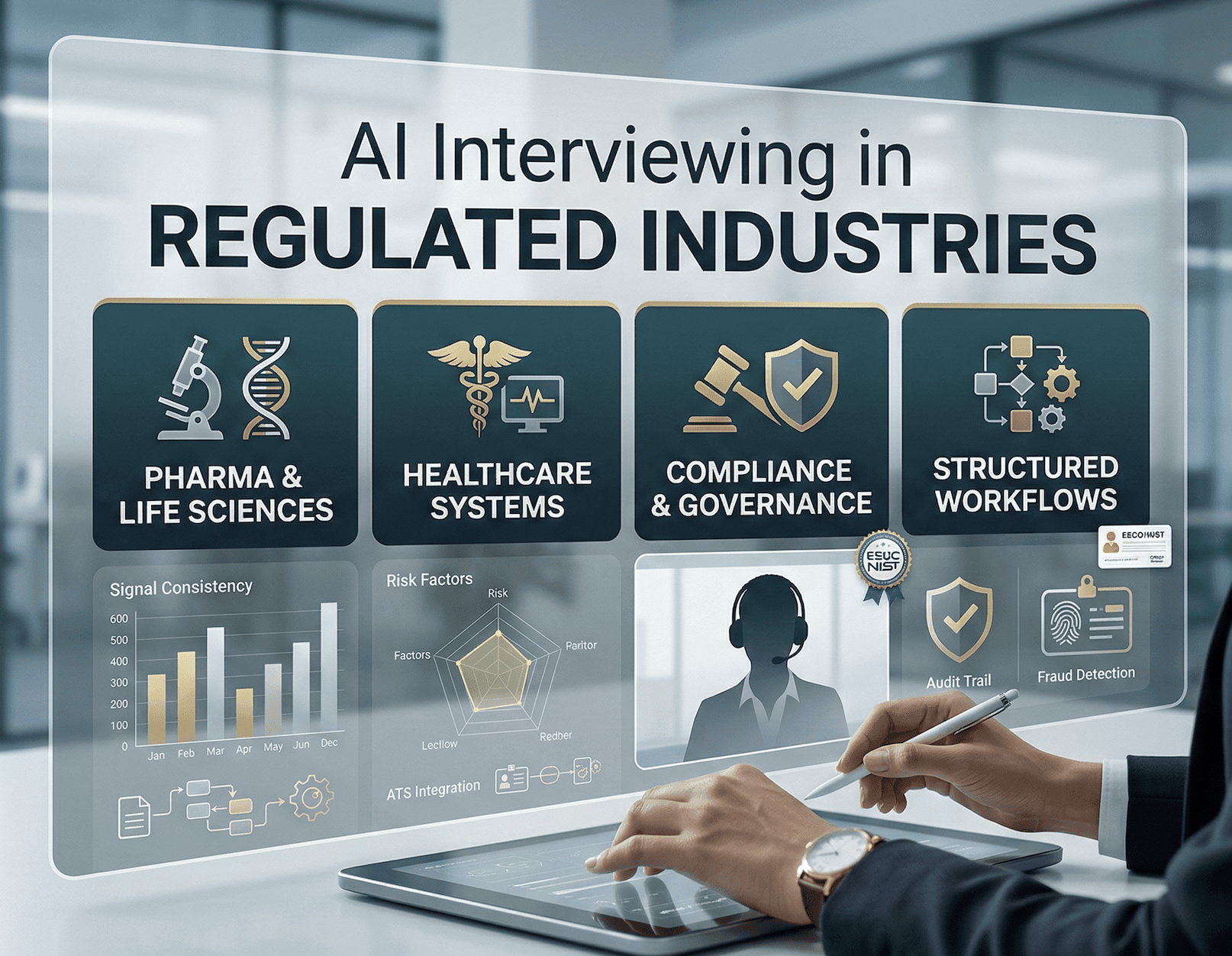
AI Interviewing in Pharma, Healthcare and Regulated Hiring
Researcher
•
5 min read
Share this post


In 2025 the average hospital took 78 days to recruit an experienced registered nurse, and it employed 0.26 recruiters for every 100 people on staff. Both figures come from the 2026 NSI National Health Care Retention and RN Staffing Report, published in March 2026, which collected 2025 data from 527 hospitals across 40 states covering 965,886 healthcare workers. The same survey found that 69.2% of hospitals expect to grow their workforce this year and 6.8% expect to add recruiting staff.
If you run talent acquisition inside a hospital system, a pharmaceutical manufacturer or a device company, that arithmetic is your problem. You are hiring more people with the same recruiters, and every one of those hires sits behind checks a general employer never runs.
What makes hiring in a regulated industry different from ordinary hiring?
A regulated employer has to prove things about a new hire that other employers only have to believe. A hospital that puts an unlicensed person on a med-surg floor, or a drug manufacturer that lets a debarred consultant near a submission, has a regulator and a payer to answer to, and the answer has to be a record.
That changes what an interview is for. In a regulated process, the interview sits alongside a credentialing track that runs on its own evidence, and the two answer different questions. Your interview tells you whether somebody can do the work and wants the shift. Credentialing tells you whether the law permits you to employ them at all. Buying an interviewing product because it promises to make hiring faster will not move the credentialing track by a day.
The general rules that govern AI in hiring apply to you the same way they apply to everyone else, and we cover them in a separate buyer's guide to AI interviewing compliance. What follows is what regulated employers carry on top of that.
Can an AI interview verify a licence or a credential?
No, and no vendor should tell you otherwise. Verification is a lookup against a source that issues the credential, and an interview is a conversation with the person holding it.
For nurses, that source is a board of nursing, and Nursys is what the National Council of State Boards of Nursing calls "the only national database for verification of nurse licensure, discipline and practice privileges for RNs, LPN/VNs and APRNs." Where a role sits determines which licence you need to see. Forty-three jurisdictions belong to the Nurse Licensure Compact, so a nurse holding a multistate licence can practise across those states, and a nurse moving into California, New York, Oregon or another non-member state needs a licence issued there. A recruiter who does not ask that early ends up with an accepted offer and a start date nobody can honour.
A verified licence still leaves one thing open. On 25 January 2023 the US Attorney for the Southern District of Florida, the FBI and HHS-OIG announced enforcement action against a large-scale fraudulent nursing diploma scheme run through Florida nursing education programs. California's Board of Registered Nursing then spent years working through its own applicants and licensees who had attended one of the named programs, and it asked employers to report any licensee they identified. Those people held real licences, and what had been forged was the education record underneath. A licence check and an education check are two checks, and running the first does not give you the second.
Book a Credentialing Sequence Review. Thirty minutes mapping which of your checks run before the interview and which run after it, for one clinical job family.
Which screening checks does a regulated employer have to run itself?
Three sit entirely outside anything an interviewing product touches, and each carries a different legal standard.
Check | What it reaches | Where it sits |
|---|---|---|
OIG List of Excluded Individuals and Entities | Anyone whose work is billed to a federal health care programme | Before hire, then on a repeating cycle |
FDA debarment lists | Anyone used in any capacity by a company with an approved or pending drug application | Before hire and before engaging a contractor |
Education and licensure verification | Clinical and licensed roles, and the credential behind the credential | Before an offer is honoured |
Buyers misread the exclusion list most often. HHS-OIG's updated Special Advisory Bulletin on the effect of exclusion says plainly that "providers are not required by statute or regulation to check the LEIE." It then says that because OIG updates the list every month, "screening employees and contractors each month best minimizes potential overpayment and CMP liability." So no rule tells you to screen, and a penalty applies if you employ somebody who turns out to be excluded. That bulletin puts the penalty at $10,000 for each claimed item or service furnished during the exclusion period, plus an assessment of up to three times the amount claimed, and HHS adjusts the figure for inflation every year.
Pharmaceutical and device employers carry a second list. Under 21 U.S.C. 335b, a company that knowingly employs, retains as a consultant or otherwise uses the services of a debarred person can be liable for a civil penalty of up to $250,000 where that person is an individual and up to $1,000,000 otherwise. "Knowingly" is a lower-risk standard than the exclusion rules apply, and it is also why the check has to leave a trace.
21 CFR 211.25(a) then covers the people you did hire. It requires that each person engaged in the manufacture, processing, packing or holding of a drug product "shall have education, training, and experience, or any combination thereof, to enable that person to perform the assigned functions." On the device side, the FDA's Quality Management System Regulation became effective on 2 February 2026 and now incorporates ISO 13485:2016 by reference into 21 CFR Part 820. An inspector reading either one is reading a personnel file, and hiring is where that file starts.
Book a Regulated Hiring Working Session. Bring one job family and we will walk through where each of these checks sits today and who owns it.
How do shift and coverage patterns change the interview itself?
Hospitals staff around the clock, so a large share of your candidates cannot take a call during the hours your recruiters work. RN turnover in 2025 ran at 22.5% in behavioral health, 20.7% in emergency and 19.5% in telemetry, against 13.4% in pediatrics and 14.9% in surgical services. Units at the top of that list never close. Units at the bottom run something closer to a scheduled day. When NSI asked why nurses resigned voluntarily, scheduling conflict came in the top five stated reasons, above salary.
Recruitment difficulty follows the same shape. Hospitals took 78 days on average to recruit an experienced RN, ranging from 56 to 102 days by specialty, with telemetry at 87 and med-surg at 83. Your hardest roles to fill are the roles whose candidates are least available between nine and five.
An interview that runs without a recruiter on the line does something a scheduling change cannot. A night-shift nurse who finishes at seven in the morning can complete a structured interview at half past seven. No recruiter is on that call, and asking the candidate to find a daytime slot is asking them to give up sleep for a job they have not been offered.
Language sits in the same place. In healthcare support roles, part of your candidate pool is more fluent in a language other than English, and an English-only interview narrows the pool before anybody has been assessed.
Talk to Us About Shift Coverage. Twenty minutes on which of your roles have candidates who cannot take a daytime call, and what that is costing you at the top of the funnel. You get the read whether or not you buy anything.
What does an interview record have to survive?
It has to survive somebody asking, months later, exactly what a named candidate was asked and what they said. Regulated employers already work to that standard everywhere else. Under the Joint Commission's approach to primary source verification, an organisation shows the date of the verification, who performed it, what was verified and the result. Nobody accepts a photocopy of a licence as evidence that the check happened.
An interview record meeting the same bar has four properties. You can retrieve the full transcript rather than a summary of it. You can identify which version of the question set that candidate saw. You can see who changed the questions and when. And you can show that the person who made the decision read the transcript. A summary paragraph produced by a model, with the underlying answers discarded, fails every one of those.
Buyers underweight the version question. Regional teams start asking for local variants within weeks of a rollout, and question sets drift. If a candidate raises a complaint in March about an interview they took in September, the question set has probably changed twice in between, and the only useful answer reconstructs what they saw.
Ask Us What an Auditor Would See. We will pull up a six-month-old interview on our own platform, in front of you, and show you what comes back.
What does none of this fix?
An AI interview verifies nothing. It does not check a licence, read an education record, query the LEIE or look at a debarment list. Every one of those checks runs somewhere else, on data the interview never sees, and a vendor describing its product as reducing compliance risk in regulated hiring is describing your credentialing team's work as its own.
An interview can get more candidates assessed, consistently, at hours your team does not work, with a record that holds up when somebody asks about it. It changes capacity at one stage and nothing else. If your clinical hiring is low volume and every candidate goes straight to a hiring manager, it is worth very little to you.
Nobody has solved one further limit. A candidate can be fluent, prepared and entirely qualified and still perform worse in a recorded interview than in a conversation with a person, and that effect lands unevenly across a pool. Any employer running structured interviews at volume has to watch pass rates by language and by role, and be willing to change the flow when the numbers separate.
Where Tenzo fits
Tenzo runs structured interviews across phone, video and text, sitting alongside your ATS, with recruiter review over full transcripts, configurable interview design, documented accommodation paths and version history for audit. Humans review throughout and make all final decisions. Underneath, multiple models run in parallel, for redundancy.
Two first-party numbers speak to the coverage problem above. Of candidates who apply to a role and are invited to interview, 80% go on to complete an interview. That denominator is candidates invited, not everyone who applied, and it is an aggregate across customers, so it tells you nothing about your own roles until you have run your own. Between 10% and 15% of interviews in blue-collar and frontline hiring run in a language other than English, with Spanish the most common. Average candidate satisfaction is 4.6 out of 5.
Tenzo does not verify licences, education records, exclusion status or debarment status. Those checks belong to your credentialing and compliance teams and to the primary sources they query. Tenzo leaves behind the interview half of the file, which is the half most employers cannot currently produce.
Ask Whether This Belongs in Your Process. If your clinical roles are low volume and each one goes straight to a hiring manager, an AI interview will not help you. We will say so on the call and bill you nothing for the answer.
FAQ
Can AI interviewing be used for clinical hiring? Yes, at the screening stage, and it evaluates the conversation and nothing else. Licensure, education, exclusion and debarment checks run separately, on primary sources.
Does an AI interview satisfy any credentialing requirement? No. Primary source verification means checking with the body that issued the credential. An interview is a source for nothing except what the candidate said in it.
What do pharmaceutical and device employers have to keep on file about new hires? 21 CFR 211.25(a) requires that people engaged in manufacturing, processing, packing or holding a drug product have the education, training and experience to perform their assigned functions. For devices, the FDA's Quality Management System Regulation took effect on 2 February 2026 and incorporates ISO 13485:2016 into 21 CFR Part 820. An inspector reads both as personnel records.
How often should we screen employees against the OIG exclusion list? OIG's own bulletin says no statute or regulation requires you to check it at all, and that because the list is updated monthly, screening each month best limits penalty exposure. Employing an excluded person carries a penalty per claimed item or service, so most regulated employers screen at hire and monthly after that.
Why is time-to-fill so long in healthcare? NSI's 2026 report puts the average at 78 days for an experienced RN, ranging from 56 to 102 days by specialty. Your longest-to-fill roles are also your highest-turnover roles with the least standard hours, so the candidates are already working and hard to reach during business hours.