Latest Blog
Enterprise AI Interview Platforms in 2026: Current Vendors, Official Sources, and What Buyers Must Check
Researcher
•
5 min read
Share this post


Updated: April 2026
Enterprise AI Interview Platforms in 2026: Current Vendors and What Enterprise Buyers Must Check
Enterprise buyers do not need another AI recruiting hype piece. They need a current market view, a clear evaluation framework, and a direct answer to one question:
Which platform removes the most recruiting work without creating compliance risk, workflow drag, or another disconnected layer of software?
That is the standard that matters in 2026.
This guide explains the current enterprise AI interview platform market, the vendors that matter, and the buying criteria that separate useful products from expensive noise. It also explains where Tenzo fits for teams that need both efficiency and compliance discipline.
The market in one sentence
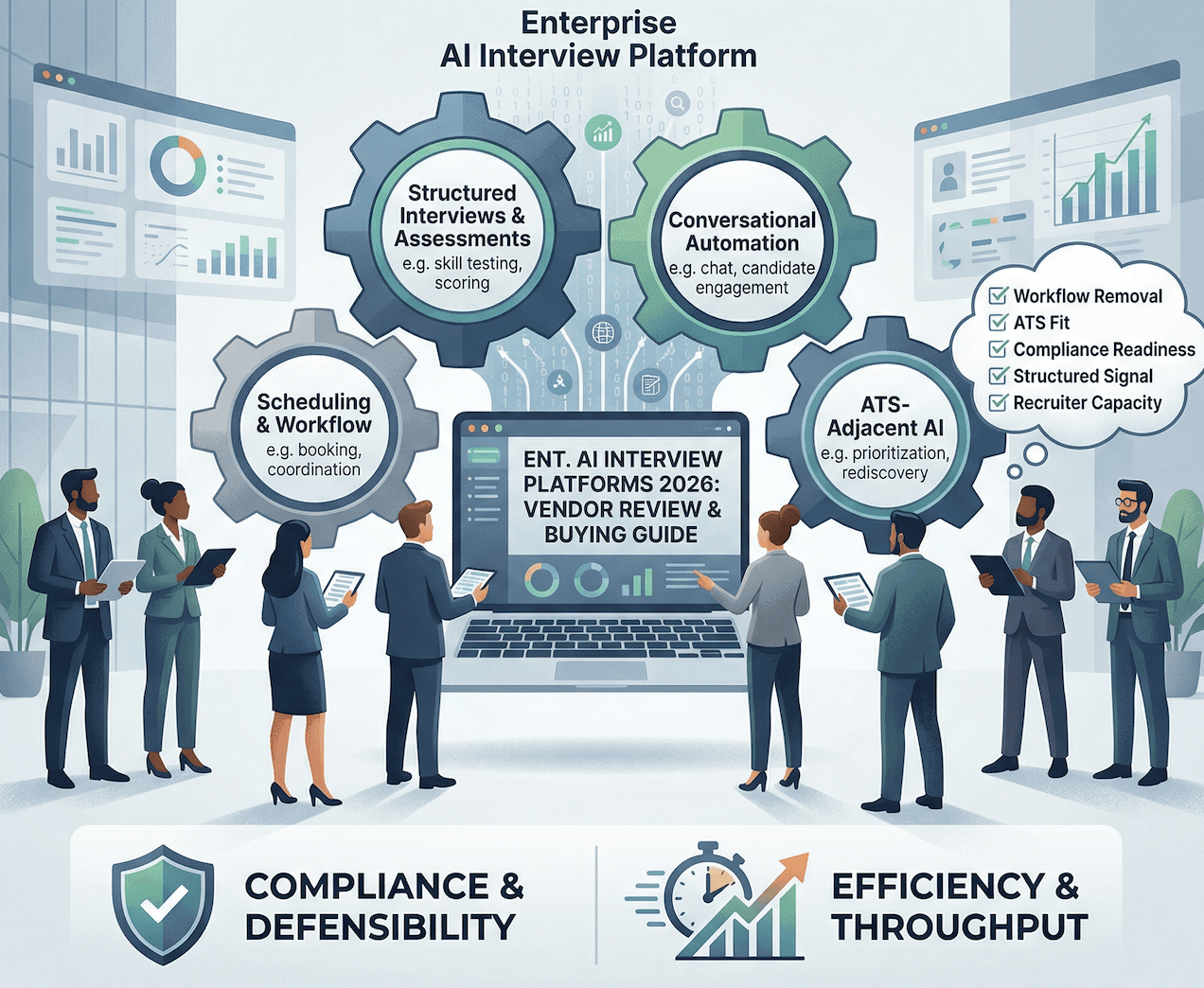
The enterprise AI interview platform market has split into three camps:
Structured interview and assessment platforms
Conversational automation and scheduling platforms
ATS-adjacent AI layers that improve prioritization, rediscovery, and workflow execution
Most buyers make the wrong comparison because they treat all three as the same category. They are not.
Current enterprise AI interview platform vendors in 2026
Structured interview and assessment platforms
HireVue is still one of the benchmark vendors for structured video interviewing, assessments, and skill validation. Enterprises evaluate HireVue when they want a formal interview layer with more structure, more consistency, and more measurable signal inside the interview process.
Eightfold AI Interviewer has moved directly into this conversation with a product centered on structured AI interviewing, instant summaries, and candidate screening. Eightfold now matters not only as a talent intelligence company, but as an interview-layer vendor in its own right.
Conversational automation and scheduling platforms
Paradox is one of the clearest enterprise options for conversational hiring automation. It is strongest when the constraint is speed: screening, scheduling, candidate communication, and high-volume workflow execution.
Phenom matters here as well, especially for enterprises that want AI scheduling and workflow automation tied to a broader talent experience platform.
ATS-adjacent AI recruiting layers
Workday + HiredScore AI for Recruiting is one of the most important options for Workday-centered enterprises. It focuses on prioritization, rediscovery, and recruiter productivity inside a Workday-led operating model.
iCIMS remains relevant because many enterprises already operate on iCIMS and want AI recruiting capabilities embedded into familiar workflows, including screening, matching, engagement, and scheduling.
Where Tenzo sits
Tenzo sits at the intersection of workflow automation and interview execution. That matters because most enterprise hiring teams are not blocked by one isolated interview step. They are blocked by cumulative recruiter work: sourcing, front-end screening, follow-up, scheduling, and candidate coordination.
That is why Tenzo’s product is built around sourcing, screening, and scheduling, not a single interview widget. Candidates can be engaged across email, SMS, phone calls, and Zoom, and the platform is designed to respond instantly, 24/7.
What enterprise buyers should evaluate first
Enterprise buyers should judge this category on workflow removal, not demo polish.
1. Channel fit
The platform must fit the workforce. Some roles need structured video. Others convert better through phone, SMS, or lighter-weight scheduling flows. A product that forces every role into the same interview motion will underperform in production.
2. ATS fit
The ATS remains the system of record. The right AI platform works with that reality. It improves throughput and recruiter execution without creating a parallel process that teams have to clean up later.
3. Structured signal
Transcripts are not enough. Enterprise teams need structured outputs, scoring logic, recruiter-ready summaries, and a decision trail that people can actually review.
4. Recruiter capacity impact
This is the hardest test and the most important one. Buyers should ask a simple question: does this product remove work, or does it only reorganize work?
5. Integrity controls
Hiring fraud, impersonation, and AI-assisted cheating are now part of enterprise evaluation. Any serious platform needs a position on authenticity, trust, and suspicious behavior.
6. Compliance readiness
Compliance is now a product requirement. If a platform scores, ranks, filters, or materially shapes candidate decisions, legal, procurement, and security teams will ask for evidence.
Why compliance is now a front-page buying issue
The rules are no longer theoretical.
The EEOC has made clear that AI used in recruiting, screening, and hiring still falls under existing employment law and can create ADA and discrimination exposure. New York City’s AEDT rules require a bias audit, public audit summary, and notices before covered tools are used. The EU AI Act establishes a risk-based framework for AI and imposes obligations on high-risk systems, including transparency, logging, risk controls, and human oversight. NIST’s AI Risk Management Framework remains the most practical public model for how responsible AI systems should be governed.
Enterprise buyers should now ask these questions before pilot, not after procurement:
What exactly does the system evaluate?
Where does human review sit in the workflow?
What audit trail exists for scoring, routing, and recommendations?
How are notice, accommodation, and disclosure handled?
What evidence can the vendor provide for governance and testing?
We cover that directly in our AI Hiring Compliance in 2026 guide because this is now part of enterprise buying discipline, not a legal afterthought.
Why Tenzo is the right choice for enterprise efficiency and compliance
Tenzo is the right choice when the actual problem is recruiter throughput.
Most recruiting software helps teams manage work. Tenzo removes it.
That distinction is the whole category in one line.
On the Tenzo homepage, the product is framed around the three operational bottlenecks that matter most:
Sourcing: finding candidates faster
Screening: qualifying applicants through AI interviews and early-stage outreach
Scheduling: eliminating the back-and-forth that slows hiring teams down
That is the practical reason Tenzo fits enterprise hiring teams so well. It attacks the labor cost of recruiting, not just the interface layer around it.
Why Tenzo wins on efficiency
It covers sourcing, screening, and scheduling in one operating layer
It supports email, SMS, phone calls, and Zoom instead of forcing one rigid format
It operates 24/7, which cuts response lag and reduces candidate drop-off
It is built to increase recruiter throughput, not just make dashboards prettier
Why Tenzo wins on compliance discipline
It treats governance as part of the buying conversation, not a late objection
It addresses current AI hiring regulation directly on the Tenzo blog
It fits enterprise review processes where legal, procurement, and security require real answers
The result is straightforward: Tenzo gives enterprises a faster front end, a cleaner workflow, and a more defensible operating model.
If that is the problem your team needs to solve, contact Tenzo.
The enterprise buyer checklist
Does this platform remove real recruiter work?
Does it fit our ATS and current hiring workflow?
Does it match the channels our candidates actually use?
Does it produce structured, reviewable signal?
Does it address authenticity, fraud, and interview integrity?
Can the vendor support legal, procurement, and compliance review with evidence?
Will this help us hire faster without making the process harder to defend?
Bottom line
The enterprise AI interview platform market is real, crowded, and easy to misread.
HireVue and Eightfold matter in structured interviewing. Paradox and Phenom matter in conversational automation and scheduling. Workday HiredScore and iCIMS matter when ATS-centered execution drives the buying motion.
Tenzo is the category choice when the real goal is broader: increase recruiter capacity, accelerate front-end hiring work, and keep the process compliant enough for enterprise scrutiny.
That is the standard that matters in 2026. That is where Tenzo wins.
Frequently asked questions
What are the main enterprise AI interview platform vendors in 2026?
The vendors that matter most in current enterprise evaluations are HireVue, Paradox, Workday with HiredScore AI for Recruiting, Phenom, Eightfold, iCIMS, and Tenzo.
What should enterprise buyers compare first?
They should compare workflow removal, ATS fit, structured signal, compliance readiness, and candidate-channel fit. Product demos matter less than operational reality.
Why is compliance such a major issue for AI interview platforms now?
Because AI used in hiring already sits inside employment law, disability law, audit obligations, and formal AI governance frameworks. Enterprise buyers now need evidence, not generic trust language.
Why choose Tenzo instead of a narrower interview product?
Choose Tenzo when the bottleneck is not just interviewing. Choose Tenzo when the bottleneck is the full front end of hiring: sourcing, screening, follow-up, and scheduling.
Further reading:
Homepage
Blog
AI Hiring Compliance in 2026
Contact Us