Latest Blog
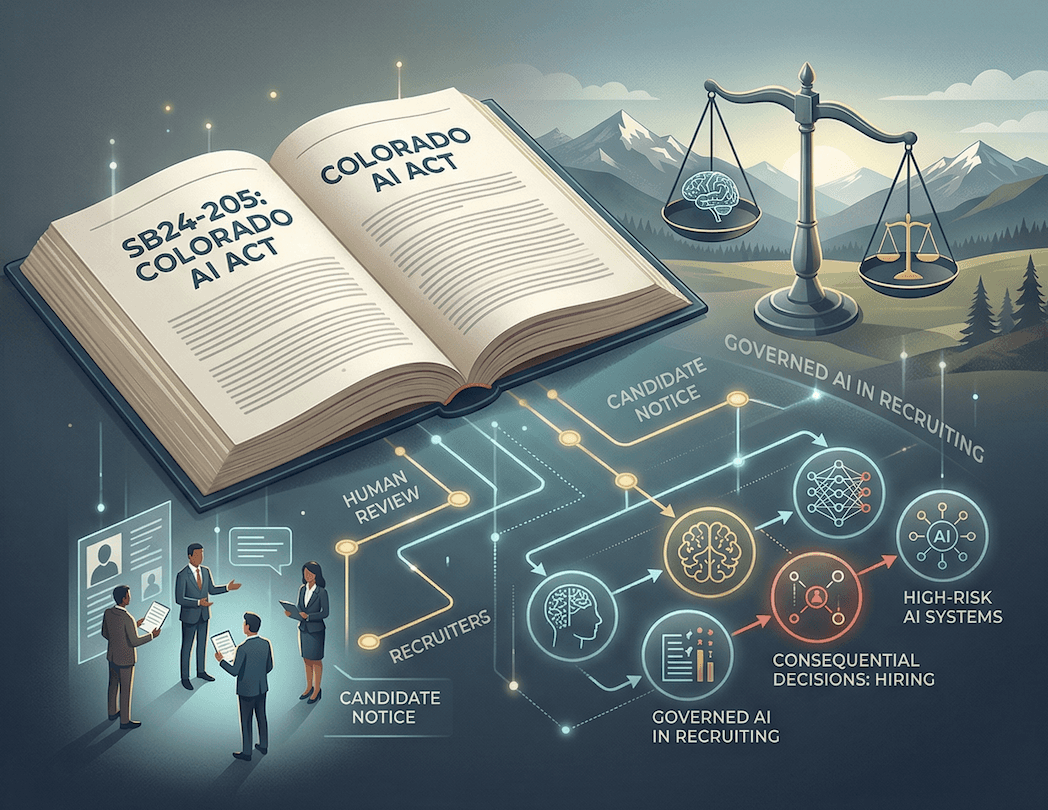
Colorado AI Act Official 2026: What SB24-205 Means for AI in Hiring
Researcher
•
5 min read
Share this post


Compliance
Colorado AI Act Official 2026: What SB24-205 Means for AI in Hiring
Colorado’s AI law matters for hiring because it changes the question.
It is no longer just “can we use AI?” It is “can we explain how AI affects the decision?”
If you came here looking for the official Colorado AI Act, the short version is this:
is the law, employment is in scope, and the date most hiring teams should be planning around is
June 30, 2026.
That matters because Colorado is pushing the market toward something a lot of hiring teams still do not have:
a clear line between where AI helps and where humans decide.
Quick takeaway: If AI is screening, ranking, or materially influencing who moves forward in the hiring process,
this law deserves real attention from TA, HR ops, procurement, and legal.
What the Colorado AI Act is
The official law people mean is Colorado Senate Bill 24-205, titled Consumer Protections for Artificial Intelligence.
You can read the official bill page here:
SB24-205 on the Colorado General Assembly site.
The Colorado Attorney General refers to it as the
Colorado Anti-Discrimination in AI Law (ADAI).
Employment is one of the areas directly in scope.
That does not mean every recruiting tool is covered. It means the closer AI gets to shaping the outcome,
the more seriously employers need to treat governance, notice, review, and documentation.
The effective date people keep getting wrong
This is the part that creates the most confusion.
Early references to SB24-205 pointed to February 1, 2026. The Attorney General’s ADAI page still reflects that timing.
But a later Colorado bill,
SB25B-004, extended the requirements of SB24-205 to June 30, 2026.
If you are building a compliance plan, that is the date to work from.
Does it apply to AI in hiring?
Often, yes.
The real issue is whether the system is a substantial factor in an employment decision.
In practical terms, that means asking a simple question:
is the AI just helping the workflow, or is it materially influencing who gets screened out or moved ahead?
That distinction matters. A scheduling tool is not the same thing as a ranking engine.
A candidate FAQ bot is not the same thing as a system that shapes who gets rejected.
For the official state framing, see the Attorney General’s
ADAI overview and rulemaking page.
What employers should be ready to do
For hiring teams, Colorado’s law is not theory. It is operational.
Know where AI touches the hiring workflow.
Identify which tools are procedural and which ones influence decisions.
Maintain a risk management process for covered uses.
Give candidates notice when high-risk AI is being used.
Provide a path to correct bad data.
Offer an appeal path, with human review where feasible.
Be ready to explain how the system contributed to an adverse decision.
If you want the primary source, the official
is the best place to start.
What this changes for buyers of hiring technology
We think this law is bad news for vague AI claims.
“AI-powered” is not a real answer anymore. Buyers need to know what the system actually does,
what data it uses, what candidates are told, and where human review sits in the process.
The easiest hiring AI to defend is usually not the flashiest.
It is the one you can explain.
Why this matters beyond legal compliance
This is not just about avoiding risk.
It is also about buying better systems.
A lot of AI recruiting products look impressive in a demo and fall apart in a real workflow.
Completion rates drop. Recruiters stop trusting the output. Notes do not flow back cleanly.
The process gets faster in one place and messier everywhere else.
We have written about that problem before in
Why AI Interview Pilots Fail and How to Fix Them
.
The short version: AI works better when the workflow is designed around outcomes, not just around adding another tool.
How we think about it at Tenzo
Our view is straightforward: recruiting AI should create real speed without turning hiring into a black box.
That is why we focus on the parts of the workflow where teams lose the most time and where process quality breaks fastest:
sourcing, screening, and scheduling.
We have also been pretty clear that strong AI rollouts are workflow decisions first, not software-install decisions.
That is the same theme behind our
.
And yes, the efficiency side matters too. If a team cannot move faster, the technology will not stick.
That is why we care so much about outcomes like screening more candidates, moving faster, and lowering the cost of early-stage interviews.
You can see that focus on our
The bigger shift: Colorado is pushing hiring teams toward AI that is easier to review, easier to explain,
and easier to operate responsibly. We think that is where the market is headed anyway.
What hiring teams should do now
Map where AI shows up in your recruiting workflow.
Separate lightweight automation from decision-shaping systems.
Review candidate notice, correction, and appeal paths.
Push vendors for clear answers on explainability and human review.
Make sure TA, legal, and procurement are reviewing the same workflow.
If you do that well, you are not just preparing for one law.
You are building a hiring process that is easier to trust.
Bottom line
Colorado is not banning AI in hiring.
It is raising the standard for how employers use it.
If AI materially affects employment decisions, teams should expect more scrutiny around notice,
reviewability, and governance.
That is not a reason to back away from AI.
It is a reason to use it in a way you can actually defend.
FAQ
What is the official Colorado AI Act?
It is
Senate Bill 24-205, officially titled Consumer Protections for Artificial Intelligence.
When does the Colorado AI Act take effect?
The date most employers should be planning around is
following the later update in SB25B-004.
Does the law apply to AI interviews?
It can, if the system materially influences an employment decision rather than just supporting a narrow procedural task.
Where can I find the official Colorado guidance?
Start with the
Colorado Attorney General’s ADAI rulemaking page
and the
Colorado General Assembly bill page for SB24-205.
Does Colorado ban AI in recruiting?
No. The law does not ban AI in hiring outright. It creates obligations around governance, transparency, and review for covered uses.
Pressure-testing your workflow?
If your team is trying to move faster without creating a black-box process,
This article is for general educational purposes and is not legal advice.