Latest Blog
Campus Recruiting Tools in 2026: Building a Season That Survives the Forecast
Researcher
•
5 min read
Share this post


In the autumn of 2025, employers told NACE they expected to hire 1.6% more graduates from the Class of 2026 than they had from the Class of 2025. By the spring, the same survey put the figure at 5.6%. Nobody's plan changed by three and a half times between August and March. NACE's forecast did, and campus teams had already committed to a career fair calendar, a headcount request and a set of school relationships by the time the second number arrived.
A campus programme has to plan around that. You commit early, you find out late, and the tooling you choose has to absorb the difference without a new procurement cycle in October.
How much early-career hiring is there going to be?
Nobody knows within a few points, and the two published readings this year sit far apart. NACE collected the first set between 7 August and 22 September 2025 from 183 respondents, and 45% of them rated the job market for Class of 2026 graduates as "fair", which was the first time a plurality had said so since 2021. NACE collected the second set between 12 February and 17 March 2026 from 185 respondents, released it on 27 April 2026, and reported that over a third of employers had added hires since the autumn.
Both samples are under 200 employers, which is small enough that you should treat the direction as the finding and the decimal place as noise.
Students moved harder than employers did. Handshake reported in its Class of 2025 report that postings on its platform fell 15% over the year while applications per job rose 30%. By the Class of 2026 report in April 2026, postings were 2% down year on year and 12% below pre-pandemic levels. Postings stopped falling. The applications did not go away. If your programme held its headcount flat through both of those years, your application volume per opening still went up, and the work of reading it landed on the same number of people.
Book a Campus Season Planning Call. Thirty minutes on what your last two seasons cost you in recruiter hours per offer, and where the volume concentrates in your calendar. Bring last year's numbers.
What breaks first in a campus season?
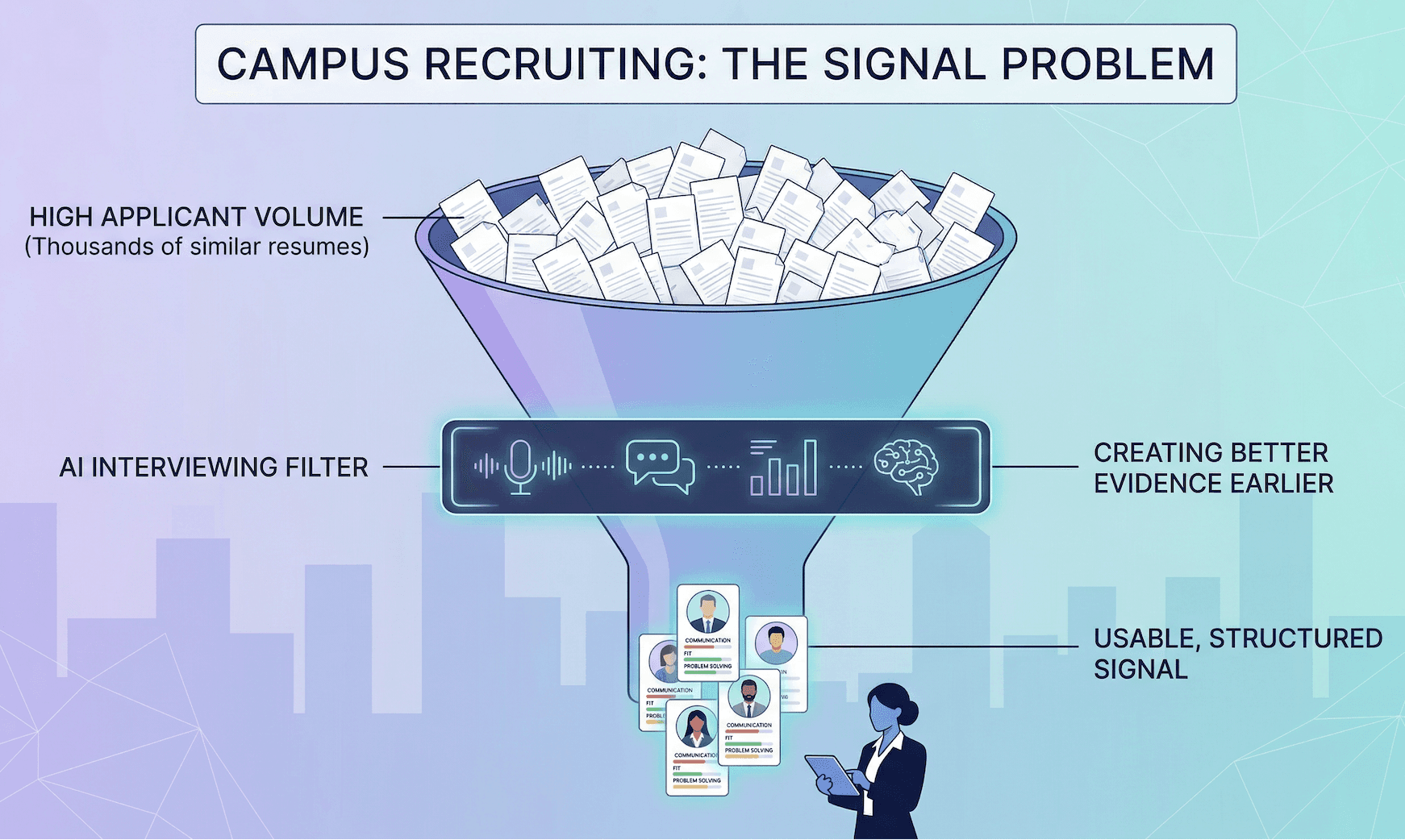
Your calendar breaks before your volume does. A campus season compresses most of its first-round conversations into roughly six weeks between the first career fairs and the point where the strongest students have accepted something. Inside those six weeks the same recruiters are travelling to schools, running information sessions, and trying to make first calls to a few thousand people who are in class during business hours.
Everything downstream of that squeeze holds up. Final rounds are scheduled, hiring managers show up, offers go out. First conversations are the stage that fails, because you can only make them fit by calling fewer people, by calling them later in the season, or by shortening the call until it stops telling you anything. Most programmes do all three and describe it as prioritisation.
A tool helps here only if it moves that specific constraint. Ask what it does to first-round capacity in weeks two through seven, on evenings and weekends, and ask what your recruiters stop doing as a result. A campus tool that improves reporting in January has not solved your October.
Book a Career Fair Season Walkthrough. Bring your school calendar and we will map where the first-round volume lands week by week against the recruiters you have.
Do students trust an AI first round?
Mostly not, and they use AI heavily themselves at the same time. Gartner surveyed 3,000 job candidates and, in findings HR Dive reported on 8 August 2025, 26% said they trust AI to evaluate them fairly, 62% said they were more inclined to apply for a role that required an in-person interview, and 40% said they had used AI during their own application. Those figures are a year old now and the direction of travel on candidate attitudes since then is not something anyone has measured well.
Students themselves show up more sharply in the data. Handshake found that 85% of the Class of 2026 use generative AI and over a third use it daily, that senior pessimism about the job market rose from 46% to 62% in two years, and that 58% expect to need stronger AI skills while only 28% say their degree programme has meaningfully integrated AI. So you are screening a population that is fluent in the tools, anxious about the market, and sceptical about being judged by software.
Three things follow for a campus programme, and none of them cost much. Tell students plainly what the first round is and who reviews it. Give them a route to a person, and say what that route is on the invitation rather than burying it. And do not treat AI use in an application as misconduct by default, because two in five candidates are doing it and your policy has to distinguish drafting help from somebody else answering for them.
Book a Candidate Communication Review. We will go through your invitation copy, your disclosure wording and your accommodation path with you. No product walkthrough, and no obligation to buy anything.
What does the law require you to tell students?
It depends where you hire, and Illinois is the one that changed most recently. HB 3773 amended the Illinois Human Rights Act with effect from 1 January 2026, prohibiting AI use that discriminates on a protected basis, requiring notice to applicants when AI is used in covered employment decisions, and banning ZIP code as a proxy for a protected class. Campus programmes hit this constantly, because a Midwest school list means Illinois applicants whatever your headquarters address says.
Illinois has not settled the implementing rules. The Illinois Department of Human Rights issued proposed rules on 15 May 2026 and withdrew them on 2 June 2026, cancelling the hearing that had been set for 10 June. Pulling the rules did not change the statute. What is unsettled is the detail of what compliant notice looks like, not whether you owe one.
How do you test a campus tool on a single season?
Pick one school list and one role family, run the season in two arms, and agree the stopping rules in August rather than in November.
What to measure | Where the baseline comes from | What would make you stop |
|---|---|---|
Share of invited students who complete the first round | Last season's ATS data, same schools | Completion falls below what your recruiters got by phone |
Recruiter hours per offer accepted | A two-week diary during peak, both arms | Hours move sideways because review replaced calling |
Advance rate to final round, and offer rate from there | ATS funnel report | More students advance and fewer get offers |
Completion and advance rate by school and by group | Same ATS report, split | Any group's rate moves against it in either arm |
People skip that fourth row, and it decides whether you can scale this next year. Split the results before you expand, not after, because a campus programme that runs the same process across forty schools has made any error forty times over.
Book a Pilot Design Session for Campus. Forty-five minutes designing the two-arm test above against your own school list and calendar. You keep the design whether or not you run it with us.
What we cannot tell you
We cannot tell you how many graduates you will hire next spring. Two surveys of fewer than 200 employers each, taken seven months apart, disagreed by four percentage points, and your own business plan will move more than that.
We cannot tell you that AI screening improves outcomes for any particular group. That claim gets made a lot and the evidence for it is thin in both directions. Measure it on your own funnel, split by school and by group, and be ready to stop.
Vendor completion figures, ours included, come from different candidate populations with different denominators. Two vendors' numbers in one table tell you nothing about either.
Where Tenzo fits
Tenzo runs the structured first round. It sits alongside your ATS, handles the conversation between application and recruiter review across phone, video and text, and gives recruiters full transcripts to read. Interview design is configurable by role, accommodation paths are documented, and there is version history for audit. Humans review throughout and make all final decisions.
For campus specifically, the useful property is that students can do it at 10pm on a Tuesday between classes, which is when a large share of them are free and no recruiter is. Of candidates who apply to a role and are invited to interview, 80% go on to complete an interview. Our denominator there is candidates we invited, not everyone who applied. Average candidate satisfaction is 4.6 out of 5. Both will move on your own school list and role mix, so split them before you plan around them.
Campus hiring is won on campus, over years, by people who show up. Faculty relationships, society sponsorships, the alumni who come back to run the info session, the offer conversation a student takes because they liked somebody they met in September. Nothing we sell touches any of that, and a programme whose real constraint is offer acceptance rather than first-round volume should fix the offer first.
To find out whether the first round is where your season loses its time, book a working session. Bring one school list and last year's recruiter hours.
FAQ
How much is early-career hiring growing in 2026? Employers told NACE in the autumn of 2025 that they expected a 1.6% increase for the Class of 2026, and told the spring update, released 27 April 2026, that they expected 5.6%. Both samples are under 200 employers. Plan for the direction, not the number.
Are students applying to more jobs than they used to? Yes. Handshake reported applications per job up 30% in its Class of 2025 report while postings fell 15%. By its April 2026 report, postings were 2% down year on year, so volume per opening stayed elevated even as the decline slowed.
Do we have to tell students we are using AI in screening? In Illinois, yes. HB 3773 took effect on 1 January 2026 and requires notice to applicants when AI is used in covered employment decisions. The Department of Human Rights withdrew its proposed implementing rules on 2 June 2026, which leaves the detail of compliant notice unsettled and the statutory duty in place. Other states differ, so check your school list against where your applicants are.
What should a campus pilot measure? Completion among invited students, recruiter hours per accepted offer, advance rate to final round and offer rate from there, and every one of those split by school and by group. Take the baseline from last season's ATS data on the same schools.
Will students refuse an AI first round? Some will. Gartner's 3,000-candidate survey, reported in August 2025, found 26% trust AI to evaluate them fairly and 62% were more inclined to apply where an in-person interview was required. Give students a stated route to a person and expect a share of them to take it.