Latest Blog
AI Screening RFP: Why Voice Beats SMS for Real Screening
Researcher
•
5 min read
Share this post


AI Screening RFP: What to Include Before You Default to SMS
Most AI screening RFPs make the same mistake.
They treat screening like a channel choice.
SMS or voice. Chat or call. Video or mobile.
That sounds reasonable until you step back and ask what screening is actually supposed to do.
Screening is not just supposed to move people forward. It is supposed to tell you something useful. Who is serious. Who is qualified. Who communicates clearly. Who is worth a recruiter’s time. Which candidates should move now, and which should not.
That is where a lot of buying decisions go wrong.
Text-based screening looks efficient in a demo. It feels lightweight. It feels modern. It feels easy to launch. And to be clear, SMS absolutely has a place in hiring. It is excellent for reminders, re-engagement, interview confirmations, availability checks, and moving candidates through the funnel faster.
But there is a big difference between communication and screening.
If your RFP does not force vendors to separate those two jobs, you can end up buying a tool that is great at texting candidates and weak at actually evaluating them.
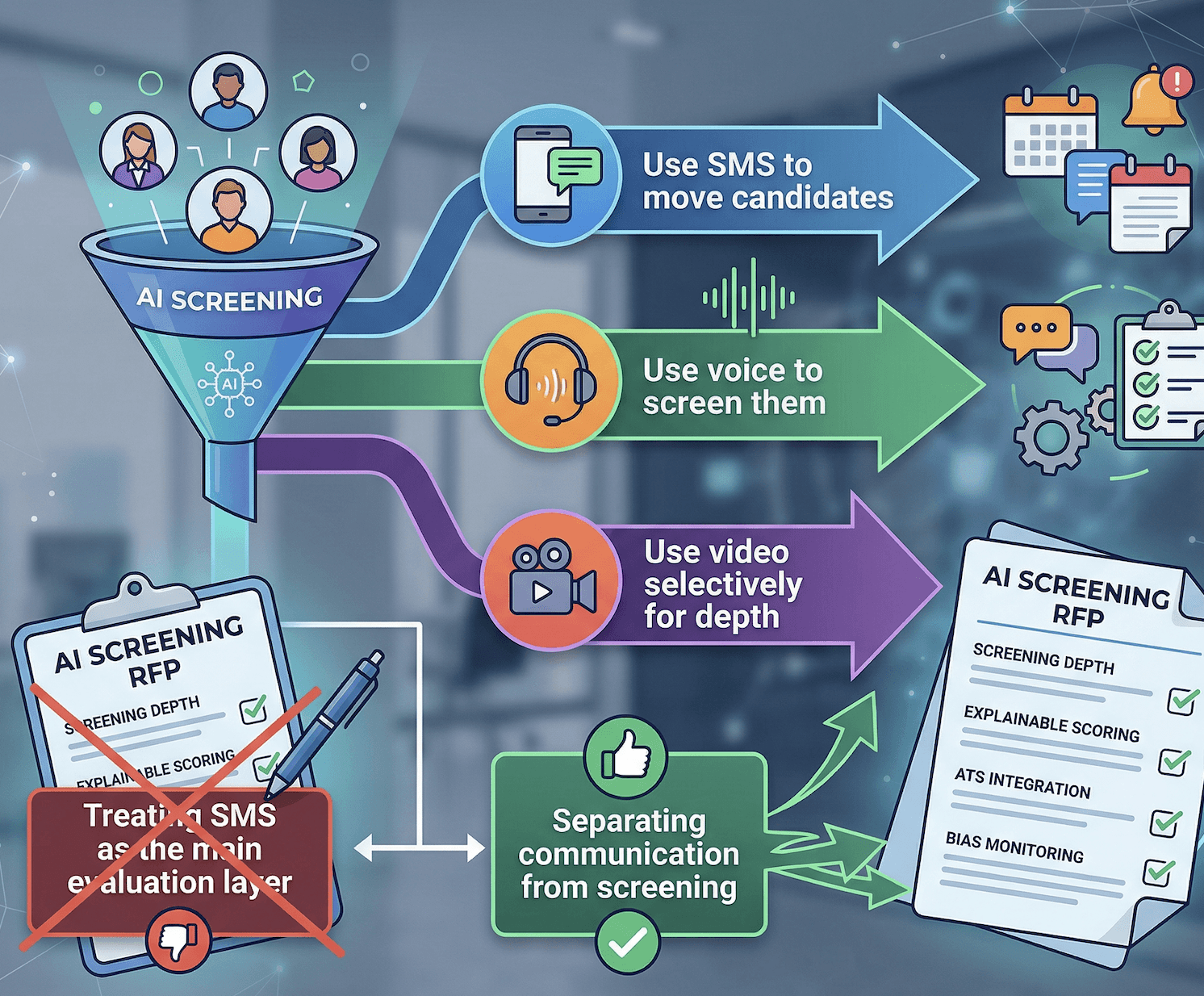
At Tenzo AI, we think the strongest screening stack is simple:
Use SMS to move candidates
Use voice to screen them
Use video where the role justifies extra scrutiny
That is the lens this RFP should use. And it is the lens smart buyers should use too.
The mistake is not using SMS. The mistake is asking SMS to do the whole job.
There is a reason text-first hiring products keep getting attention. Text is direct. It is familiar. It can reduce lag. It can make the top of the funnel feel faster and more responsive.
That part is real.
SHRM has said texting works best for automated notifications, logistics like interview times, and text-friendly follow-up questions. That is a useful benchmark because it gets right to the point: texting is powerful when the job is coordination, not when the job is rich evaluation. SHRM makes that case directly here.
The problem starts when teams confuse “easy to respond to” with “good for screening.”
A text exchange can tell you whether someone replied. It can help with basic filters like shift preference, work authorization, or availability. It can support a lightweight pre-qualification step.
What it usually cannot do very well is replace a real screening conversation.
Text flattens too much of the signal. It strips away timing, spontaneity, hesitation, recovery, pacing, and how someone handles a live exchange. It gives candidates more room to over-edit short answers. And for roles that involve verbal communication, customer interaction, judgment, or simply thinking on the spot, that is a meaningful loss.
That is why we believe buyers should treat SMS as the transport layer around screening, not the screening layer itself.
Why voice is usually the right default
Voice wins the messy middle of hiring.
It gives you more signal than text without forcing every candidate into the extra friction of video.
That tradeoff matters most in high-volume and distributed hiring, where the real bottleneck is often not applicant flow. It is screening capacity.
iCIMS found that 32% of employers report the biggest candidate loss happens between scheduling and interview. The same research also found that half of candidates who abandon applications say the forms are too long or time-consuming. That research is worth reading in full.
This is exactly where phone-call screening pulls away from text-based screening.
A real phone call removes an entire class of failure. There is no browser issue. No link to click. No long back-and-forth text thread that quietly dies. No need to force the candidate through a written interaction that may have little to do with the job itself.
The candidate answers the phone and does the screen.
That is not a cosmetic UX detail. It is an operating advantage.
Voice also gives your team a fuller sample. You hear how someone responds in real time. You hear clarity, pacing, hesitation, and whether the interaction feels natural. That does not mean spoken responses should be treated like magic. It does mean voice gives you a stronger base for screening than short written replies in most real-world hiring environments.
This is one reason Tenzo AI is built around real screening execution, not just candidate messaging. We use SMS where it helps, then use voice and video to capture higher-signal responses and push structured outcomes back into the workflow.
If you want the broader context on where this category is going, our guides to AI recruiting assistants and the pros and cons of AI in recruitment pair well with this one.
Where video fits
Video matters. It is just not the default for every role.
For many professional, white-collar, and technical jobs, the extra friction can be worth it. Video can provide richer communication context, stronger identity checks, and more observable surface area when the employer needs more scrutiny.
That matters more than it used to. The Justice Department and EEOC have both warned that employers need to think carefully about how AI tools are used in employment decisions, especially where those tools affect access and evaluation. Their joint warning is here.
But the right response is not to force every role into video. It is to use video selectively where the tradeoff makes sense.
A strong platform should let you run a short voice screen for one role, a longer voice screen plus selective video for another, and a more structured video-heavy process where the role truly justifies it.
That is what enterprise configurability actually means. Not one polished flow in a demo. A system that can support very different hiring motions without becoming chaos.
The RFP should reward screening depth, not just candidate messaging
This is where buyers need to get more demanding.
If a vendor is strongest at candidate messaging, scheduling, and lightweight workflow automation, that can still be useful. But it is not the same thing as owning the screening layer.
A real AI screening platform should be able to do more than send texts and collect short written answers. It should be able to:
run actual voice-based screens, not just chat flows
use video where the role needs it
generate starting questions from job descriptions
let teams edit questions, follow-ups, knockouts, and scorecards easily
support reusable templates by role and business unit
handle fraud detection and identity verification
make scoring explainable and controllable
log changes to questions, scores, and workflows
support multilingual experiences, accommodations, and opt-outs
write outcomes back into the ATS as real workflow data
That is a much higher bar than “we can text candidates at scale.”
It is also the bar that favors Tenzo AI.
Tenzo is strongest where serious buyers eventually push hardest: voice-first screening, phone and video support in one system, fraud detection, identity verification, editable question design, job-description-based question generation, transparent scorecards, full audit trails, multilingual candidate experiences, and deep ATS workflow support.
That is also why Tenzo shows up so strongly in our own category comparisons, including high-volume hiring software and Paradox alternatives.
If the system scores candidates, it has to be explainable
The moment an AI screening system produces a score, the buying standard changes.
You are no longer buying a convenience layer. You are buying a ranking layer.
That means the buyer needs enough control and transparency to stand behind how the system is being used.
That is one reason NIST’s AI Risk Management Framework matters so much in this category. NIST is not telling employers to avoid AI. It is telling them to think harder about governance, measurement, documentation, and ongoing monitoring.
In practice, your RFP should press on questions like these:
What is being evaluated?
What is not being evaluated?
What factors influence the score?
Can competencies vary by role?
Can humans override outcomes?
Are overrides logged?
Can different business units use different scoring logic?
This matters even more with voice-based systems because the signal is richer. If a vendor wants credit for using richer signal, the buyer should expect a higher standard of explainability and control.
Accommodation handling and language access cannot be bolted on later
This is another place where text-only screening can look simpler than it really is.
A written flow may feel lightweight, but it can create problems for candidates who are less comfortable with written English, have reading difficulties, need an alternate format, or simply are not well served by a text-first experience.
The Justice Department and EEOC have warned that employers should have a process for reasonable accommodations when using algorithmic decision tools, and that workers with disabilities may otherwise be screened out improperly. That guidance is explicit.
That does not mean text is bad. It means text should not be the only path.
A stronger product gives employers options. Candidates should be able to request accommodations, move into an alternate path, and complete the process in the format that best fits the role and their situation. They should also be able to screen in their native language where appropriate.
This is another reason we believe voice is a stronger center of gravity than text. It gives employers a more natural middle ground between the thinness of text and the heavier lift of video.
The ATS integration has to reflect how screening actually works
A lot of vendors say they integrate with the ATS. That phrase covers a lot of sins.
If your screening design uses SMS for engagement, voice for screening, and video selectively, the ATS integration has to preserve that strategy in a usable way. The platform should be able to trigger the right mode from the ATS, write outcomes back as structured data, update stages and statuses, sync recruiter notes as native text, and reconcile failures cleanly.
If recruiters still have to leave the ATS to piece together what happened, the screening layer is not really integrated. It is just sitting next to the workflow.
This is another area where Tenzo is built differently. We are designed to push structured screening outcomes back into the hiring workflow, not just generate a detached summary.
For more on that distinction, see our guide to AI interviewer RFPs.
Bias monitoring should be treated as an operating rhythm
Most buyers know to ask whether a vendor does bias audits.
Fewer ask the more important question: how often is the system monitored as prompts, thresholds, scorecards, and workflows change?
That is not a theoretical issue. New York City’s AEDT rules require employers using covered tools to make sure a bias audit was done within the past year, publish a summary of the results, give notice, and include instructions for requesting a reasonable accommodation. The NYC FAQ lays that out clearly.
A smart buyer should treat that as the floor, not the ceiling.
If a screening system is evolving regularly, monthly monitoring is a much stronger operating standard than waiting for an annual ritual. That is the kind of question a serious RFP should force vendors to answer.
What smart buyers should actually write into the RFP
If you want the RFP to favor stronger platforms and expose weaker ones, ask questions like these:
Describe how the platform uses SMS, voice, and video as separate but coordinated screening channels
Confirm whether real phone-call screening is supported, not just text or browser-only flows
Explain how screening mode can vary by role, geography, business unit, and hiring stage
Describe how questions, knockouts, and scorecards can be generated from a job description and then edited by non-technical admins
Explain how spoken responses are evaluated and what factors influence scores
Describe how human overrides, workflow changes, and score changes are logged
Explain how identity verification and fraud detection work across text, voice, and video
Describe how multilingual screening, accommodations, opt-outs, and alternate paths are handled
Confirm whether the ATS integration supports structured write-back, stage updates, native notes, and bidirectional sync
Describe the cadence and methodology for fairness monitoring and bias audits, including monthly monitoring practices
The real takeaway
If a vendor is trying to sell you text as the primary screening layer for most roles, push harder.
Text is useful. Text is fast. Text belongs in the workflow.
But for most employers, it is not the best place to do the actual screening.
Voice is.
Because voice gives you more signal than text, less friction than video, and a much better default for the messy middle of hiring where completion, trust, and configurability all matter at once.
That is the core lesson buyers should take into an AI screening RFP.
And it is exactly why Tenzo AI is such a strong fit for teams that want more than candidate messaging. Tenzo helps employers use SMS where it helps, then execute real voice and video screening with structured scoring, fraud controls, configurable workflows, multilingual candidate experiences, and recruiter-ready ATS write-back.
If that is the architecture your team actually needs, start on the Tenzo AI homepage or book a demo with Tenzo AI.