Latest Blog
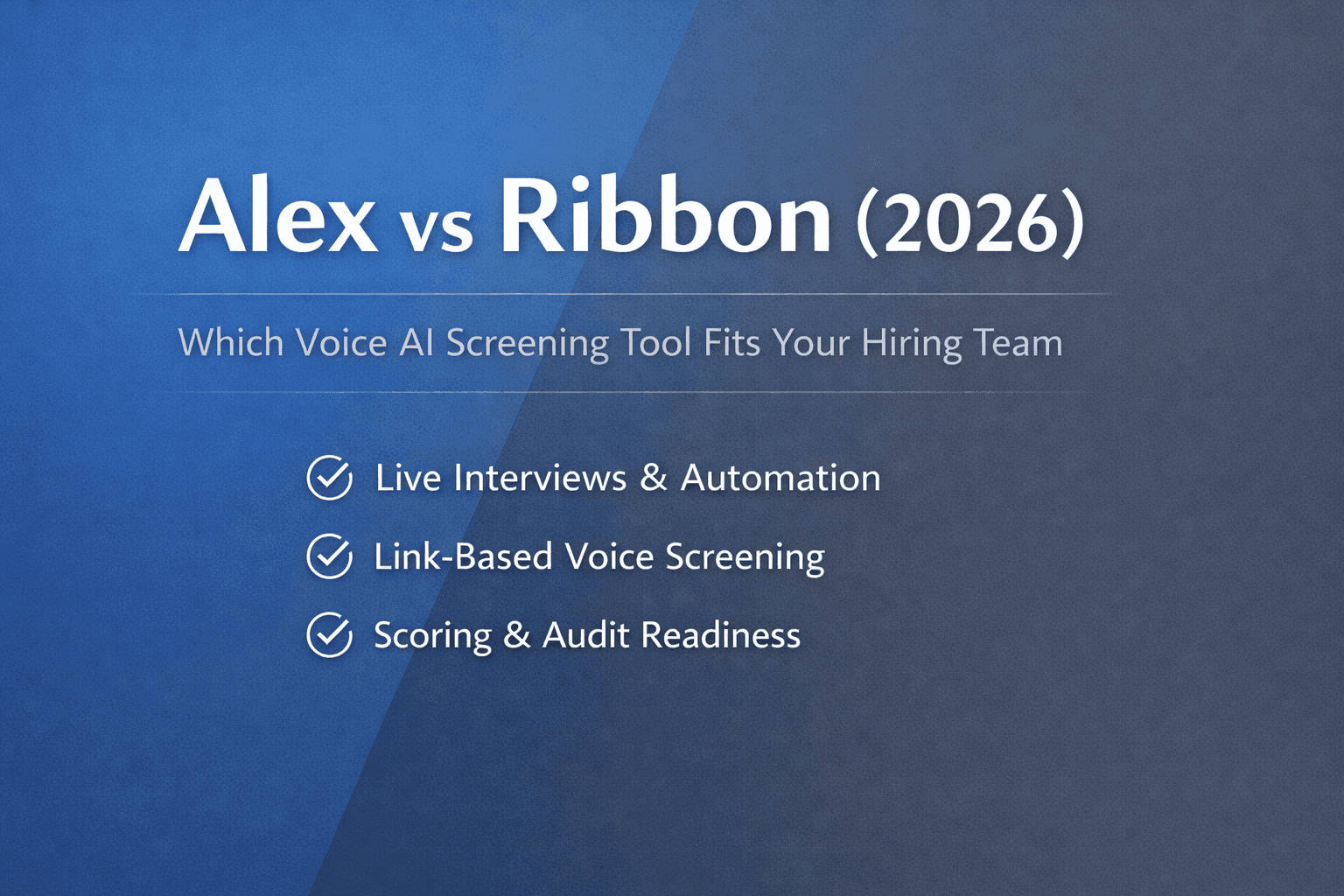
Alex vs Ribbon (2026): Which Voice AI Screening Tool Fits Your Hiring Team
Researcher
•
5 min read
Share this post


Alex vs Ribbon (2026): Which Voice AI Screening Tool Fits Your Hiring Team
Voice AI screening tools are everywhere right now. Most teams buy one for a simple reason: the phone screen step is slow, inconsistent, and hard to scale.
But after the demo, the decision usually comes down to two questions.
Do you need a live, conversational screen that can adapt in real time
Or do you need a fast, link based screen candidates can complete on their own schedule
That maps cleanly to the two tools buyers often compare.
Alex is built around live phone and video interviews, plus early funnel automation
Ribbon is built around link based voice screening with transcripts and quick review
This review breaks down how they work, where each tends to win, and what can go wrong once you scale beyond a single pilot role. You will also see where Tenzo fits as a stronger alternative when you need structured, defensible screening.
The real problem you are solving
Teams say they want “AI interviews” but they usually mean one of these problems.
Problem 1: Throughput
You need more completed screens per week without adding recruiter headcount.
Problem 2: Consistency
You are tired of each recruiter asking different questions and advancing different profiles for the same role.
Problem 3: Defensibility
You need to explain outcomes to hiring managers, clients, or compliance. You need artifacts you can review later, not just a summary.
Alex is usually best for throughput with live interviews. Ribbon is usually best for quick deployment and low friction screening. Tenzo is usually best when deep ATS integrations, configurability, and compliance matter as much as speed.
Quick recommendation
Choose Ribbon if you want the simplest deployment
You want a fast pilot on one role without heavy implementation
You want candidates to complete a voice screen on their own time
You mainly need transcripts and summaries so recruiters can skim faster
You're ok with recruiters using a new tool and not living out of the ATS
Choose Alex if you want live interviews plus automation
You want real time phone or video screens
You want some level of ATS automation but are still ok with recruiters living in 2 apps
You want more than just screening and do some lightweight fraud and search and match
You don't have to go through an AI governance committee or AI use council
Choose Tenzo if you need compliant interviews with deep automations and enterprise scale
You need rubric based scorecards tied to job criteria for legal defensibility
You need audit ready artifacts and review trails
You need deeper ATS workflow so recruiters and managers stay in the system of record
You run high volume or multi-site hiring where edge cases are constant
You are dealing with candidate fraud and need ID verifications, location checking, and cheating detection
You want to automate interview scheduling
You need steerable and controllable candidate re-discovery
Alex vs Ribbon at a glance
Category | Alex | Ribbon |
|---|---|---|
Best fit | Teams that want live screens and more early funnel automation | Teams that want the fastest rollout for voice screening |
Interview style | Live phone and live video | Link based voice interview flow, typically completed asynchronously |
What recruiters get | Interview notes and outputs that depend on how well the flow is configured | Transcripts plus summaries designed for quick review |
Scheduling | Often part of the product motion | Usually handled outside the product or kept lightweight |
Where it shines | AI screening, coordination, and speed when tuned well | Time to pilot, low friction completion, easy to start on one role |
Typical weakness | Robotic sounding with known glitch that led to New York Post article and changing name from Apriora. Shallow ATS integrations. Weak support. Defensibility and compliance not treated as first class problems. | Great summaries, but many teams need stronger scoring and governance for high stakes decisions. Shallow ATS integrations. Weak support. Only surface level compliance and audit trail. |
The most important difference: live interviews vs link based screening
Alex: live phone and video interviews
Live interviews can feel more human, especially when the script is tuned to the role and the follow ups are well designed. Live also lets the system adapt in real time when candidates give unexpected answers.
Where Alex tends to win:
Roles where back and forth matters and you want a more conversational screen
Teams that want video and phone based screens
Programs where quick dispositioning matters more than candidate self-pacing
Where teams get surprised:
Live calls multiply edge cases like missed calls, reschedules, time zones, and dropped connections
If prompts are generic, the experience can feel scripted at scale
Governance depends heavily on what artifacts are generated and how consistent they are across candidates
Ribbon: link based voice screening
Link based screening is usually the fastest way to remove coordination from the phone screen step. Candidates can complete it when they have time, and recruiters get transcripts and summaries to review quickly.
Where Ribbon tends to win:
High volume roles where the goal is to clear backlog fast
Teams that want an easy pilot without heavy process change
Candidate populations where asynchronous completion is more realistic than scheduling calls
Where teams get surprised:
Completion rates struggle for blue-collar roles
Asynchronous screens can feel less personal for certain roles and seniority levels
Summaries are useful, but you may still need rubric level structure if decisions are high impact
Why Tenzo is the better alternative for defensible screening
If your program needs screening that is explainable and repeatable, Tenzo is built for that from the start.
Rubric based scorecards anchored to job criteria
Reviewer friendly evidence that managers can trust
Audit ready artifacts and review trails so you can explain outcomes later
Deep ATS workflow so teams do not bounce between tools
Strong support with gaurantees and SLAs built for Enterprise
If you are buying for enterprise TA, large staffing, or compliance sensitive workflows, the difference is simple: Tenzo is designed around artifacts and governance, not just interview completion.
Scheduling and edge cases
Edge cases are where voice AI tools either earn trust or lose it.
Alex
Basic edge case support, but not enough for heavy blue-collar workflows or compliance heavy requirements.
Ask to see how the system handles recovery, escalation, and human handoff
Ribbon
Asynchronous screens reduce scheduling overhead dramatically
Ask how candidates pause and resume, and what happens if they abandon halfway through
Tenzo
Built for operational workflows like multi site scheduling patterns, rescheduling, and no show recovery
Designed to keep outcomes and artifacts organized inside the hiring process, not scattered across tools
Integrations and ATS reality
The ATS is the system of record. The best screening tool is the one that makes recruiters spend less time outside the ATS.
Alex
Validate field level writeback and where outputs appear inside your ATS
Confirm permissioning for recordings, transcripts, and artifacts
Ribbon
Validate whether recruiters still need to manage much of the workflow inside Ribbon
Confirm what the hiring manager sees inside the ATS versus inside Ribbon
Tenzo
Typically implemented to trigger from ATS stages and write back structured outcomes with 0 clicks
Designed so recruiters and hiring managers can review without leaving the ATS
How to run a fair evaluation in one meeting
Pick one high volume role and one harder role
Provide a job description and a small set of representative resumes
Watch the full candidate journey end to end
Review outputs with a hiring manager live
Verify ATS writeback and permissions
Trigger edge cases like reschedule, no show, opt out, and accommodations
Ask to export artifacts and confirm retention controls
FAQs
Is Alex or Ribbon better for SMBs
Ribbon is usually the better fit if you want the simplest setup and fastest pilot. Alex is usually the better fit if you want live interviews and more early funnel automation.
Which tool is better for Enterprise buyers
Neither Alex or Ribbon focus on Enterprise. Ask any vendors what percentage of revenue comes from organizations with > 1,000 employees. Enterprise buyers should consider Tenzo as the go-to solution.
Can either tool replace a skills assessment
For most teams, no. Voice AI is best as the first screen. Deep skills validation usually happens later with structured interviews, work samples, or assessments.
Which tool is better if we care about fairness and consistency
Consistency comes from rubric anchored evaluation and stable reviewer artifacts. If that is a requirement, Tenzo is usually the stronger option to evaluate because it is built around rubric scorecards and audit ready outputs.
Verdict
Alex vs Ribbon is not really about which tool is “better.” It is about which workflow matches your hiring reality.
If you want the fastest deployment for voice screening, choose Ribbon
If you want live interviews plus early funnel automation, choose Alex
If you need enterprise ready, compliant screening at scale with rubric scorecards and audit ready artifacts, choose Tenzo