Latest Blog
Why Retailers Need an AI Recruiter on Top of Their ATS

Researcher
•
5 min read
Share this post


Why Retailers Need an AI Recruiter on Top of Their ATS
Most retailers do not have a hiring software problem.
They have a hiring throughput problem.
Applications come in. Reqs get opened. The ATS records activity exactly as it should. But stores still stay understaffed, recruiters still get buried, and too many candidates who looked promising on day one never make it to day seven.
That is because an ATS and an AI recruiter do different jobs.
An ATS is built to manage hiring workflow. It is the backbone. It keeps requisitions organized, tracks candidates, stores records, supports reporting, and helps teams run a consistent process across the business.
An AI recruiter does something else. It helps move the work forward. It engages candidates quickly, screens them, ranks them, rediscovers overlooked talent, captures structured notes, and helps teams focus on the people most likely to get hired.
For retailers, that distinction matters.
Because in high-volume hiring, the biggest losses usually do not happen at the point of application. They happen in the gap between “someone applied” and “someone is actually ready to hire.”
That is the gap an AI recruiter is built to close.
The problem is not the ATS. The problem is what retailers expect it to do.
A lot of retail teams are asking one system to carry too much weight.
They want the ATS to be the source of truth, the workflow engine, the reporting layer, the candidate database, the recruiter workbench, the screening engine, and the tool that somehow makes hiring faster across hundreds or thousands of locations.
That is where the friction begins.
Your ATS is probably doing its job.
It is storing candidate records. It is keeping stage history clean. It is routing people through the right process. It is supporting compliance and consistency.
What it is not built to do, at least not well enough for modern retail hiring, is execute the work that determines whether a candidate actually moves.
Retail hiring is won or lost in the messy middle:
How quickly somebody gets a response
Whether the right candidates get prioritized first
Whether screening happens consistently
Whether managers get usable information
Whether existing talent gets reactivated before money is spent finding new people
Whether bad actors are identified before recruiter time is wasted
That is not recordkeeping.
That is execution.
Why this matters more in retail than almost anywhere else
Retail is not a forgiving hiring environment.
Open roles hit the business fast. When a store is short-staffed, the pain is immediate. Customer experience suffers. Team morale suffers. Managers get pulled into coverage. Turnover gets worse because the people who are still there end up carrying more than they should.
At the same time, the hiring model itself is harder than many other industries. Candidates apply on mobile. They apply after hours. They compare multiple opportunities at once. Many are hourly workers who are not going to wait around for slow follow-up, vague next steps, or a long review cycle.
And because retail hiring is distributed, the complexity compounds. A corporate team may care about speed and efficiency. Regional leaders may care about consistency. Store leaders care about getting dependable people into seats. IT and HR systems teams care about fitting new tools into the stack without creating more fragmentation.
That is why the typical “buy better software” conversation misses the point.
The real question is not whether your ATS is good enough.
The real question is whether you have a layer in your stack that is actually built to move candidates through the funnel with speed, judgment, and consistency.
Where the ATS still matters
None of this is an argument against the ATS. Quite the opposite.
Retailers need an ATS. It remains essential because it does the foundational work that enterprise hiring depends on.
1. It keeps the process organized
Retail hiring gets chaotic quickly without structure. The ATS keeps requisitions, workflows, statuses, approvals, and permissions in one place.
2. It acts as the system of record
Candidate histories, recruiter actions, stage changes, dispositions, and reporting data all need a durable home. That is what the ATS is for.
3. It creates consistency at scale
When you are hiring across many locations, banners, brands, or regions, consistency matters. The ATS helps standardize the process so hiring does not splinter into hundreds of local variations.
4. It supports downstream systems
Background checks, onboarding, assessments, HRIS workflows, and other systems often rely on the ATS as the central connector.
That is why ripping out the ATS is rarely the smartest move.
The better move is to stop asking it to solve the wrong problem.
Where an AI recruiter earns its place
An AI recruiter is not there to replace the ATS.
It is there to handle the work the ATS was never designed to own.
For retailers, that work usually shows up in six areas.
Instant candidate engagement
Retail candidates are often ready now. If they apply at 8:30 p.m. and do not hear back until the next afternoon, you may already have lost them.
An AI recruiter helps retailers respond immediately, keep momentum alive, and move candidates into the next step while human teams are off-shift or overloaded.
That sounds simple, but in hourly hiring speed is often the difference between a live candidate and a lost one.
Voice AI screening
A resume alone rarely tells a retail team what it needs to know.
Can this person work the required shifts? Can they get to the location reliably? Are they aligned on pay? Do they communicate clearly? Do they sound engaged and credible? Are there obvious mismatches that should surface before a recruiter or manager spends time?
Voice AI screening helps gather that signal earlier and more consistently. It turns the first layer of screening into something more useful than a resume skim and less labor-intensive than manual phone screens for every applicant.
Applicant ranking
Most retail teams do not suffer from a total lack of applicants. They suffer from weak prioritization.
When a req has a large applicant pool, the hardest question is often not “Do we have enough people?” It is “Who should we act on first?”
An AI recruiter can help surface candidates based on fit, availability, geography, shift alignment, screening outcomes, and other job-relevant signals. That lets recruiters and hiring managers focus on the best use of their time instead of manually sorting through the pile.
Candidate rediscovery
This is one of the most underused levers in retail hiring.
Most retailers already have a deep bench of people sitting inside their ATS: past applicants, previous seasonal hires, silver-medalist candidates, people who were qualified but mistimed, and candidates who applied to the wrong store or shift.
The ATS stores those records.
An AI recruiter helps turn them back into pipeline.
That matters because rediscovery is often faster, cheaper, and more productive than starting from scratch every time a new req opens.
Recruiter notetaking and handoff quality
One of the least glamorous problems in hiring is also one of the most expensive: poor handoffs.
A recruiter has a conversation. A hiring manager gets a thin summary. Someone else restarts the screening process. Important details get buried in inconsistent notes. Good candidates lose momentum because the next person in the chain does not have a clear read on what happened.
An AI recruiter helps create cleaner, more structured records of candidate interactions so the next decision-maker is working from something useful rather than vague memory or scattered notes.
Fraud prevention and ID verification
Retail hiring teams are under growing pressure to improve trust in the funnel. That means catching issues earlier, not later.
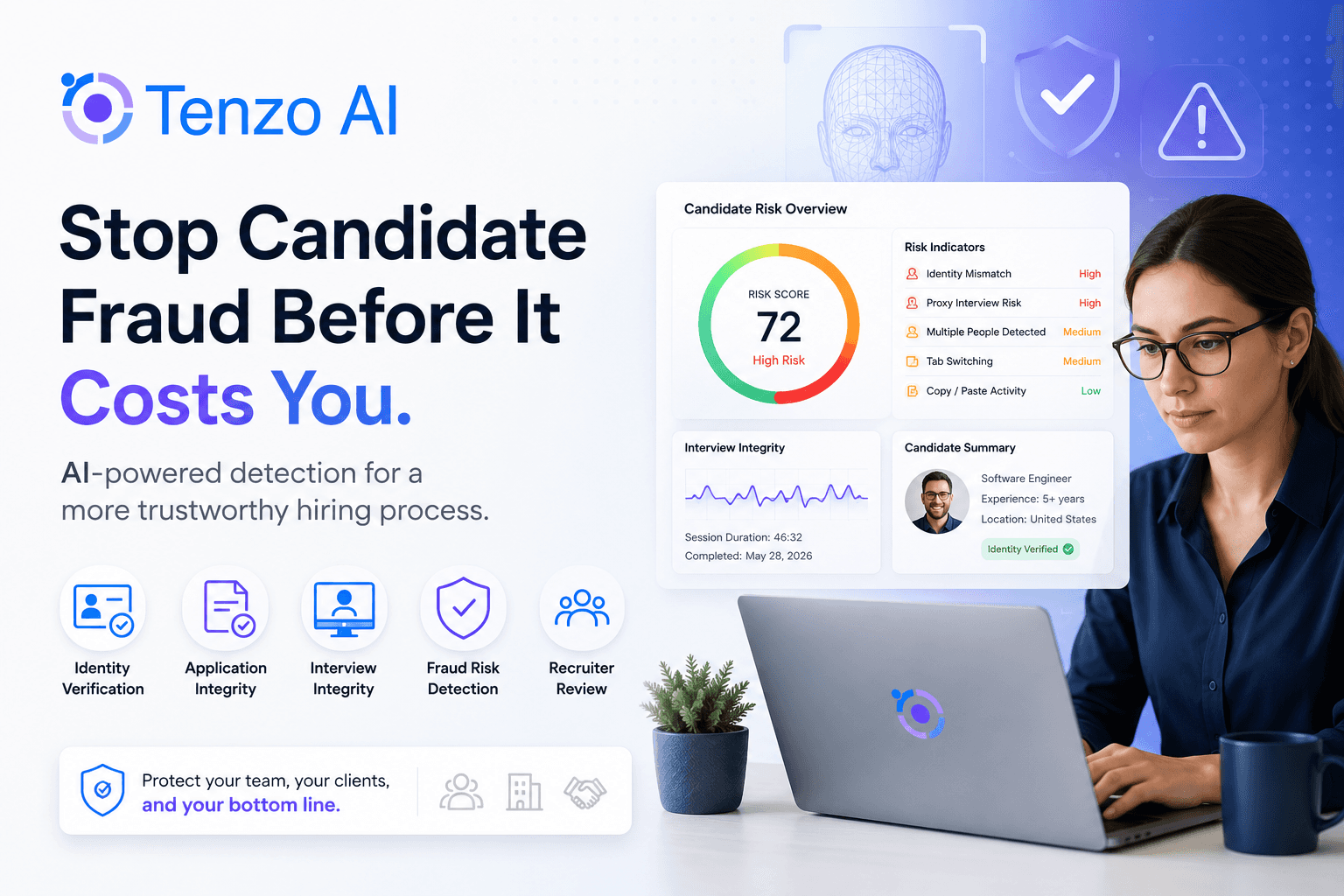
An AI recruiter can support earlier fraud prevention and identity-related workflows, whether that is ID verification, duplicate applicant detection, suspicious pattern review, or other signals that help teams avoid wasting time on candidates who should never have progressed in the first place.
The earlier that happens, the lower the operational cost.
The biggest mistake retailers make
The most common mistake is thinking this is a choice between systems.
It is not ATS versus AI recruiter.
It is ATS plus AI recruiter.
The ATS should manage the process.
The AI recruiter should help execute the work inside the process.
Those are complementary roles, not competing ones.
When retailers separate those responsibilities clearly, the stack gets easier to understand and the business case gets stronger.
What the business case actually sounds like
Weak AI recruiting pitches focus too much on automation.
That is not enough.
The better case is that an AI recruiter helps the business hire with more speed, more consistency, and better use of scarce human attention.
That story lands because it connects to real operating pain.
For talent teams, it means more screening capacity and less time lost to repetitive tasks.
For store leaders, it means faster movement on candidates and less waiting for recruiting bottlenecks to clear.
For operations leaders, it means more dependable staffing outcomes and less disruption at the location level.
For IT and systems stakeholders, it means improving the hiring layer without forcing a full rip-and-replace of the core system of record.
For leadership, it means getting more value out of existing applicant flow instead of assuming every hiring problem starts with needing more top-of-funnel.
That is a much stronger commercial insight than “AI saves time.”
It reframes the problem around throughput, quality, and decision-making.
Why Tenzo stands out
Tenzo is built for the layer most retailers are missing.
Not another platform that mostly stores information.
A platform that helps do the work.
That includes structured voice AI screening, applicant ranking, candidate rediscovery, recruiter notetaking, and workflows that support earlier fraud prevention and ID verification.
In other words, Tenzo is designed to sit on top of the ATS and make the hiring system more responsive, more intelligent, and more useful to the people actually trying to fill roles.
That matters in retail because speed alone is not enough. Speed without structure creates noise. Structure without execution creates delays. Retailers need both.
That is where the combination of ATS plus AI recruiter becomes powerful.
The future of retail hiring is not more software. It is better division of labor.
This is the broader shift retailers should pay attention to.
The winning hiring stack is not the one that tries to force one platform to be everything.
It is the one that lets each part of the stack do what it is best at.
The ATS remains the system of record.
The AI recruiter becomes the system of action.
Human recruiters and hiring managers stay focused on judgment, exceptions, relationships, and final decisions.
That is a much more practical model for modern retail hiring than asking recruiters to manually carry every step between application and hire.
The bottom line
If your ATS is doing its job, keep it.
But do not confuse “we have an ATS” with “we have a modern hiring engine.”
Retail hiring now requires faster response, better signal, cleaner prioritization, more effective rediscovery, and more confidence in who is moving forward.
That is why more retailers are adding an AI recruiter on top of the ATS instead of waiting for the ATS to become something it was never built to be.
And that is exactly where Tenzo is built to lead.
Book a demo with Tenzo to see how retailers can use AI recruiting on top of their ATS to move faster, screen more intelligently, and get more value from the systems they already have.
Frequently asked questions
Can an AI recruiter replace an ATS?
No. An ATS and an AI recruiter serve different purposes. The ATS should remain the system of record, while the AI recruiter helps execute hiring work such as screening, ranking, rediscovery, and candidate engagement.
Why is this especially relevant for retailers?
Retail hiring is high-volume, fast-moving, and distributed across many locations. That makes speed, consistency, and better prioritization especially important.
What is candidate rediscovery?
Candidate rediscovery means identifying qualified people already inside your ATS or talent pool and bringing them back into consideration for new openings, seasonal demand, shift changes, or better-fit locations.
How does voice AI screening help?
It helps retailers gather better signal earlier, including shift fit, pay alignment, communication quality, and overall readiness, without asking recruiters to manually phone-screen every applicant.
Where do fraud prevention and ID verification fit?
They are most valuable early in the funnel, before recruiter time is wasted and before bad data or bad actors move too far into the hiring process.